

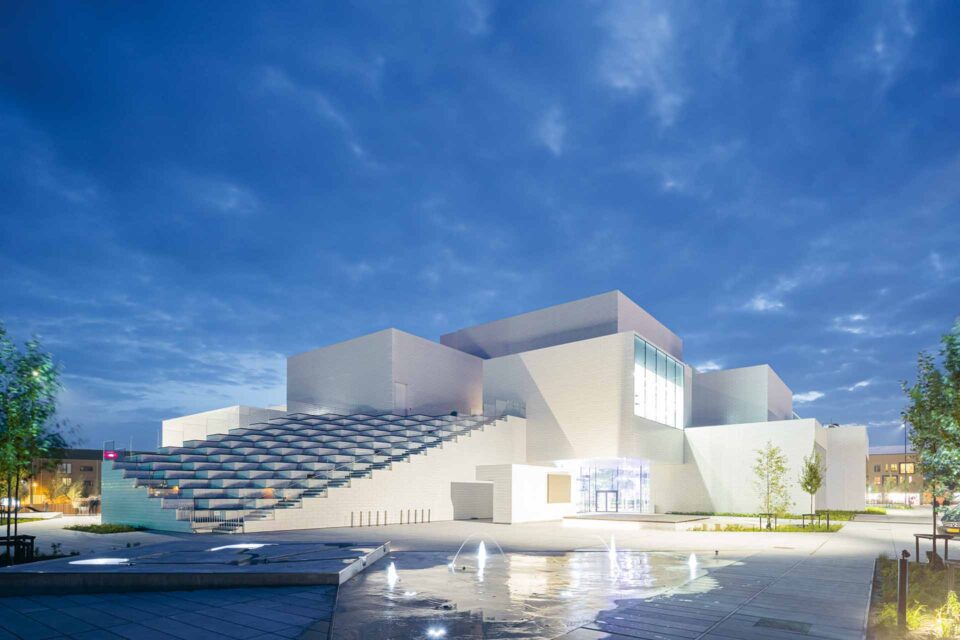
The Danish architecture firm BIG was founded in 2005 by Bjarke Ingels (b. 1974), one of the most celebrated figures in the field. What began as a small Copenhagen practice has now grown into a major studio, with offices in Barcelona London, Los Angeles, New York, Riyadh, Shanghai and Zurich. BIG’s designs – often described as “pragmatic utopian” – stand out for their bold-yet-practical forms, elements of surprise and people-focused solutions. From Denmark’s playful LEGO House, which appears to be made from the famous colourful bricks, to The Twist, a warping structure situated in the Kistefos Sculpture Park outside Oslo, BIG continues to produce buildings that push the boundaries of imagination.
Now, BIG Atlas, published by Phaidon, offers an all-encompassing portrait of the studio’s work to date, featuring 600 photographs of more than 50 constructions across Canada, China, Denmark, Ecuador, France, Italy, Japan, Mexico, Singapore, Switzerland, Qatar, the UK, USA and more. These case studies are illuminated by words from prominent architects Joseph Grima and Kent Martinussen, as well as an essay by Icelandic writer and documentarian Andri Snær Magnason.
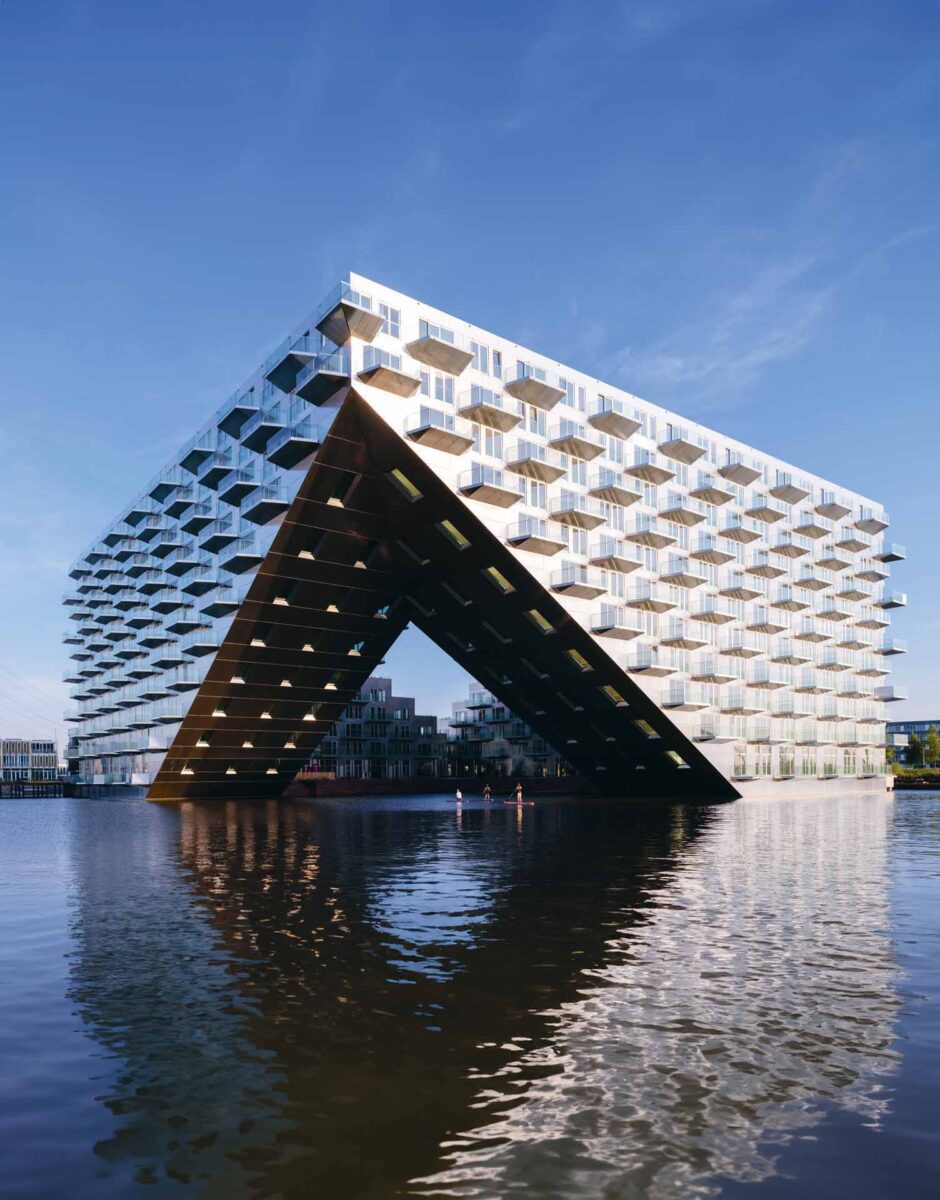
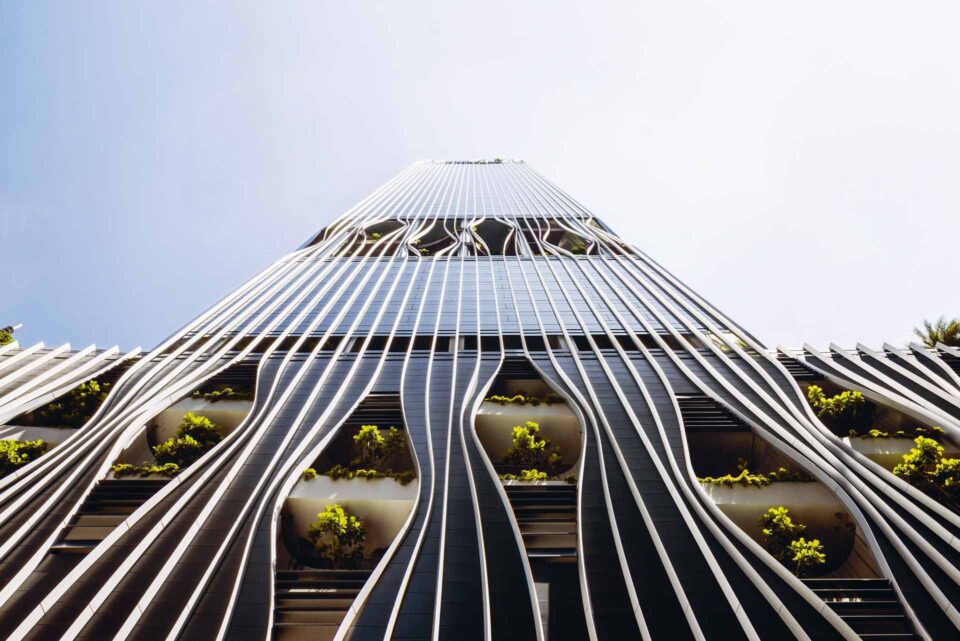
BIG Atlas also includes residential developments such AARhus, Denmark, and Sluishuis, Amsterdam, which adapt traditional courtyard housing and canal-side living for the present-day waterside. There’s also a focus on sustainability, with inclusions such as CapitaSpring and Shenzhen Energy Mansion HQ, as well as the CopenHill plant and ski slope, one of BIG’s most iconic mixed-use projects. Aesthetica sat down with Ingels to talk about the new publication, his key design philosophies, projects and what’s next for the studio.
A: How did your early interests shape your path to BIG? BI: Through kindergarten, to high school, I loved drawing more than most things. I was certain I was going do something with it. But in the absence of a cartoon academy in Denmark, I fell in love with architecture. I went to Barcelona during my first week of architecture school, and was blown away by the Catalan architects, especially Gaudí. I had my eyes opened to the fact that architecture could be interesting – and beautiful. It was storytelling in built form. I also stumbled upon a book called Delirious New York by Rem Koolhaas: I realised that I needed to work for this architect, and I ended up working on the design of the Seattle Public Library. One of BIG’s first projects was the Copenhagen Harbor Bath.
A: Your work is often described as “pragmatic utopian.” How do you define this concept? How does it guide you? BI: It sounds like an oxymoron, or a contradiction. Utopia is a place so perfect it can only exist in fiction, whilst pragmatism is looking at and dealing with the world based on how it is. But when you put them together, as an architect, you have a chance to turn a piece of reality into a fragment of your dreams. A great way to explain the power of architecture is through the traditional Danish word for design: “formgivning.” When you design a space or place, you are giving form to the future. It’s a reminder that the world is not the way it is because it has to be, but because that’s exactly how far the people who came before us got. And if it doesn’t fit with the way we want to live our lives, then we have not only the possibility, but the responsibility, to make it the way we wish it was.
A: Which projects best demonstrate your philosophies?
BI: The CopenHill waste to energy power plant in Copenhagen is incredibly pragmatic, but it has an almost utopian appearance – a manmade mountain in a city that is otherwise completely flat. It’s a philosophy of opposites coming together to form new hybrids. There’s also The Twist, a museum we designed in Norway that is a bridge, gallery and a sculpture, as well as the Suzhou Museum of Contemporary Art, which is organized like a Chinese garden of interconnected pavilions. Citizens can pass between the galleries and move underneath bridges to travel all the way to the city’s lakefront.
A: How is BIG integrating environmental consciousness into its buildings, and are there any examples where this has been particularly visible or ambitious in scale?
BI: We’ve been pursuing “hedonistic sustainability” since our first project in Copenhagen. It’s the idea that the sustainable city, or building, is not only better for the environment, but it’s also more enjoyable for the people that live in and around it. It’s about turning sustainability into something desirable. To return to CopenHill, it’s so clean that you can hike and ski down the roof. You can climb the façade, too. It’s the tallest, manmade climbing wall in the world – a symbol and landmark that shows how a city, by prioritising the environment, can become a more enjoyable for its citizens to live in.
A: What is the goal of this new publication? How is it different from other titles you have released in the past?
BI: We’ve published four books so far. The first one, in 2009, was called Yes is More and it was a bit of a manifesto. Architecture is such a slow-moving vehicle, and at that point I’d only been practicing under my own name for nine years, so there was relatively little built evidence of what we were about. So, we told the stories in the form of a graphic novel. As we advanced, we kept the same format for our next books, Hot to Cold and Formgiving, including a higher and higher degree of work. I’ve always maintained that the reason architects need to be good communicators is because we’re always defending our designs, before they can speak for themselves. So now, after 25 years, I thought it would be interesting to step back and let the buildings, as well as book designers, critics, editors and writers, do the talking. BIG Atlas is a portrait of the world – the built reality – that we’ve given form to. There are no concepts or unrealised projects included. Instead, it’s a chronological journey through the last quarter of a century.
A: Which buildings or ideas do you feel are most synonymous with BIG in the public imagination? Does this align with the concepts that personally resonate with you?
BI: People tend to want to reduce the identity of what we do to some kind of formalistic shorthand: triangles or circles or curves or squares or boxes or fanning. For many architects, their identity is somehow anchored in their style. And in that sense, you could say a style is a limitation on the things you can do, a stylistic straight jacket. My favourite example is that some architects only do white buildings. Which means they could never do a red or a blue one. In our case, our buildings end up looking different because they perform differently. If they use certain geometries, it is because those shapes achieve something different. The most striking part of our identity is that we reserve the right to use any form or any material in the service of the idea we are trying to accomplish.
A: BIG Atlas also includes the Serpentine Pavilion (2016). How do temporary projects compare to permanent ones?
BI: Architecture is inherently slow. CopenHill took 10 years. We’re designing the Zurich airport, which will be the largest timber building on Earth, but it’ll take 15 years. I love the permanence of what we do, but there is something fun about shooting from the hip and doing smaller or quicker projects. A great little manifesto is the Biosphere in Swedish Lapland. It’s a tree ouse: a room for humans that is surrounded by a cloud of 300 houses for birds and bats. Nature is around you, above you and beneath you. We call The Serpentine the “unzipped wall.” On the one hand, it looks like a perfect rectangle. But from other angles, it looks like it’s being pulled apart.
A: How do you bridge architecture, art and design?
BI: We created Superkilen, a one-kilometre-long public space in Copenhagen, in collaboration with the Danish artist group Superflex. Nørrebro is the most diverse neighbourhood in Denmark; more than 60 different nationalities live in the buildings surrounding that space. We reached out to the local community to recommend elements from their other home countries that they would like to see in Denmark. It’s like an art exhibition of ready-mades. There are 120 artifacts: including a Morroccan fountain, Qatari dentist sign and Mexican loveseat. It is a portrait of contemporary Copenhagen.
A: What is your relationship to emerging technologies?
BI: We need to wrap our heads around the power and possibility of AI and AI-enabled practical robotics, which will offer unimaginable possibilities to the construction site over the next decade. We are working with a company called ICON on 3D printing neighbourhoods in Texas and creating the technology to use lasers to melt moon dust into the first buildings on the moon. I think, over the next decade, we’ll begin to see the journey from data to matter become much more seamlessly executed. These are incredibly powerful tools and we all need to understand how to how best to wield them.
A: Can you speak what happened in London earlier this year, after a major project unfortunately collapsed?
BI: The irony of architecture is that the bigger a project is, the more fragile it is. It takes longer, requires bigger permits, is more vulnerable to fluctuating economic trends. What happened in London was that a project occupying 110 of our staff went into a coma. We had to say goodbye to some of our colleagues. It’s a heavy burden to bear. There was no way we could drum up that amount of work in such a short amount of time. For better or worse, it’s something that has been part of the architectural industry since the dawn of time.
A: What would you say is the studio’s focus right now?
BI: We are helping the government of Bhutan create Gfu Mindfulness City, where we are moving ahead with the airport and the Temple Dam which will power the whole city. It has been a full immersion – getting to know the king, the government and the people of Bhutan. It’s a labour of love. We are working on the Prague Philharmonic and the Hamburg State Opera, which will be incredible public buildings in two of the most beautiful cities in Europe. On the cover of BIG Atlas is the Suzhou Museum of Contemporary Art, opening to the public at the end of June. I am really looking forward to seeing it be inhabited by both the artworks and the guests.
Image Credits:
1 Shenzhen Energy HQ, Shenzhen, China, (2019). Image credit: Chaos.Z. Page 147.
2. LEGO House, Billund, Denmark, (2017). Image credit: Iwan Baan. Pages 144-145.
3. Sluishuis Residences, Amsterdam, The Netherlands, (2022). Image credit: Ossip van Duivenbode. Page 337.
4. CapitaSpring, Singapore, Singapore, (2022). Image credit: Finbarr Fallon. Pages 302-303.
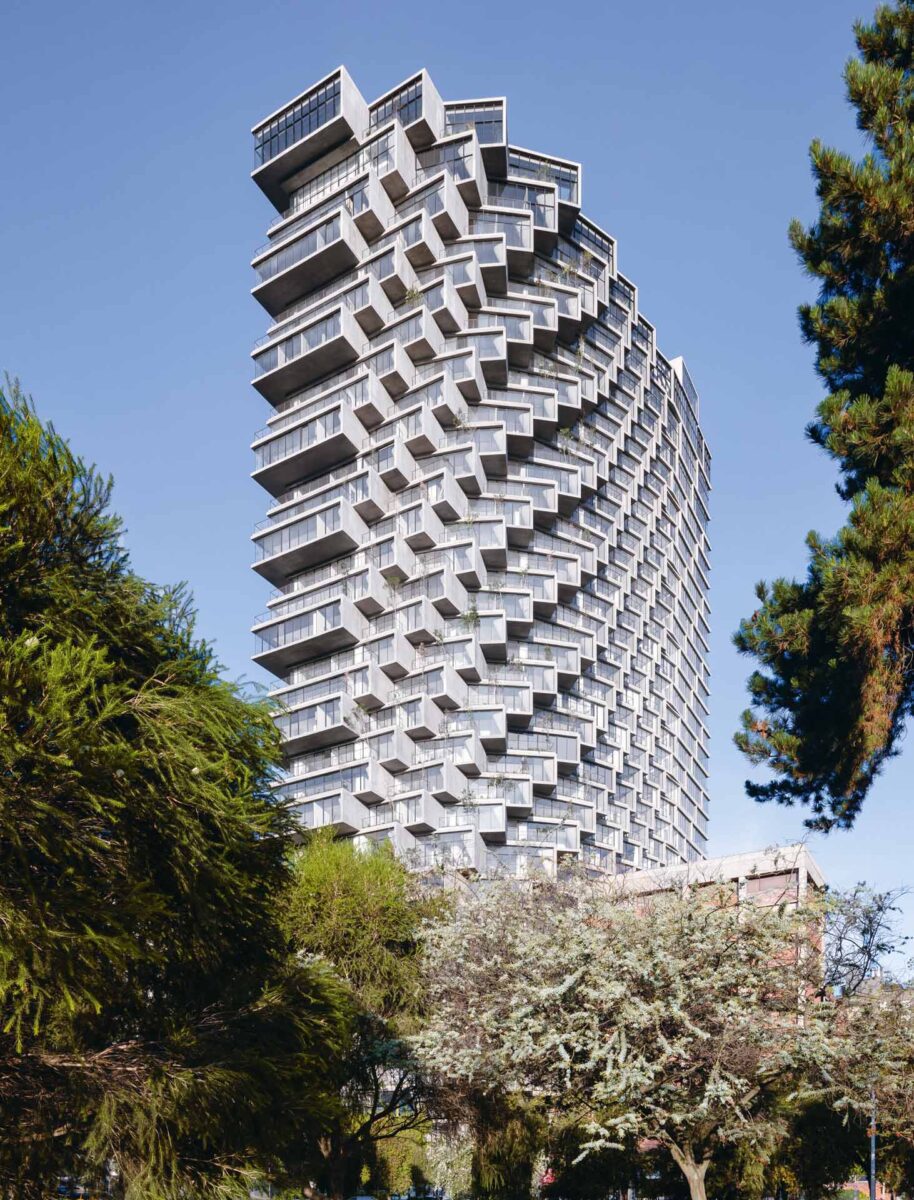
5. IQON Residencies, Quito, Ecuador, (2022). Image credit: Bucubik Architectural Photography. Page 350.
The post Building the Future appeared first on Aesthetica Magazine.


