

Artists, cultural organisations and creative industries play an essential, active, role in driving technological advancement while ensuring human values remain at the centre of innovation, according to a new British Council report, Why Technology Needs Artists: 40 international perspectives.
Published today, the report features contributions from 56 global leaders in the field of art and technology, including research leaders from tech giants such as Adobe and Google Quantum AI. They are joined by artists including Sougwen Chung, Libby Heaney, Mat Dryhurst and Holly Herndon, alongside programme leaders from institutions such as Serpentine in London and the Berlin-based LAS Foundation.
“Artists aren’t just using technology, they’re transforming it,” said Hannah Andrews, the director of digital innovation at the British Council. “From independent studios to quantum computing labs, artists internationally are creating new tools, demystifying complex concepts, and ensuring diverse voices shape our digital future.
“This practice relies on a rich cultural and creative ecosystem which, both nationally and internationally, is an incredibly powerful asset; a network that is capable of not only advancing technology, but doing so from a place of awareness, sensitivity and cultural nuance.”
Laure Prouvost, WE FELT A STAR DYING (2025), installation view at Kraftwerk Berlin, commissioned by LAS Art Foundation and co-commissioned by OGR Torino © 2025 Laure Prouvost, photograph by Andrea Rossetti
The 140-page report published by the British Council—the UK’s international organisation for cultural relations and educational advancement—appears following five years of rapid advance in three scientific fields where artists’ central roles have been recognised by both technology companies and the wider public.
In Web3, the boom in non-fungible tokens (NFTs) in 2020-21 showed artists (and a new art market) giving cultural relevance to the blockchain. In artificial intelligence—an existential global reality since the launch of ChatGPT 3 in November 2022—artists and curators have played a central role in defining data ownership and the threat to intellectual property posed by commercial AI models based on scraping data from the internet without the permission of copyright holders.
In quantum computing, a still-nascent technology with boundless theoretical potential, artists such as Libby Heaney and Laure Prouvost have been working with big tech to create new aesthetics in a technology based on the quantum fluctuations in the smallest, sub-atomic particles. The latest quantum chips can in five minutes complete some tasks that the world’s fastest conventional computers would take 10,000,000,000,000,000,000,000,000 years to complete.
In a foreword to the report, Ruth Mackenzie, the director of Arts at the British Council, emphasises the international and creative variety of artists’ involvement in technological development. “In Berlin, Holly Herndon and Mat Dryhurst are piloting new ways to protect artists’ intellectual property; in Senegal, Linda Dounia Rebeiz is highlighting under-representation of West African biodiversity in AI datasets; in the UK, Libby Heaney [is] creating with quantum computers; in India, Harshit Agrawal is retraining generative AI on Kathakali and Theyyam dance rituals; and in China, Xu Bing is hosting international artist residencies in space.”
Vukosi Marivate, the founder of Lelapa AI, a socially-grounded Africa-centric AI research & product lab, says in the report: “AI will impact society in profound ways. Given this, it’s crucial that we think carefully about how AI can best serve humanity.
“The answer to this question won’t come from computer scientists and engineers alone. It will come from collaboration with social scientists, philosophers, artists, writers: those who deeply understand human culture, creativity and history—what makes us human.”
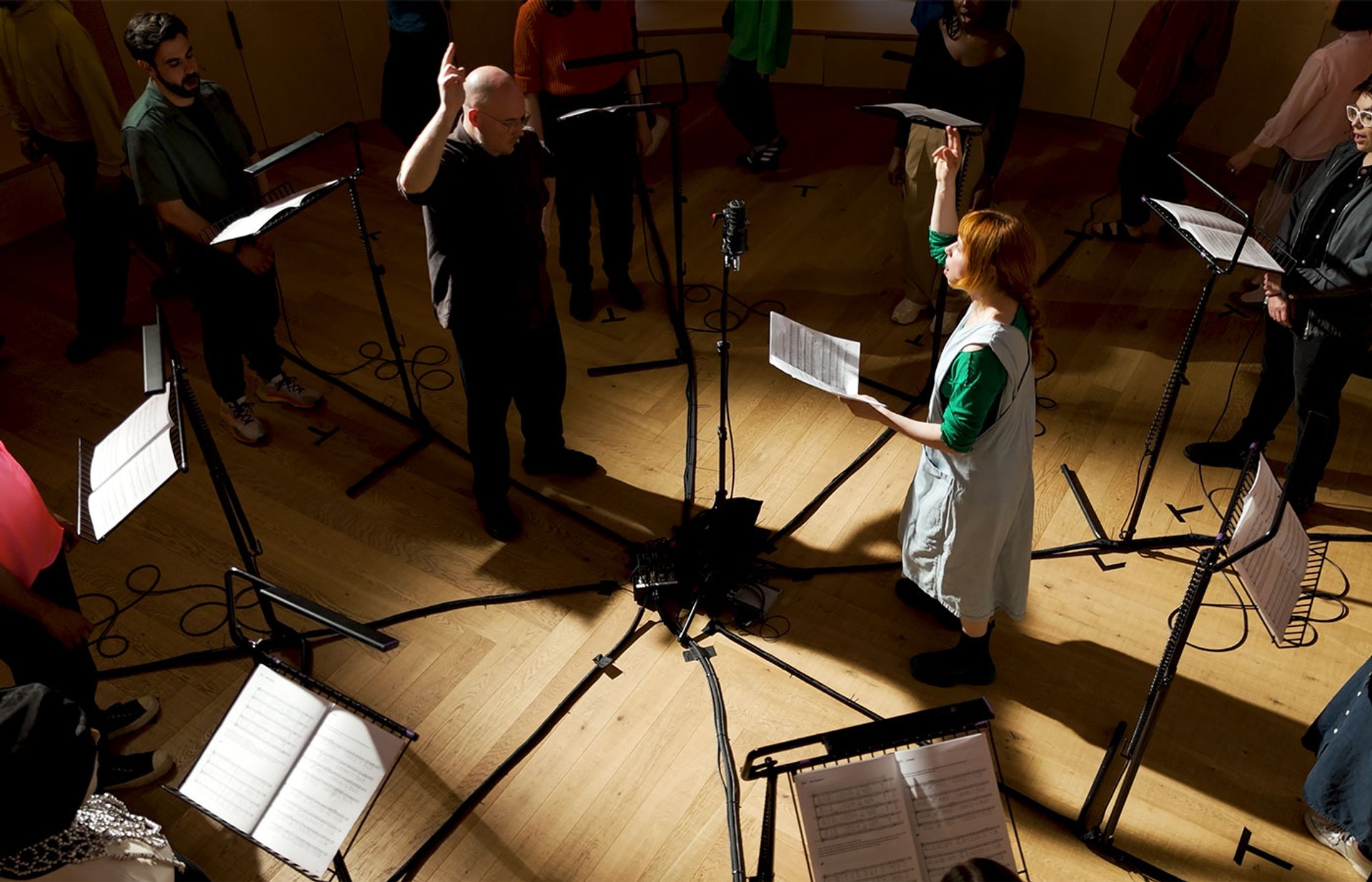
Holly Herndon and Mathew Dryhurst making a recording for The Call (2024), Serpentine, London © Leon Chew
In a contribution to the report, LAS Art Foundation outlines one case study of an artist’s contribution, based on Prouvost’s large-scale installation WE FELT A STAR DYING which was shown in the vast industrial space Kraftwerk Berlin earlier this year. Prouvost worked with the physicist Hartmut Neven of Google Quantum AI Lab and the philosopher Tobias Rees for two years on a generative AI model based on quantum noise—data extracted directly from Google’s advanced quantum processor. That data, LAS writes, “unlike classical noise typically used in AI”, is “quantum noise” which is not merely mathematical “but arises from the fundamental quantum fluctuations that occur in all matter”.
This data “became a generative force, shaping audiovisual works that reflect the indeterminacy defining the quantum scale of reality.” LAS writes that in creating this “AI-quantum hybridity”, Prouvost’s prompts “led the model’s developers to consider conceptual and aesthetic challenges they hadn’t previously encountered”.
This is an example of what Erik Lucero, the lead engineer at Google Quantum AI, points to in the report. Google’s Artists in Residence programme has, he says, “helped us re-envision the scientific lab” as “a space whose energy evokes innovation, inspiration, and creativity”.
Holly Herndon and Mat Dryhust—whose breakout installation The Call (2024), at Serpentine, presented a new data trust model for intellectual property ownership based on recordings of choirs made across the UK—als contributed to the report. They note that “artistic practice offers a relatively safe space in which to experiment, before contemplating collective AI governance in higher-risk contexts such as health data”.
With characteristic wit, they also emphasise the domestic, quotidian, nature of so many artistic contributions in the field. “The process is equally thrilling and alienating, as on top of the pressures of producing art for a living we are running the world’s least funded AI think-tank from our kitchen.”


