

Activist. Iconoclast. Provocateur. English fashion designer Vivienne Westwood (1941-2022) is synonymous with many words, but one rules supreme: punk. Now, NGV pairs her up with Rei Kawakubo (b. 1942), founder of Comme des Garçons, an equally radical Japanese creative force whose driving philosophy has long been to “break the idea of clothes.” The pair of “self-taught rebels” were born a year apart in different countries and cultural contexts. Yet, as NGV reveals, they shared many remarkable commonalities. Perhaps most striking is that their debut runway collections, both launched in 1981, revolved around the same title and theme: pirates. It makes for an intriguing curatorial premise.
NGV’s exhibition comprises five thematic sections. Punk and Provocation taps into the 1970s zeitgeist, featuring Westwood’s iconic bondage trousers, distressed knitwear, leather, safety pins and chains. These designs cemented her reputation as a provocateur; they were anarchic, anti-authoritarian and confrontational. As Westwood reflected in 2004: “We weren’t only rejecting the values of the older generation; we were rejecting their taboos as well.” Likewise, Rupture examines the pair’s desire to break with norms, focusing in on Kawakubo and Westwood’s respective Pirate and Pirates collections. NGV describes these debuts as “representative of a new design manifesto that would define their work for decades to come.” For Westwood, this meant historic cutting techniques and the destabilisation of gendered dress. Kawakubo, meanwhile, was establishing her modernist spirit and experimental patterns.
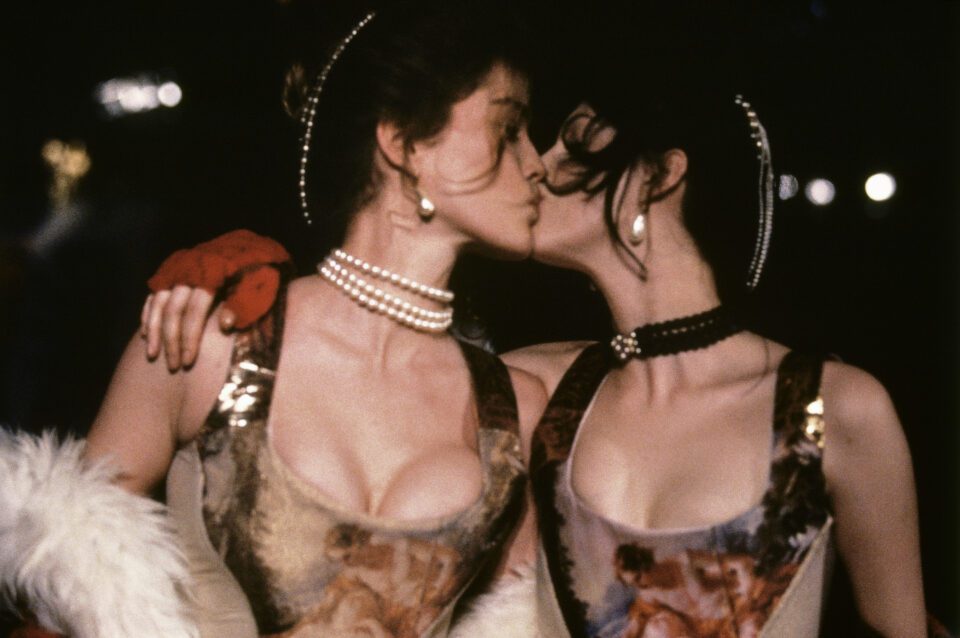
Next, Reinvention considers the influence of the past on both creatives. Here, Westwood’s 18th century-inspired gowns – which reclaimed elements like the crinoline and corset – contrast with Kawakubo’s deconstructions of the period’s silhouettes and fabrics. There’s also an in-depth look at their approaches to cut and form. Kawakubo subverts traditional “fashion logic”, rejecting functionality and expectations of fit to create garments that explode shape, size and proportion. A case in point: she once developed a collection around a crumpled piece of paper. Westwood was also critical of the design establishment; she parodied clichés of Britishness – from twinsets and pearls to hunting attire and royal dress – to offer a new vision of Savile Row tailoring, reframing familiar materials like wools, tweeds and tartans.
The next theme, The Body, challenges ideals of beauty and gender. This is where Kawakubo’s work really comes into its own. The Body Meets Dress–Dress Meets Body collection (1996) is a prime example, in which irregular padding was added to otherwise conventional outfits – placed on the abdomen, back, hips and shoulders. It became known as the “lumps and bumps” collection. Another notable moment came in 2012, when she used two-dimensional pattern-cutting to create completely flat garments that disregarded the contours of the body altogether. More recently, Comme des Garçons’ “wearable objects” have risen to acclaim, treading the line between art, sculpture and fashion. Here, Kawakubo abandons comfort and function to critique socially constructed ideas of what we “should” wear. Westwood similarly contested precepts of the “fashionable body”, but did so through irony and exaggeration, including rejecting the “waif” aesthetic of the early 1990s by creating “hyper-feminine” silhouettes that reclaimed sexual agency.
Finally, the personal and political collide in The Power of Clothes, which demonstrates Westwood’s outspoken humanitarian and ecological activism – emblazoned across garments and runways alike. She campaigned fiercely, and her garments often featured painted and printed slogans and graphics. Kawakubo’s work, whilst at first glance more opaque in meaning, is similarly charged with ideas of freedom and revolution. Her globally-resonant messages have become more obvious in recent years, as she has issued written statements intimating the themes of her collections. This show covers a lot of ground, and, whilst both designers are deserving of solo retrospectives, the idea to connect them is novel and revealing. With Westwood | Kawakubo, NGV provides an opportunity to come face-to-face with two titans of culture, whose unrelenting efforts to defy the status quo transformed fashion forever.
Westwood | Kawakubo is at NGV, Melbourne, until 19 April.
Words: Eleanor Sutherland
Image Credits:
1. Comme des Garçons Jumper, from the Holes collection, autumn – winter 1982 – 83. Paris, 1982. Photo © Peter Lindbergh. Model: Linda Sperrings.
2. Vivienne Westwood, London (fashion house), Vivienne Westwood (designer) Outfit from the Anglomania collection, autumn – winter 1993 – 94. Photo © Sheridan Morley via Shutterstock. Model: Naomi Campbell.
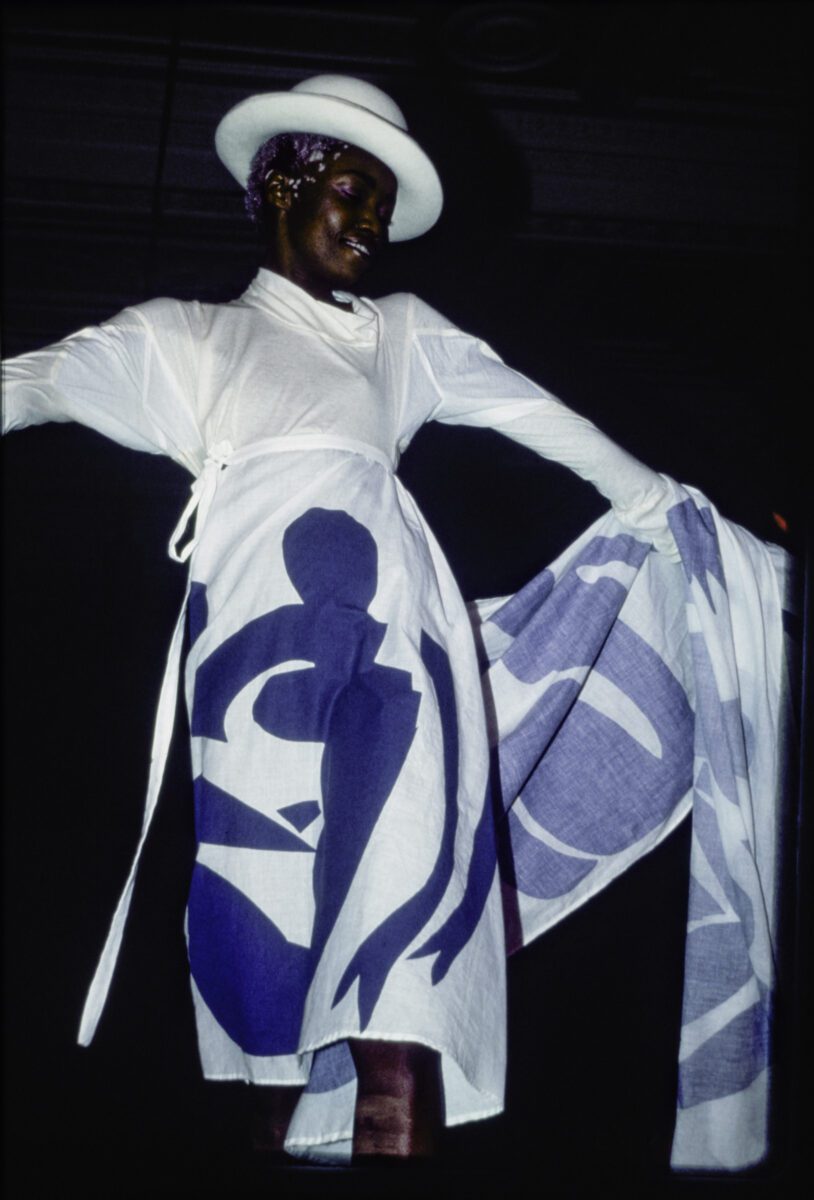
3. World’s End, London (fashion house), Vivienne Westwood (designer), Malcolm McLaren (designer) Outfit from the Savage collection, spring – summer 1982. Pillar Hall, Olympia, London, 22 October 1981. Photo © Robyn Beeche.
4. Vivienne Westwood, London (fashion house), Vivienne Westwood (designer) Outfits from the Portrait collection, autumn – winter 1990 – 91 (detail). 116 Pall Mall, London, March 1990. Photo © John van Hasselt / Sygma via Getty Images. Models: Susie Bick & Denice D. Lewis.


