

The latest exhibition at MASS MoCA grapples with the rapidly advancing technologies that are reshaping daily life. From AI and algorithms to computer-aided design, Technologies of Relation brings together 12 creatives who move beyond the oft-referenced binary of digital innovation as “good” or “bad,” instead offering more nuanced viewpoints. The goal: “to reframe how we relate to each other, to our devices, and to our future.” This show acknowledges that contemporary tools can indeed “manipulate, marginalise, and oppress us,” whilst also asking how they might be resisted, redirected and wielded more ethically.
“Artists have long been key to identifying the colonialist logic, racism and violence embedded in and produced by corporate-dominated technologies and datasets in addition to offering a vision of a technological future that is inclusive and liberatory,” says Susan Cross, MASS MoCA’s Director of Curatorial Affairs and the curator of this show. “The artists in the exhibition demystify technology, reminding us that it is neither neutral, nor authoritative, or beyond our scope of influence. Though most are skilled technologists, they often choose simple materials to give shape to their ideas and work across mediums, addressing technology both with its own tools and through analogue means.”
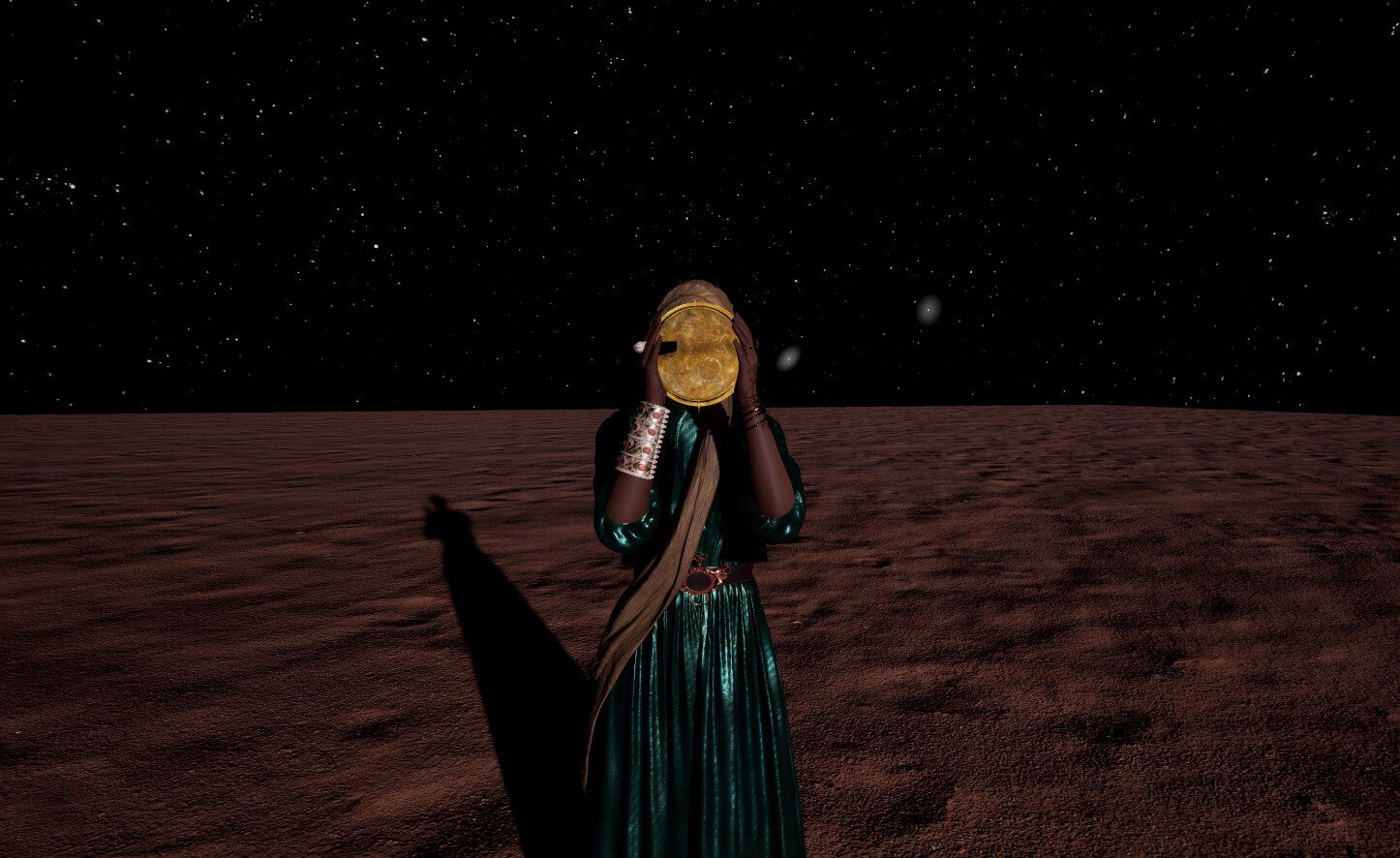
Standout works include Morehshin Allahyari’s (b. 1985) Speculations on Capture (2024). The film explores the histories of astronomical instruments made in Iran and Pakistan during the 1200s to the 1700s, which are now held within the Victoria & Albert Museum in London. The V&A houses one of the largest collections of Islamic art in the world, with over 19,000 objects. Allahyari imagines a future where these early technologies – astrolabes, cameras and telegraphs – are returned to the peoples and cultures that created them. It is a powerful statement that shows how technology has long been entwined with colonial agendas, tapping into contemporary conversations around the repatriation of contested objects.
Elsewhere, Kite, an Oglála Lakȟóta visual artist, presents Wičháȟpi Wóihaŋbleya (Dreamlike Star) (2024). The multimedia installation grew out of Kite’s translations of her dreams into Lakȟóta visual language, a geometric lexicon traditionally used in women’s quilting. It comprises a video projection which shimmers with images of earth, water, stones, stars and sky, as well as a constellation of stones on the gallery floor. Kite’s work resonates with that of Pelenakeke Brown, who also looks to ancestral teachings in Reverb (2025–2026). Brown travelled with her mother to their ancestral village to learn the traditional Samoan art of tapa cloth-making, producing large-scale works from mulberry bark. Brown combines digital and screenprinting technologies with the visual languages of tatau (tattooing) and siapo, to share Samoan stories. Here, technology becomes a way of preserving knowledge, passed down through generations.
Other contributions explore the of impact of digitisation on the everyday. Roopa Vasudevan’s Requiem for the Early Internet (2022/2026), for example, looks back to the online world as the artist experienced it in her youth, contrasting it with the experience of navigating today’s web. In LAUREN: Anyone Home? (2024-2026), Lauren Lee McCarthy presents a futuristic home that contemplates issues of surveillance, privacy and labour. Mashinka Firunts Hakopian also welcomes audiences into a space-age domestic space; she’s trained an AI model in the art of tasseography divination – the reading of tea leaves or coffee grounds.
A focus on human creativity runs throughout the exhibition. Taeyoon Choi’s Interweaving Poetic Code (2021), for example, emphasises the historical connection between computing and textile machinery, where a binary system and punch cards were used to program the loom. Analia Saban, meanwhile, takes the same idea and catapults it into the present – imagining how an algorithm might be produced to teach someone to make a portrait. Saban’s ten-foot wide, blackboard-like painting Flow Chart (2023), asks: is art computable? Can creative vision be programmed or learned from a dataset? These are some of the biggest questions facing the art world today, with generative AI creating 34 million images every single day.
What really makes this show stand out is its expansive historical lens – underscoring the different forms of communication technology humans have developed around the world and over time. It relates today’s emerging developments to the ancient arts of divination, tattooing, weaving and writing, demonstrating how the human drive to innovate has endured across centuries and geographies and resulted in myriad tools to record knowledge and express identity. The artists gathered here remind us that technology is neither inevitable nor neutral: it is something we make, and therefore something we can remake.
Technologies of Relation is at MASS MoCA, 21 February – Spring 2027.
Words: Eleanor Sutherland
Image Credits:
1. Morehshin Allahyari, Speculations on Capture, snapshot from film, 2024, courtesy of the artist and V&A
2. Kite, Wičháȟpi, Wóihaŋbleya (Dreamlike Star), 2024. Multimedia environment with video, sound, stones, mirror; 21:16 min. Site-specific dimensions. Photo: Dario Lasagni, courtesy of MIT List Visual Arts Center, Cambridge, MA.
3. Morehshin Allahyari, Speculations on Capture, 2024 (film stills). Installation with single-channel HD video, with sound, 36.42 min. Installation dimensions variable. Courtesy of the artist and V&A.


