

Museums have long served as vital vessels of culture, shaping collective memory whilst nurturing curiosity and imagination. They provide spaces where history, art and ideas intersect, allowing society to reflect on its past and envision its future. Exhibitions, programmes and public engagement offer opportunities to explore diverse perspectives and challenge conventional thinking. Within their walls, knowledge and creativity coalesce, creating narratives that transcend time and place. The New Museum has become a beacon for contemporary art, offering a platform for artists to interrogate the present moment and speculate on what lies ahead. Its reopening signals a new chapter in the ongoing mission to inspire, provoke and connect. Lisa Phillips, Director of the Museum, says: “Since our founding nearly 50 years ago, the New Museum has been a home for the most groundbreaking art of today and a haven for the artists who make it. Our new 120,000 sq ft building on the Bowery signals our redoubled commitment to new art and new ideas, and to the museum as an ever-evolving site for risk-taking, collaboration and experimentation.”
Nestled on the Bowery at Prince Street, the New Museum will unveil a 60,000-square-foot expansion, designed by OMA, with Shohei Shigematsu and Rem Koolhaas leading the project in collaboration with Executive Architect Cooper Robertson. Visitors will move through the space via three new elevators, a dramatic Atrium Stair, and an entrance plaza that encourages a sense of arrival and openness. On upper floors, dedicated studios for artists-in-residence and the cultural incubator NEW INC provide resources for creative experimentation and collaboration. Ground-level enhancements include an enlarged lobby, expanded bookstore and a full-service restaurant operated by the Oberon Group. The seventh-floor Sky Room and the newly introduced 74-seat Forum offer venues for talks, performances and public events, extending the museum’s reach beyond its galleries. Together, these features create a building designed to nurture both art and community, reflecting the institution’s commitment to innovation.
Since its founding in 1977, the New Museum has championed emerging artists and unconventional ideas, establishing itself as a laboratory for contemporary practice. Its original SANAA-designed building, completed in 2007, became celebrated for its stacked rectangular volumes and luminous interiors, providing a striking architectural presence on the Bowery. Over the decades, the museum has hosted exhibitions that have shaped cultural discourse, supporting artists such as Kara Walker, Doug Aitken, Taryn Simon and Rashid Johnson. By embracing experimentation and risk, the institution has remained agile in response to the evolving art world. The expansion continues this legacy, offering new opportunities for engagement, research and presentation. Architectural innovation and curatorial vision come together to create an environment where creativity can truly flourish without any constraint.
Opening with the exhibition New Humans: Memories of the Future, the museum invites visitors to consider what it means to be human in an era of rapid technological and societal change. Over 200 contributors, including artists, writers, scientists, architects and filmmakers, explore questions of identity, embodiment and memory. Contemporary works by Sophia Al-Maria, Lucy Beech, Meriem Bennani, Cyprien Gaillard, Pierre Huyghe, Tau Lewis, Daria Martin, Wangechi Mutu, Precious Okoyomon, Berenice Olmedo, Philippe Parreno, Hito Steyerl, Jamian Juliano-Villani, Andro Wekua and Anicka Yi will be shown alongside historical pieces by Francis Bacon, Constant Nieuwenhuys, Salvador Dalí, Ibrahim El-Salahi, H. R. Giger, Kiki Kogelnik, Hannah Höch, Tatsuo Ikeda, Gyula Kosice, El Lissitzky, Lennart Nilsson, Eduardo Paolozzi, Carlo Rambaldi, Germaine Richier and Elsa von Freytag-Loringhoven. This dialogue between past and present illuminates the evolving ways in which artists imagine the future. Themes of transformation, adaptation and cultural speculation offer a multifaceted reflection on contemporary life and visitors are encouraged to engage deeply, discovering connections between seemingly disparate works and eras.
Site-specific commissions activate the new architecture, integrating art and space in compelling ways. Tschabalala Self’s installation on the façade transforms the exterior into a canvas of colour and form, inviting interaction before visitors enter. Within the Atrium Stair, Klára Hosnedlová’s monumental sculpture creates a dynamic vertical experience, drawing attention to movement and scale. Sarah Lucas’ work in the new public plaza encourages playful engagement while framing the entrance as a social and contemplative space. These interventions extend the museum experience into public life, blurring the boundary between interior and exterior, art and environment. By embedding art into circulation and architecture, the museum reaffirms its role as a space for experimentation and discovery.
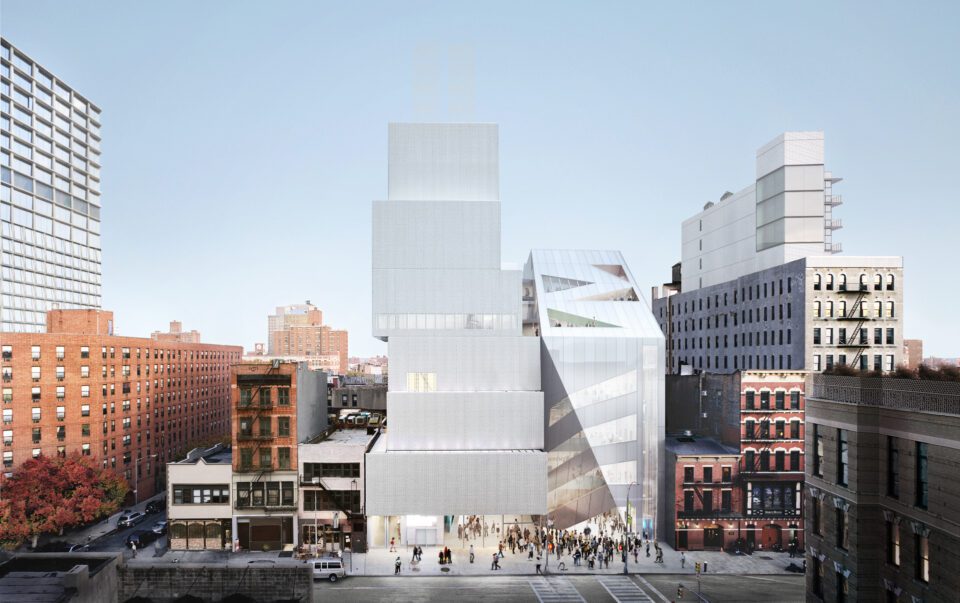
Architecture and exhibition design converge in the new expansion, creating a building that is as conceptually rigorous as it is visually striking. Collaboration between OMA and SANAA allows the structures to converse across time and style, demonstrating the possibilities of architectural dialogue. Light and materiality are carefully orchestrated to enhance circulation and gallery experience, ensuring visitors encounter art in dynamic and unexpected ways. Public areas, from the Forum to the Sky Room, emphasise openness, fostering engagement with programmes and performances. This thoughtful integration underscores the museum’s commitment to both aesthetics and functionality. The building becomes a living organism, shaping and responding to the art and ideas it houses.
Opening weekend, on 21-22 March will be celebrated with free admission, music and activities designed for audiences of all ages. Registration for entry will be made available in February, thanks to the support of trustee Charlotte Feng Ford. Visitors will experience the inaugural exhibition, site-specific commissions and the newly expanded facilities in a festival-like atmosphere. This communal celebration reinforces the museum’s position as a civic and cultural anchor in the city. It also reflects the institution’s ethos of accessibility, inviting diverse audiences to engage with contemporary art. The event promises to be a milestone in the museum’s history and a signpost for its evolving future.
Throughout nearly 50 years, the New Museum has remained a platform for challenging ideas, new voices and experimental practice. Its expanded building provides a home for artists, a laboratory for innovation and a stage for global dialogue. By marrying architectural audacity with curatorial ambition, the institution positions itself at the forefront of contemporary art. Visitors encounter a space where past, present and future converge, encouraging reflection, dialogue and discovery. With its reopening, the New Museum reminds the world that museums are living arenas where culture is made, questioned and transformed.
New Museum, New York reopens on 21 March: newmuseum.org
Words: Simon Cartwright
Image Credits:
All images courtesy New Museum.


