

Lygia Clark was an artist of quiet radicalism, whose work turns perception into a lived experience. She explored how touch, movement and attention could become the medium of creation, dissolving the boundaries between body, mind and artwork. From early geometric abstractions to later immersive sensory propositions, Clark’s practice transforms ordinary moments into opportunities for engagement and reflection. The viewer is never passive; the artwork emerges through interaction and in that encounter, both object and participant are reshaped. Her enquiry into perception, consciousness, and connection remains urgent and compelling today. This winter, these qualities come vividly to life in Lygia Clark. Retrospective at the Kunsthaus Zürich, the first comprehensive presentation of her work in a German-speaking country, featuring 120 original pieces alongside 50 participatory replicas in collaboration with Berlin’s Neue Nationalgalerie.
Born in Belo Horizonte in 1920 and based in Rio de Janeiro until her death in 1988, Clark consistently challenged what art could be. She rejected static forms in favour of experiences that foreground the senses and the body. “For me, making art is about developing as a person, which is the most important thing of all. Art should not seek to emulate a name or any kind of concept,” she explained. Her work is deeply personal yet socially resonant, emphasising interaction, awareness, and transformation over traditional objects or representation. Clark’s ideas were central to Neoconcretismo, a Brazilian movement she helped shape in the late 1950s. While influenced by European constructivism and concrete art, Neoconcretismo embraced intuition, the body, and emotional experience over rigid formalism. Clark’s practice evolved from spatial explorations to movable sculptures and ultimately to “proposiciones” – instructions for performative, participatory artworks. These works collapse the line between artist and audience, privileging action, perception, and presence as the core of the art experience.
Her oeuvre can be divided into four overlapping phases. In the 1960s, the Bichos (Animals) series – modular metal sculptures – responded to the touch of the viewer, each configuration unique. Caminhando (Walking), introduced in 1963, treated movement itself as the artwork: “The action is what produces Caminhando. Nothing exists before it, and nothing after it.” By the 1970s, her work had become entirely experiential, inviting participants to activate masks, clothes, or goggles to discover new ways of seeing and sensing the world, a practice Clark also understood as a form of gentle self-exploration and healing.
Clark’s work was inseparable from its social and political context. Emerging in a Brazil undergoing rapid modernization and authoritarian repression, her emphasis on bodily presence, relationality, and participation operated as a subtle but profound ethical and aesthetic intervention. Engagement is agency in her work: it distributes power, fosters empathy, and creates a shared space of reflection. The influence of her method is evident in contemporary practice. Brazilian artist Ernesto Neto transforms textiles and aromatic materials into enveloping, meditative spaces, inviting visitors to inhabit his installations fully. Belgian artist Francis Alÿs turns the quotidian into poetic intervention, echoing Clark’s belief that art exists through action and attention. Swiss artist Pipilotti Rist uses light, colour, and sound to create environments where the body is central to perception, mirroring Clark’s focus on the participant’s experience.
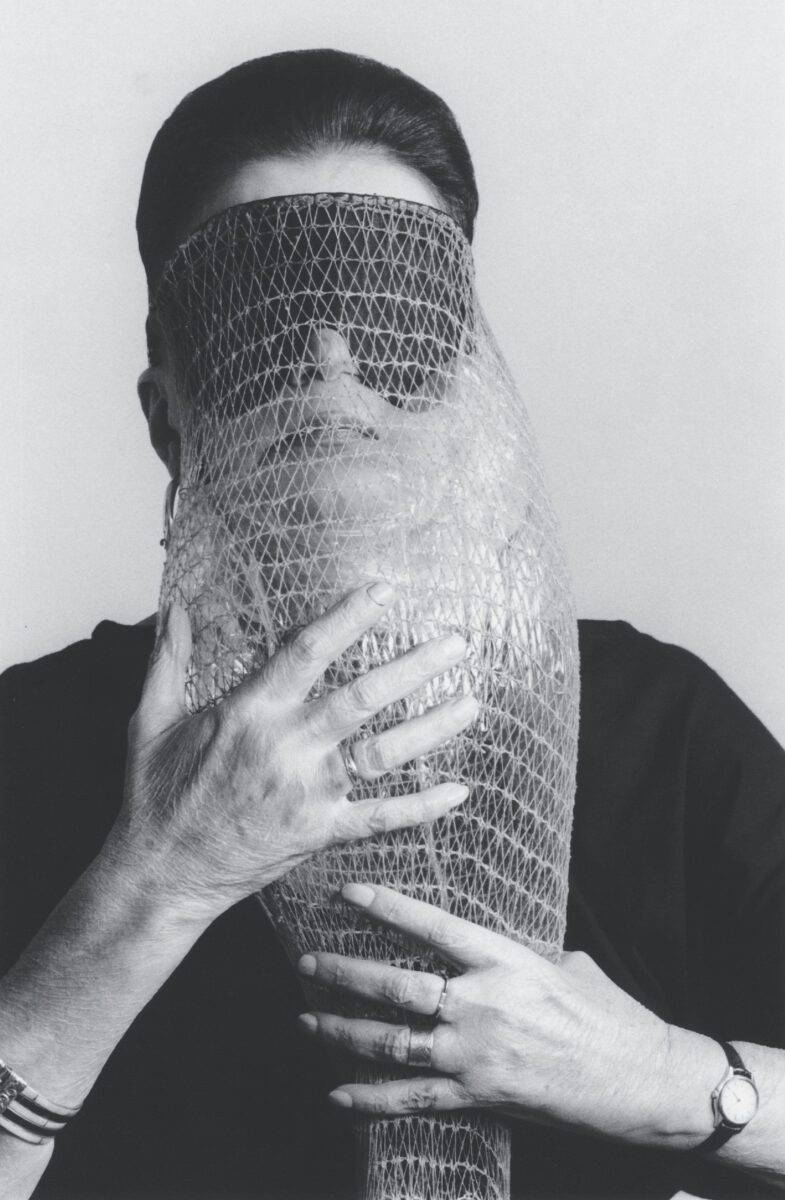
Clark’s radicalism lies as much in concept as in form. She refused to allow the artwork to exist as a static object or commodity, insisting instead that meaning unfolds through presence, engagement and shared experience. The Kunsthaus retrospective brings this principle to life. Here, the artwork is not complete until it is experienced, and in that process, perception itself becomes the medium.
In a world dominated by screens and passive observation, Clark’s insistence on bodily presence and attentive interaction is prescient. Her work reminds us that art is not only to be seen but to be inhabited, felt, and activated. As Caetano Veloso wrote in tribute: “If you hold a stone / Hold it in your hand / If you feel the weight / You’ll never be late / To understand.” The exhibition at Kunsthaus Zürich exhibition allows audiences to feel, act, and understand – experiencing Clark’s extraordinary vision.
Lygia Clark. Retrospective is at Kunsthaus, Zürich from 14 November until 8 March: kunsthaus.ch
Words: Simon Cartwright
Image Credits:
1. Lygia Clark, Caminhando, 1963.
2. Lygia Clark, Dialogo Maos.
3. Lygia Clark, Mascara Abismo.


