

In art and life, the future has emerged as both a caution and a possibility. The climate crisis, accelerating technologies and new planetary infrastructures now shape the narratives artists construct about tomorrow. Increasingly, creative practice is less about prediction and more about rehearsal, imagining how humanity might navigate the realities unfolding. The news cycle right now shows a new senseless war, and this, coupled with Gaza and Ukraine, sees the planet inching closer and closer to that doomsday clock.
Immersive exhibitions have emerged as powerful arenas for this speculative thinking, intersecting art, science fiction and design, They allow audiences not merely to observe but to inhabit imagined worlds. This summer, one of the UK’s most ambitious cultural institutions invites visitors to step directly into that terrain. Barbican Centre will open In Other Worlds, marking the first major UK solo exhibition by BAFTA-nominated filmmaker, artist and speculative futurist Liam Young. Running from 21 May to 6 September, the project transforms multiple locations within the building into a cinematic landscape of possible futures. The Silk Street Entrance, The Curve and the subterranean Car Park 5 are reimagined as interconnected environments where fiction collides with real technological possibility. Here LED installations, monumental projections, hypothetical artefacts and graphic narratives unfold in a choreographed sequence. The exhibition asks audiences to reconsider their relationship with the future, not as something inevitable but as something collectively constructed. As Young himself states, “The future doesn’t rush over us like water. It’s not something that happens to us. It’s an act of creation.”
Liam Young has spent more than a decade forging a practice that moves fluidly between filmmaking, architecture and speculative research. Described by the BBC as “the man designing our futures,” his work examines the infrastructures, technologies and environmental systems shaping the Anthropocene. Young creates elaborate fictional worlds that function as thought experiments for society, blending documentary research with cinematic imagination. These narratives often unfold through vast digital landscapes and imagined urban environments. He positions storytelling as a critical tool for confronting global crises. For Young, fiction is not an escape from reality but a lens through which its consequences become clearer.
Young trained as an architect, yet he is widely recognised as a filmmaker and artist. His career has been defined by interdisciplinary exploration with films, installations and design objects forming part of collections in institutions such as the Museum of Modern Art in New York, Smithsonian, Art Institute of Chicago and the Victoria and Albert Museum in London. Exhibitions and screenings have appeared at the Venice Biennale, Royal Academy, Getty and Singapore’s ArtScience Museum amongst many others. His science fiction film Planet City premiered at Tribeca and subsequently reached global audiences through lectures and online platforms. Young consults widely as a futurist, advising organisations from NASA’s Jet Propulsion Laboratory to technology companies including Google and Sony. Academic research also underpins his work, with teaching roles at Princeton, MIT and Cambridge as well as his leadership of the Masters in Fiction and Entertainment at SCI-Arc in Los Angeles. To say he is prolific is an understatement – he is one of the greatest contributors to interdisciplinary contemporary discourse today.
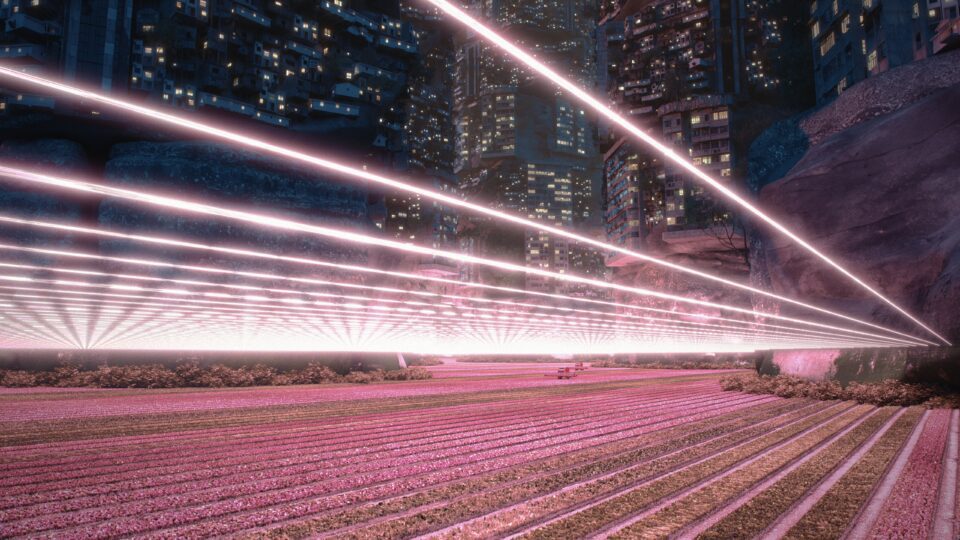
Within this broad trajectory, In Other Worlds, represents a significant new chapter. The exhibition unfolds as a sequence of immersive environments that combine film, sound and design to create speculative futures grounded in real research. Visitors encounter enormous LED installations, audio narratives and cinematic projections that surround them on all sides. The works explore how emerging technologies might reshape cities, landscapes and planetary systems. Rather than presenting dystopian collapse, Young imagines alternative futures that remain precarious yet simultaneously hopeful.
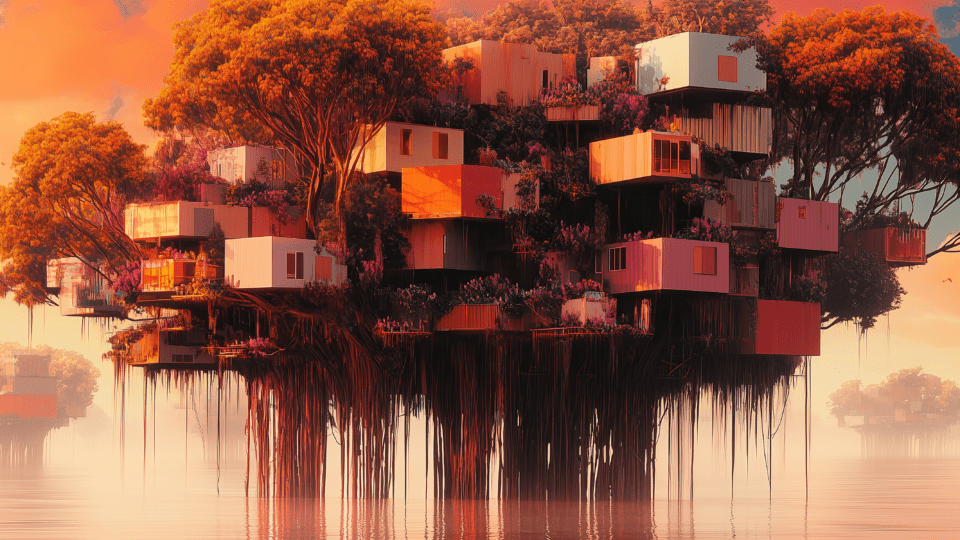
Central to the exhibition are a series of films that operate as narrative anchors. Amongst them is World Machine (2026), a newly commissioned work premiering at the Barbican on a 12 metre wide projection. The film imagines a future in which vast networks of renewable energy and artificial intelligence form a planetary supercomputer woven into the Earth’s surface. Through a combination of documentary footage and CGI, the project ponders the infrastructures required to sustain emerging technologies. Elsewhere, Planet City revisits Young’s visionary concept of a single hyper-dense metropolis housing the entire global population while the rest of the planet returns to wilderness. The scale of these scenarios emphasises the extraordinary transformations required to confront climate collapse.
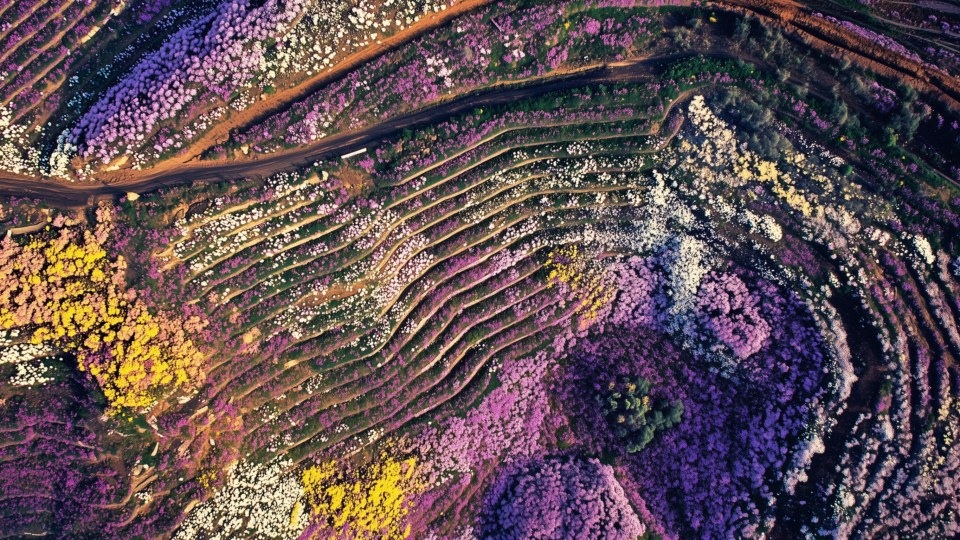
Another key work, After the End (2024), offers a speculative creation story for Australia developed in collaboration with Aboriginal actor and activist Natasha Wanganeen. Presented as a 50,000-year time-lapse film, it traces the arc from ancient First Nations communities through colonisation and resource extraction towards a future shaped by new energy infrastructures. Meanwhile The Great Endeavour imagines the monumental engineering project required to remove carbon dioxide from the atmosphere. These films operate as narrative provocations. Young explains this approach clearly: “Imaginary Worlds aren’t concerned with predicting the future, instead they prepare us for it. Within their fictional streets and speculative landscapes, we rehearse new ways of living, new relationships between humans and machines, between cities and the Earth, between extinction and survival.”
Collaboration sits at the heart of the exhibition’s world-building approach. Writers, filmmakers and scientists contribute audio narratives and speculative texts that deepen each environment. Participants include screenwriter Lisa Joy, director Jane Wu and celebrated science fiction authors Kim Stanley Robinson and Chen Qiufan. Their stories are voiced by actors and cultural figures such as Dame Dr Maggie Aderin, Richard Ayoade and Alma Pöysti. Costume designer Ane Crabtree, known for her work on The Handmaid’s Tale, creates garments for the imagined inhabitants of these worlds. Music and soundscapes by artists including Forest Swords, Lyra Pramuk and Space Afrika envelop visitors in an atmospheric sonic environment. Together these elements transform the exhibition into a collective experiment in storytelling.
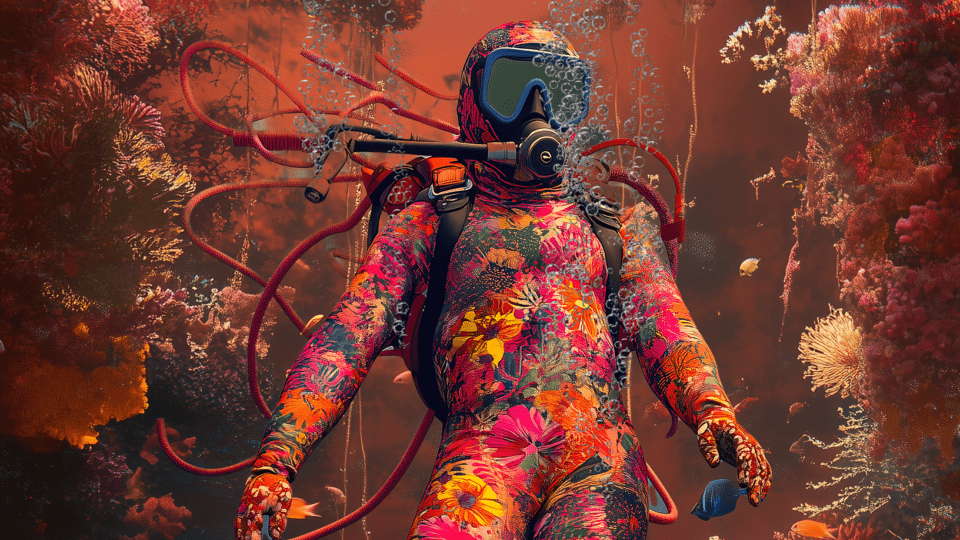
Across contemporary art Young’s practice resonates with a wider movement of artists interrogating the technological and environmental future. Figures such as Hito Steyerl have explored the political implications of digital systems and global networks through immersive video installations. Refik Anadol similarly harnesses data and artificial intelligence to create monumental visual environments that blur the boundary between machine perception and human imagination. Meanwhile Tomás Saraceno’s speculative architectures envision new relationships between humans, ecosystems and planetary atmospheres. Like Young, each artist moves beyond traditional media boundaries to construct experiential worlds that question how we inhabit the Earth. Their practices reflect a growing understanding that complex global challenges demand an instant response of equally complex artistic languages.
Increasingly, such work positions art as a laboratory for imagining alternative futures. Young’s films and installations demonstrate how speculative narratives can illuminate technological systems that otherwise remain invisible. From satellite networks to energy grids, the infrastructures shaping contemporary life often operate far beyond public perception. By visualising these systems at planetary scale, Young encourages audiences to reconsider their role within them. His work suggests that imagination is a form of civic engagement. Through storytelling, society gains the ability to rehearse potential futures.
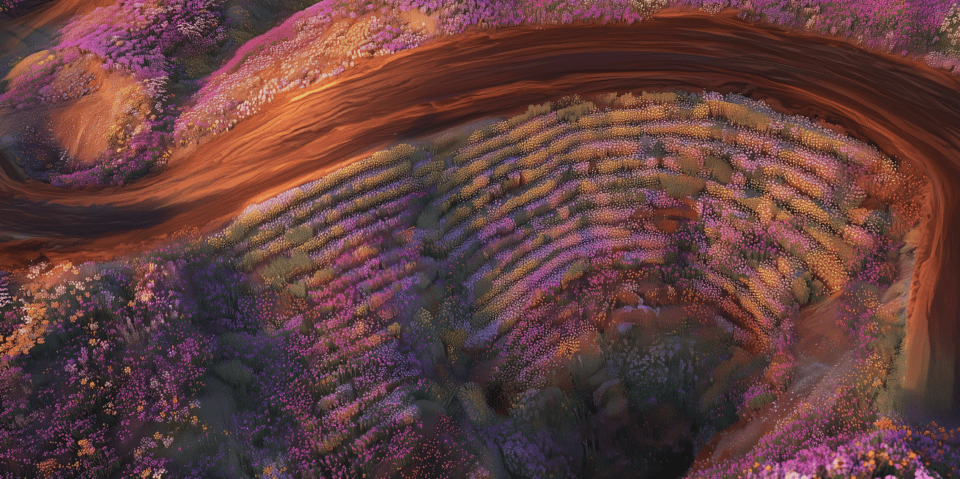
Meanwhile the Barbican’s immersive programme provides a fitting platform for this ambitious undertaking. Over recent years the institution has cultivated exhibitions that merge art, science and digital culture in increasingly experiential ways. In Other Worlds extends that trajectory by occupying multiple architectural spaces across the complex. Visitors first encounter an LED installation at the Silk Street entrance where animated portraits introduce characters from one of the exhibition’s speculative worlds. From there the journey moves into The Curve gallery where an antechamber of draped architecture and layered sound begins to dissolve the boundary between present and future. The experience ultimately descends into the cavernous Car Park 5 where a constellation of LED screens presents The Future Present, a series of documentary films revealing real renewable energy sites around the world.
Within these environments the exhibition continually shifts between fiction and reality. The documentary footage of wind farms, automated agriculture and solar infrastructures demonstrates that many technologies required for radical environmental change already exist. By juxtaposing them with speculative narratives, Young collapses the distance between possibility and imagination. Visitors are asked to consider not only what the future might look like but how collective action might shape it. As Barbican curator Luke Kemp observes, “now is the time to once again look for new stories, imagine different futures and create the worlds that we want to exist.”
In Other Worlds feels poised to become one of the most significant exhibitions in the UK this summer. Its scale, ambition and interdisciplinary scope place it among the Barbican’s most compelling immersive projects to date. Critics and cultural commentators are already anticipating the show as a highlight of the 2026 season, drawing together art, architecture, cinema and environmental thought. Young’s ability to translate complex scientific realities into cinematic storytelling gives the exhibition an immediacy that resonates beyond the gallery. Visitors are participants in an unfolding narrative about humanity’s future.
Young’s worlds resist the fatalism that often dominates conversations about climate and technology. Instead, they propose that storytelling remains a vital tool for shaping the decades ahead. By walking through these speculative environments, audiences glimpse the possibilities that emerge when creativity confronts crisis. In that sense the exhibition is less about distant tomorrows than about the decisions made today. The future is not waiting somewhere ahead but being constructed in every moment we inhabit.
In Other Worlds is at Barbican, London from 21 May to 6 September: barbican.org.uk
Words: Anna Müller
Image Credits:
1. Film still from After the End (2024) by Liam Young. Image courtesy of the artist
2. Film still from After the End (2024) by Liam Young. Image courtesy of the artist.
3. Film still from Planet City (2021) by Liam Young. Image courtesy of the artist.
4. Film still from After the End (2024) by Liam Young. Image courtesy of the artist.
5. Film still from After the End (2024) by Liam Young. Image courtesy of the artist.
6. Film still from After the End (2024) by Liam Young. Image courtesy of the artist.
7. Film still from After the End (2024) by Liam Young. Image courtesy of the artist.


