

At the intersection of art, technology and the political imagination, Hito Steyerl’s latest exhibition, The Island, opens at Fondazione Prada’s Osservatorio in Milan as a meditation on the fluidity of time, space and knowledge. In a world simultaneously inundated by digital images and threatened by rising seas, Steyerl interrogates the structures through which we perceive reality. Her work situates itself in the uneasy spaces where scientific discovery, historical trauma and cultural myth converge, posing questions that are urgent, unsettling and deeply resonant. The Island is not merely a presentation of objects or images; it is an ecosystem of ideas that operates as much in conceptual registers as in physical environments.
Steyerl’s practice has long been defined by this synthesis of media theory and visual experimentation. Since her early investigations into the circulation of images and the politics of representation, she has consistently explored the ambivalent power of technology and its capacity to shape perception and influence society. In The Island, she extends this enquiry into new dimensions, drawing on quantum physics and science fiction as frameworks for understanding the coexistence of multiple temporal and spatial realities. Flooding, both literal and metaphorical, becomes a recurring motif, tracing the currents of climate change, the pressures exerted on scientific research by political and commercial interests and the authoritarian tendencies amplified by artificial intelligence. The exhibition is a study in how knowledge is produced, obscured and transformed under the weight of social, political and environmental crises.
The exhibition’s conceptual foundation is rooted in an anecdote recounted by literary critic Darko Suvin. During a bombing in Zagreb in 1941, Suvin imagined himself transported to the world of Flash Gordon’s Trip to Mars, finding in science fiction a space for resilience and invention amidst destruction. For Steyerl, Suvin’s experience exemplifies the radical potential of fiction to create parallel worlds in conditions of extreme adversity. She translates this sensibility into visual form, deploying quantum logic to suggest that multiple states, contradictory realities and alternative histories can coexist simultaneously. The exhibition becomes a laboratory for thought, a space in which scientific inquiry and poetic speculation intersect.
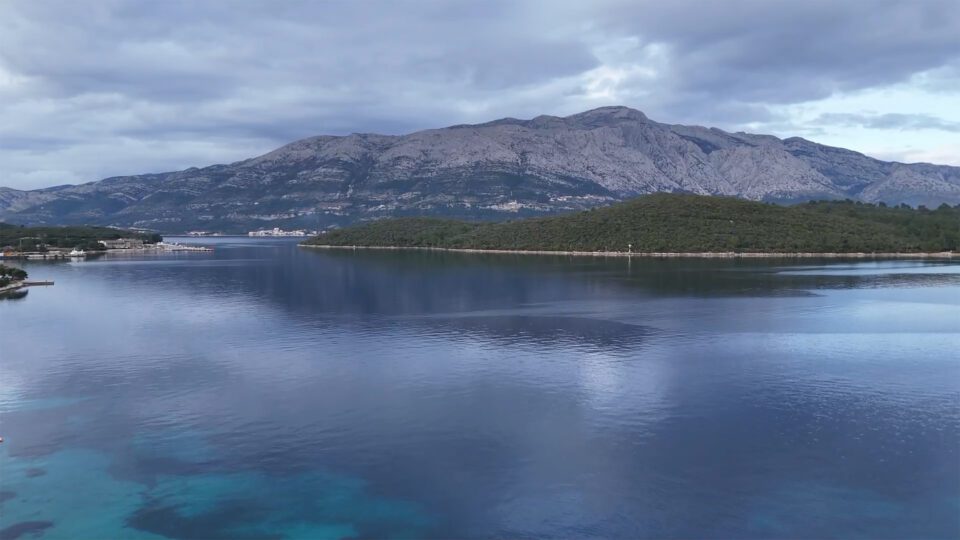
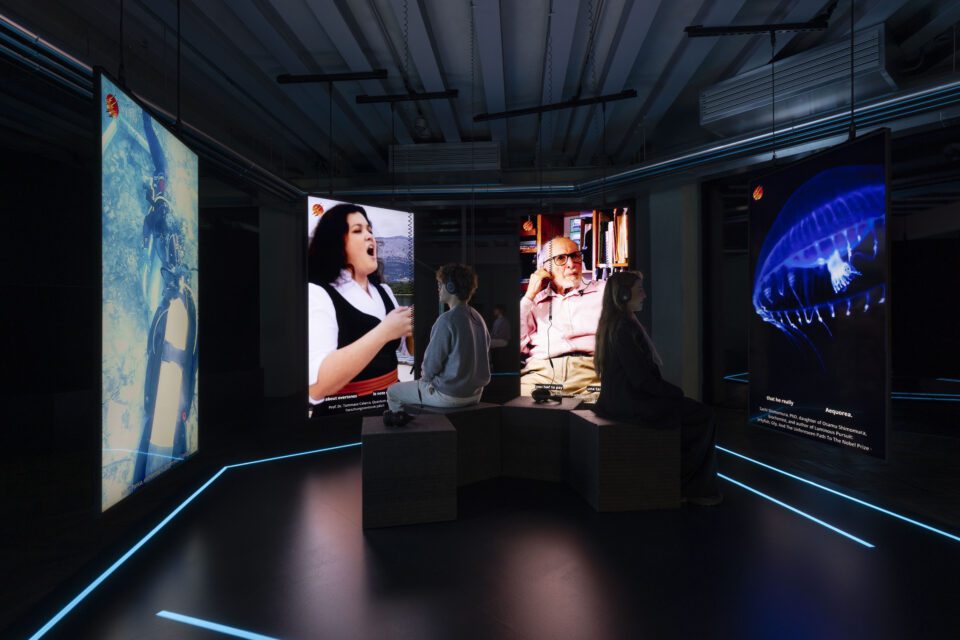
The Island unfolds through four interconnected narratives, each addressing a distinct aspect of Steyerl’s inquiry. In The Artificial Island, the work traces a submerged Neolithic site off the coast of Korčula, discovered in 2021 by archaeologist Mate Parica. The site, originally connected to the mainland by an ancient road, now lies four to five metres beneath the Adriatic Sea, submerged by rising waters that speak both to geological deep time and contemporary climate upheaval. Steyerl’s luminous spherical installation on the first floor of the Osservatorio reanimates this site through 3D scanning, enveloping the viewer in a sense of ancient and ongoing transformation. Documentary clips, LED screens and interviews with Parica, physicist Tommaso Calarco and other scholars create a polyphonic environment.
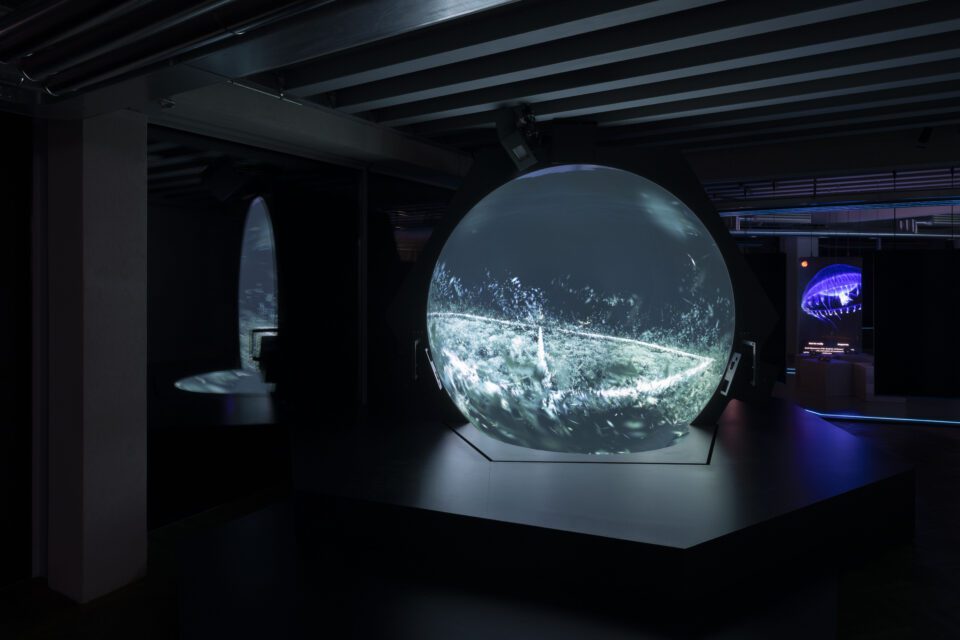
In Lucciole, bioluminescence becomes a metaphor for observation, discovery and the persistence of life. Drawing on the work of Osamu Shimomura, who isolated the Green Fluorescent Protein from jellyfish, Steyerl situates science as both illumination and revelation. The organic molecule Luciferin, which enables plankton to glow, serves as a bridge between the microscopic and the cosmic, the empirical and the poetic. Through the shimmering light of GFP, the exhibition stages a conversation between material phenomena and human perception, reminding us that knowledge is often contingent, delicate and extraordinary.
The Birth of Science Fiction traces the intellectual legacy of Suvin’s seminal text Metamorphoses of Science Fiction, which defined the genre as literature of cognitive estrangement. Steyerl’s work emphasises the political and philosophical dimensions of this estrangement, revealing how the imaginative freedom of science fiction can illuminate the structures of power, history and ideology. By situating literary and theoretical inquiry alongside visual and technological forms, she creates a network of meanings in which fiction is inseparable from fact and speculation becomes a lens through which reality is apprehended.
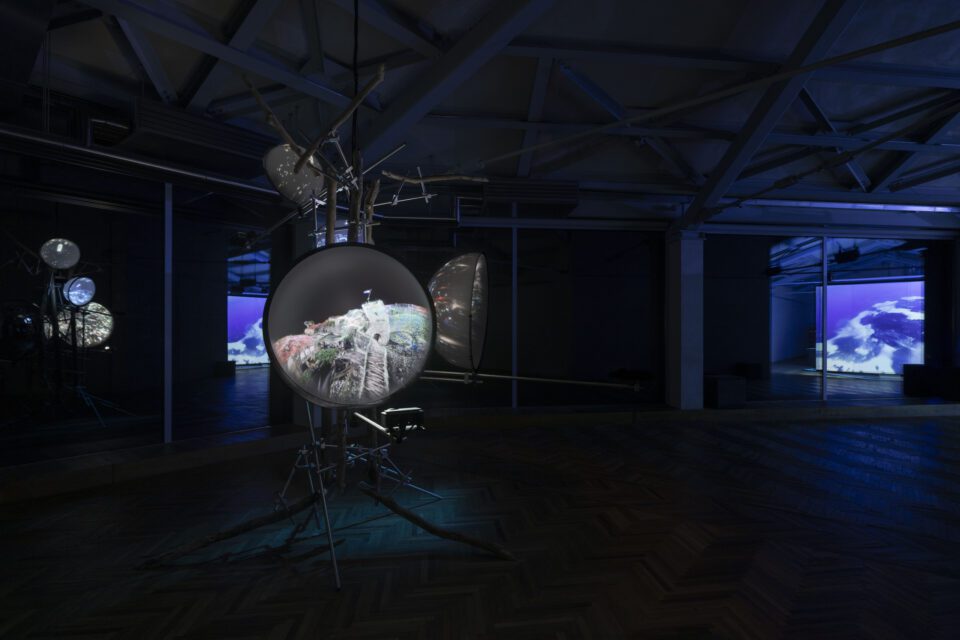
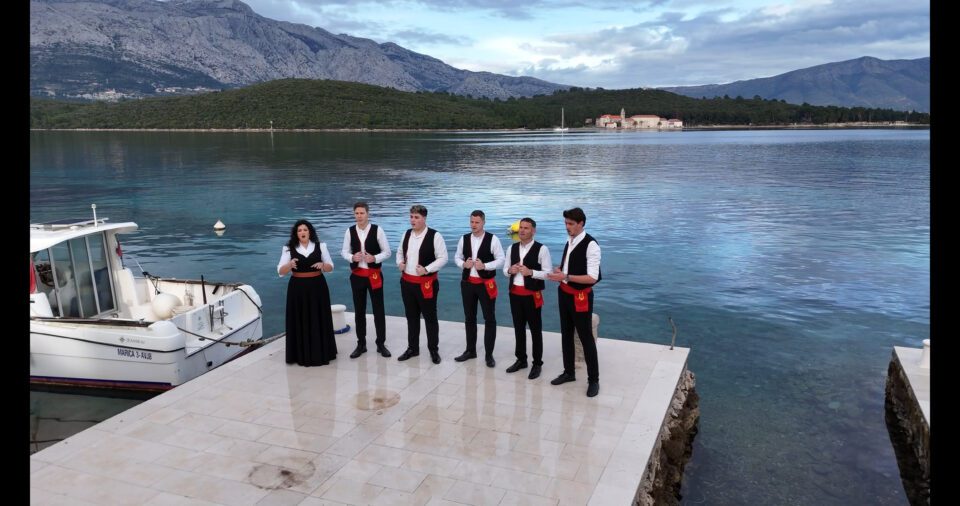
Flash! returns to Suvin’s personal narrative, dramatising the collision between lived experience and imagined worlds. The exhibition’s second floor transforms into a cinematic environment reminiscent of the Zagreb cinema where Suvin watched Flash Gordon as a child. Red armchairs are arranged on a platform shaped like the submerged island, a formal gesture linking historical memory, geographical specificity and imaginative projection. Steyerl’s film, accompanied by local choir singing, entangles these diverse strands into a seamless audiovisual encounter. Here, utopia and catastrophe coexist, reflecting the paradoxes of memory, invention and survival. Materiality and narrative converge in installations composed of driftwood supporting hemispheres that display photogrammetric scans of Neolithic artefacts. These sculptural forms bridge the gap between temporal registers, evoking the endurance of matter and the fragility of knowledge. Poetry, scientific diagrams and literary texts are interwoven into this environment, producing a layered experience in which viewing is simultaneously an intellectual, emotional and aesthetic act.
Throughout The Island, Steyerl plays with two notions of time: the accelerated, fractured temporality of contemporary digital life and capitalism, and the deep, almost incomprehensible temporality of natural, geological and historical processes. She juxtaposes the “junk time” of technological loops and endless media consumption with Neolithic underwater time and the enduring rhythms of natural phenomena. This collision forces the viewer to confront the limitations of human perspective and the ethical and philosophical implications of our interventions in both the natural and technological worlds. The exhibition offers a meditation on responsibility, imagination and the possibility of thinking beyond the human scale.
Steyerl’s achievement lies in her ability to synthesise diverse registers—archaeology, physics, literature, film and biochemistry—into a coherent yet radically open-ended artistic experience. The Osservatorio becomes a space in which science and fiction, past and future, observation and imagination collide in ways that are intellectually rigorous and sensorially compelling. The exhibition refuses simple narrative closure, instead privileging multiplicity, ambiguity and the continual emergence of unforeseen connections.
The Island exemplifies the contemporary potential of art as a tool for critical thought and reflection. Steyerl does not merely document or illustrate; she interrogates, juxtaposes and reconstructs, demonstrating how visual practice can reveal the hidden structures that shape our understanding of history, science and culture. The exhibition suggests that knowledge is never singular, that reality itself is unstable and human perception is always partial. It invites the viewer to inhabit this instability, to move across dimensions and confront the possibilities that emerge when imagination and empirical inquiry intersect.
By presenting a work that operates simultaneously as film, installation, research project and theoretical meditation, Fondazione Prada reinforces its commitment to fostering experimental interdisciplinary approaches to contemporary art. The Island is not only an exhibition; it is a manifestation of how art can intervene in the production of knowledge, how it can challenge conventional modes of seeing and how it can provoke reflection on the social, political and environmental challenges of our moment. Steyerl’s work emphasises that the aesthetic encounter is inseparable from ethical and intellectual engagement.
In its blending of quantum thought, historical research and speculative narrative, The Island positions the viewer at the threshold of multiple worlds. It is a testament to the power of imagination, the resilience of knowledge and the necessity of confronting both human and nonhuman temporality. Through Steyerl’s lens, the boundaries between fact and fiction, science and narrative, history and possibility dissolve, revealing the complex architecture of reality itself. In this sense, the exhibition is not only a reflection on contemporary crises but a declaration of the enduring relevance of art as a medium for understanding.
The Island invites visitors to step into a space where time folds upon itself, where human ambition meets ecological consequence and where stories of survival and invention illuminate the intertwined trajectories of history and future. Steyerl’s work confronts us with the fragility and wonder of existence, the urgency of scientific and political engagement and the potential of artistic practice to expand consciousness. It is an exhibition that resists the closure of linear narratives, demanding instead that the viewer navigate the flux of images, ideas and histories with curiosity, care and imagination.
In its conceptual and material richness, The Island exemplifies the capacity of contemporary art to bridge disciplines and reveal the unforeseen consequences of human and technological action. It reminds us that in times of crisis, imagination becomes a vital tool of survival, that knowledge must be both rigorous and imaginative and that art remains one of the most profound means of exploring what it means to exist in a world defined by flux. Steyerl’s exhibition is a luminous meditation on these imperatives, a work that speaks to the urgency of our moment while offering visions of resilience and possibility beyond it.
The Island is at Fondazione Prada’s Osservatorio, Milan until 30 October 2026: fondazioneprada.org
Words: Simon Cartwright
Image Credits:
1. Hito Steyerl. Stills from: The Island, 2025 Single channel HD video, Cinema; Quantum noise holograms; Archaeological projection spheres; Documentary videos. Duration 26 minutes (Single channel HD video); installation dimensions variable.
2. Hito Steyerl. Stills from: The Island, 2025 Single channel HD video, Cinema; Quantum noise holograms; Archaeological projection spheres; Documentary videos. Duration 26 minutes (Single channel HD video); installation dimensions variable.
3. Hito Steyerl, The Island, 2025. Single channel HD video, Cinema; Quantum noise holograms; Archaeological projectionspheres; Documentary videos. Duration 26 minutes (Single channel HD video); installationdimensions variable. Courtesy of the artist, Fondazione Prada, Andrew Kreps Gallery, New York, and Esther Schipper, Berlin/Paris/Seoul.
4. Hito Steyerl. Stills from: The Island, 2025 Single channel HD video, Cinema; Quantum noise holograms; Archaeological projection spheres; Documentary videos. Duration 26 minutes (Single channel HD video); installation dimensions variable.
5. Hito Steyerl, The Island, 2025. Single channel HD video, Cinema; Quantum noise holograms; Archaeological projectionspheres; Documentary videos. Duration 26 minutes (Single channel HD video); installationdimensions variable. Courtesy of the artist, Fondazione Prada, Andrew Kreps Gallery, New York, and Esther Schipper, Berlin/Paris/Seoul.
6. Hito Steyerl. Stills from: The Island, 2025 Single channel HD video, Cinema; Quantum noise holograms; Archaeological projection spheres; Documentary videos. Duration 26 minutes (Single channel HD video); installation dimensions variable.
7. Hito Steyerl, The Island, 2025. Single channel HD video, Cinema; Quantum noise holograms; Archaeological projectionspheres; Documentary videos. Duration 26 minutes (Single channel HD video); installationdimensions variable. Courtesy of the artist, Fondazione Prada, Andrew Kreps Gallery, New York, and Esther Schipper, Berlin/Paris/Seoul.


