

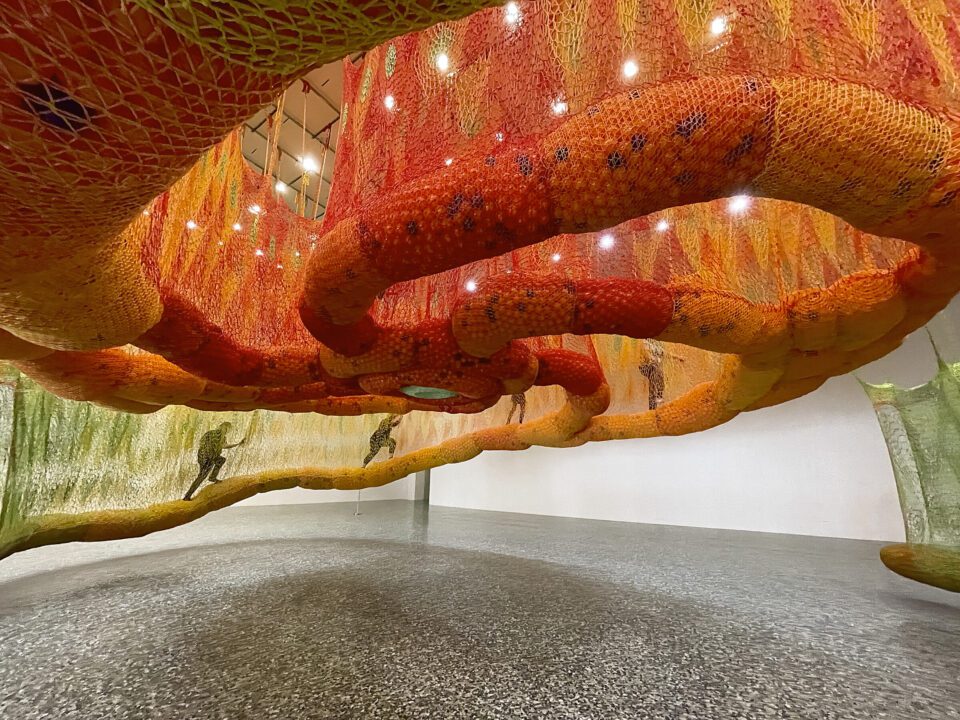
Immersive environments that engage the body, mind and senses are a defining thread in contemporary art, and Ernesto Neto’s SunForceOceanLife exemplifies this approach with unparalleled vibrancy. At the Museum of Fine Arts, Houston, the Brazilian artist transforms Cullinan Hall into a spiralling labyrinth suspended 12 feet above the ground. The installation draws attention to the cyclical relationship between the sun and the sea, reflecting the generative forces that sustain life on Earth. Colour and texture merge to create a dynamic, tactile experience: yellow, orange, and green hand-woven textiles form intricate patterns, while soft plastic balls beneath visitors’ feet subtly shift with every step. This interplay compels audiences to consider balance and stability within the work. In doing so, Neto elevates crochet, a craft learned from his grandmother, into a monumental form that resonates with both memory and imagination.
Ernesto Neto, born in 1964 in Rio de Janeiro, has cultivated a practice that bridges social, natural and spiritual worlds. Since the mid-1990s, his work has invited physical interaction and multisensory engagement, drawing from Biomorphism, Arte Povera, and Minimalist sculpture alongside Neo-Concretism and Brazilian avant-garde movements of the 1960s and 1970s. His installations often incorporate spices, sand and shells, offering an expansive sensorial experience that redefines the boundaries between viewer and artwork. Neto continues to live and work in Brazil, producing projects that are simultaneously personal and globally resonant. Each piece foregrounds relationality – between people, materials and space – encouraging audiences to perceive the natural and social worlds as interconnected.
Early exhibitions established Neto’s reputation for transforming gallery spaces into environments of sensory discovery. Works such as Leviathan Thot (2006) and Navedenga (2010) enveloped visitors in labyrinthine constructions, emphasising tactility and physical engagement. His installations have been presented internationally at institutions including the Museum of Modern Art, New York, Tate Modern, London, and in the Venice and São Paulo Biennales, situating him at the forefront of participatory contemporary sculpture. Each project continues to build on his interest in the interface of human perception, materiality and organic form. Crochet, fabric and suspended structures recur as signature motifs, seamlessly marrying craft traditions with conceptual experimentation.
SunForceOceanLife, a major 2019 commission for MFAH, continues this trajectory with heightened ambition. “Ernesto Neto created this site-specific piece as a tribute to the life-giving forces of the sun and the ocean. Inspired by crochet, which he learned from his grandmother, the piece transforms this traditional Brazilian craft into a massive, enveloping structure that engages the body and the mind,” notes Mari Carmen Ramírez, Wortham Curator of Latin American Art and Founding Director of the International Center for the Arts of the Americas at MFAH. The spiralling, suspended form allows visitors to move through interior pathways, following patterns that radiate from the very centre of Cullinan Hall. The tactile response of the plastic balls underfoot reinforces a focus on bodily awareness, inviting reflection on balance, movement and personal rhythm within a shared singular public space.
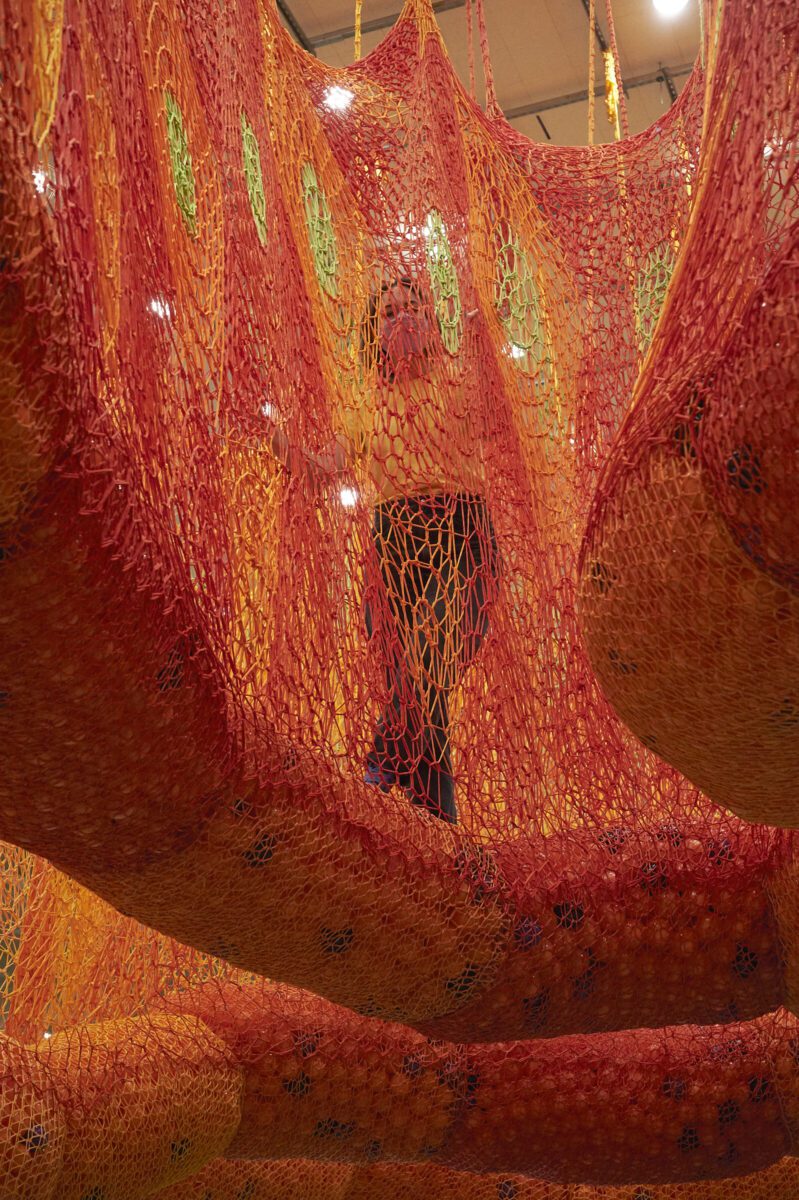
The installation continues Neto’s dialogue with Latin American avant-garde pioneers, connecting the present with historic explorations of kinetic and participatory art. Gary Tinterow, Director of MFAH, observes, “This singular commission reflects our commitment to Latin American artists and to engaging our visitors in unique art experiences. SunForceOceanLife has joined landmark installations by other Neto’s predecessors, most notably Gyula Kosice and Jesús Rafael Soto, whose visionary work we are able to present on an ongoing basis.” Neto’s work expands on these legacies, creating environments that are both monumental and intimate, technological and organic, conceptual and tactile.
Across contemporary practice, immersive and participatory art has found multiple resonances with Neto’s methodology. Olafur Eliasson uses light, water and reflective surfaces to challenge perception, while Tara Donovan transforms ordinary materials into expansive environments that shift spatial awareness. Do Ho Suh fabricates architectural structures from translucent materials to explore home, identity, and movement through space. Similarly, Ann Veronica Janssens experiments with colour, light, and sensory disorientation to heighten awareness, while Roni Horn investigates materiality and the perception of environment in subtle, contemplative forms. Combined, these artists share Neto’s interest in expanding the viewer’s relationship to the physical world, underlining an international dialogue around interactivity.
Neto’s influence on emerging and contemporary Latin American artists is evident in their engagement with materials, scale and audience participation. Adriana Varejão reflects his expansive approach to craft and monumental installations, using texture and pattern to interrogate cultural histories. Rivane Neuenschwander’s interactive works evoke multisensory experiences that echo Neto’s interest in relational perception. Brazilian artist Jac Leirner similarly adopts soft materials and spatial arrangements that invite visitor interaction, tracing lines back to Neto’s groundbreaking integration of body and space. These responses illustrate how Neto has cultivated a legacy that resonates across generations, linking the formal innovation of Brazilian modernism with concerns about ecology, sociality and embodiment.
The formal qualities of SunForceOceanLife amplify its conceptual ambitions. The spiralling crochet pattern evokes the constant motion of ocean currents and solar rhythms, emphasising cycles that govern life on Earth. The installation’s immersive scale transforms Cullinan Hall into an enveloping landscape, creating a continuous dialogue between the physical environment and human perception. Movement through the work cultivates awareness of one’s body in space and invites contemplation of how life, energy and matter interact. Visitors experience the work not only visually but physically and emotionally, encountering a multisensory architecture that balances playfulness and reflection. In doing so, Neto continues his exploration of the intersection between craft, organic form and conceptual sculpture.
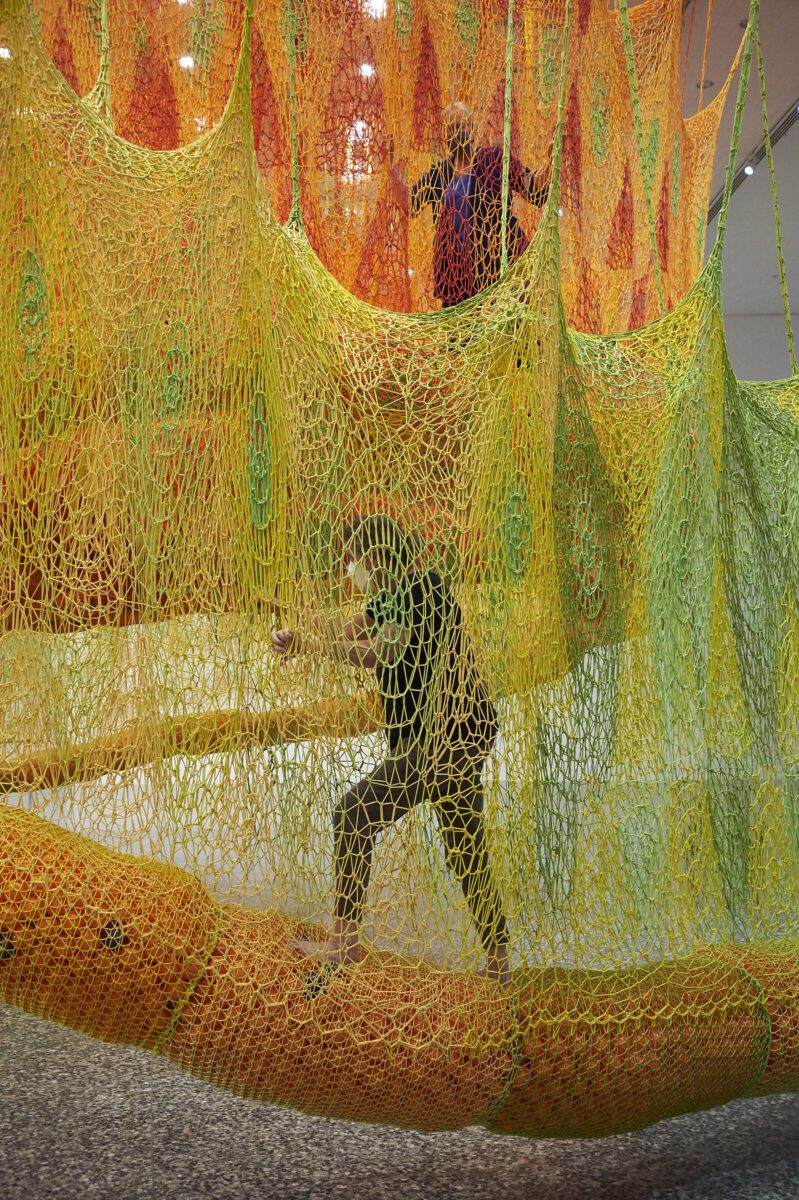
By engaging multiple senses and activating the body, SunForceOceanLife asserts a broader relevance for contemporary art. Neto’s work encourages audiences to reconsider their relationship with natural cycles, the environment, and one another. The installation also elevates the crochet into a monumental contemporary artwork that is socially and spiritually resonant. Visitors leave not only with impressions of colour and texture but with an awareness of interconnectedness, rhythm, and the cyclical patterns of life. In celebrating the sun, the ocean and their generative energies, Neto demonstrates the enduring power of art to create shared experiences that are simultaneously joyful and transformative.
SunForceOceanLife is a landmark within Neto’s oeuvre, encapsulating his lifelong exploration of social and environmental interconnectedness. It exemplifies the potential of immersive art to transcend visual spectacle and activate deep sensory engagement. The work continues to shape contemporary discourse around participatory art, influence younger artists, and reinforce the relevance of Latin American contributions to global contemporary art. In occupying and transforming Cullinan Hall, Neto’s installation becomes a lived encounter, leaving an indelible impression on all who experience it.
SunForceOceanLife is at The Museum of Fine Arts, Houston until 7 September: mfah.org
Words: Anna Müller
Image Credits:
All images: Ernesto Neto, SunForceOceanLife (installation view), 2020.

