

Mona Hatoum (b. 1952) has long been recognised as one of the most vital figures in contemporary art, with a voice shaped by displacement and exile, and a practice rooted in the fragility of everyday structures. Born into a Palestinian family in Lebanon, she moved to London in 1975 after the Lebanese Civil War broke out, beginning a lifelong exploration of instability and estrangement. Training first at Byam Shaw School of Art and later at the Slade School of Fine Art, she developed an approach that shifts seamlessly between performance, installation, video, sculpture and works on paper. Across these forms, Hatoum continually returns to domestic objects and familiar materials, destabilising them until they appear uncanny or threatening. This inversion reflects the precariousness of “home” when ruptured by conflict.
Her career has taken her across continents, from surveys at Centre Pompidou, Tate Modern and KIASMA Helsinki in the mid-2010s, to US retrospectives at the Menil Collection in Houston and the Pulitzer Arts Foundation in St. Louis. Berlin staged a remarkable trio of simultaneous exhibitions in 2022, while recent years have seen her in dialogue with Käthe Kollwitz at Kunsthaus Zürich and Kunsthalle Bielefeld and featured in a comprehensive solo show at Kunsthal KAdE in Amersfoort in early 2025. These projects underscore Hatoum’s ability to engage audiences globally with works that destabilise the familiar.
This trajectory leads to her latest exhibition, Encounters: Giacometti x Mona Hatoum at the Barbican. The exhibition is staged in dialogue with historic works by Alberto Giacometti (1901–1966). It is the second in a series of three exhibitions produced in collaboration with the Fondation Giacometti, following Encounters: Giacometti x Huma Bhabha earlier this year and preceding Encounters: Giacometti x Lynda Benglis in 2026. Together, the trilogy places Giacometti’s 20thcentury sculptures into new intergenerational conversations with contemporary artists known for originality and radical vision.
The Barbican situates this encounter within its new Level 2 gallery, and the curatorial premise is as ambitious as it is charged. Visitors first meet Giacometti’s Woman with Her Throat Cut (1932), a mutilated form that sets a tone of unease, immediately resonating with Hatoum’s own investigations into violence and rupture. Giacometti’s The Nose (1947) and The Cage (1950–51) are shown nearby, their existential weight reframed by Hatoum’s sculptural interventions. Against these historic bronzes and plasters, Hatoum installs Remains of the Day (2016–2018), a haunting composition of charred furniture encased in wire mesh that recalls the ruins of war. These juxtapositions reveal the ways in which both artists, though separated by decades, insist on the vulnerability of the body and the alienation of space.
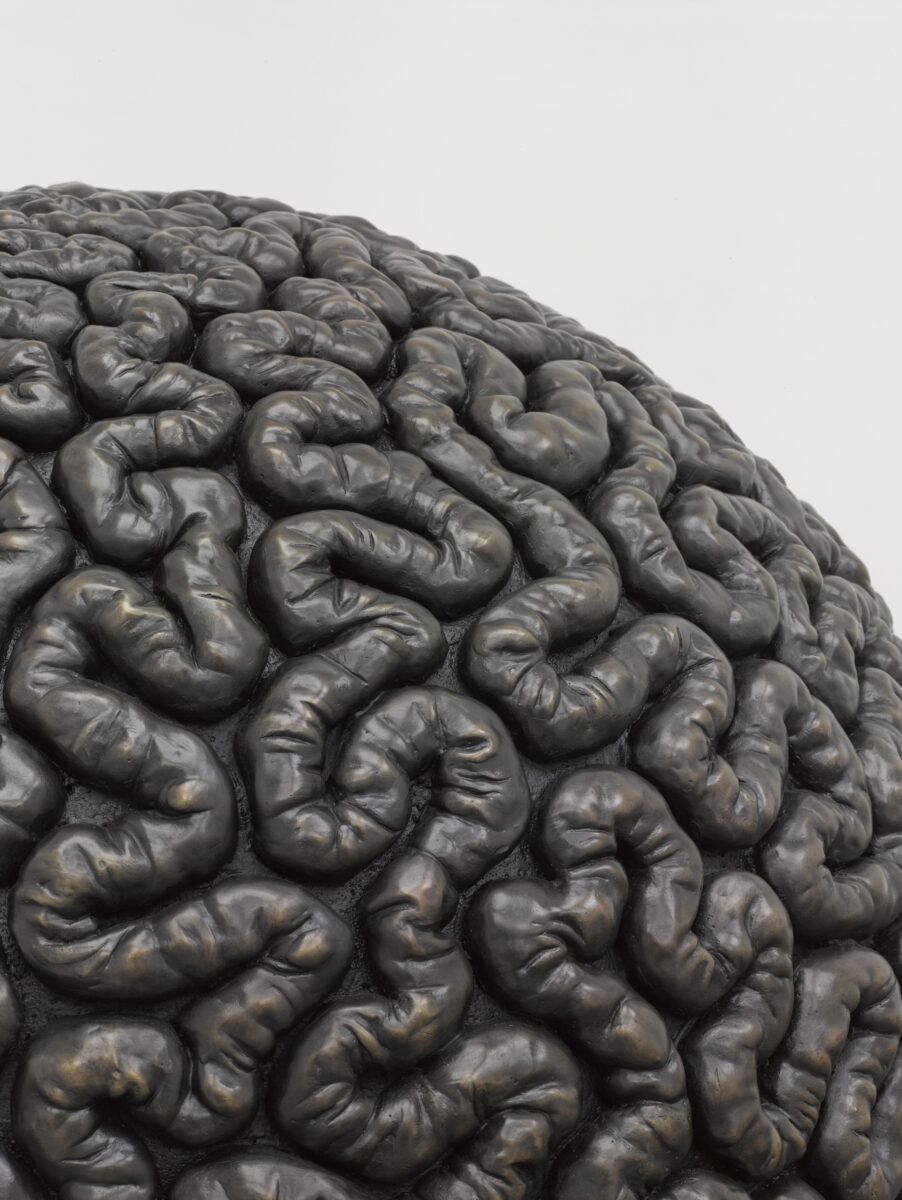
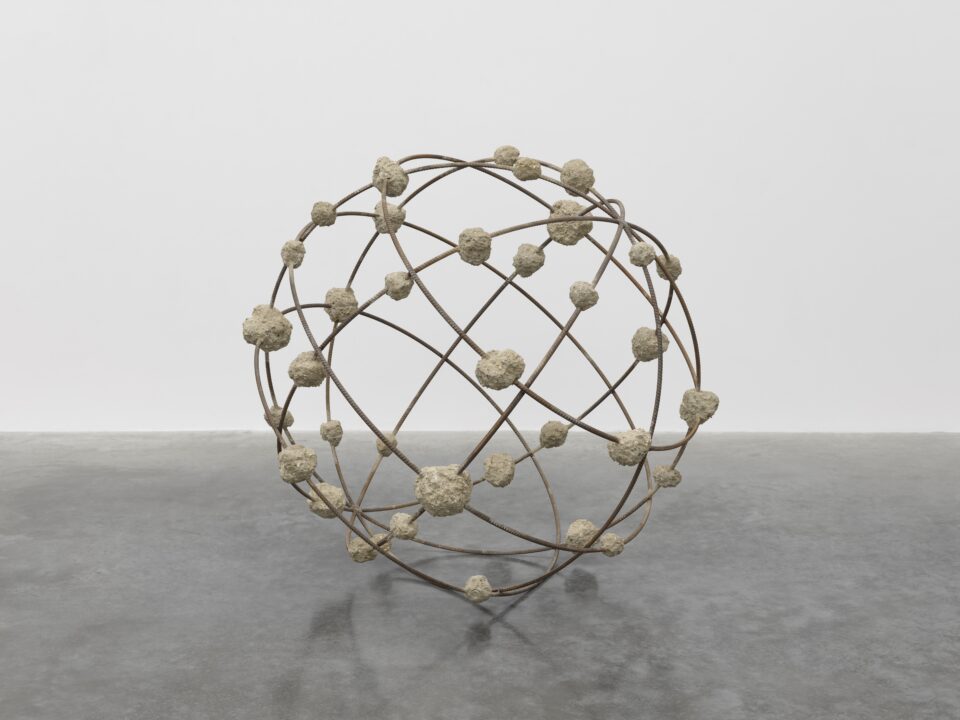
The exhibition extends into the Barbican’s foyer, where Hatoum’s large-scale sculptures punctuate the space. Orbital (2018), skeletal and open, contrasts with the impenetrable solidity of Inside Out (2019). This staging recalls Giacometti’s interest in the relationship between figure and void, between the body and its surrounding architecture. The entire installation becomes a dialogue in spatial terms: Hatoum reconfigures the Barbican into a strange, threatening domestic interior, while Giacometti’s fragmented forms remind audiences of the post-war despair from which they emerged. As Émilie Bouvard, Director of Collections at Fondation Giacometti, remarks: “A rich artistic confrontation, driven by a shared vision of creation as both intellectual and charged with affects, dealing with bodies at stake, human fragility and violence.”
The presence of Giacometti throughout the exhibition is not incidental. His elongated figures, produced in post-war Europe, became icons of human fragility, embodying devastation whilst seeking new meaning after catastrophe. Hatoum, living through exile, transforms domestic objects into structures of danger and estrangement. Both practices suggest that trauma inscribes itself on material, body and space, a theme that remains pressing today. Shanay Jhaveri, Head of Visual Arts at the Barbican, underscores this urgency: “Hatoum’s deeply charged installations transform our new gallery into a site of disquiet, resonance and revelation – mirroring Giacometti’s own explorations of existential alienation.”
The dialogue staged here connects Hatoum not only to Giacometti, but also to a broader field of artists addressing conflict, memory and displacement. Doris Salcedo’s major survey at Fondation Beyeler in 2023 brought together three decades of sculpture and installation that turn domestic materials into acts of collective mourning, a language of rupture that converses fluently with Hatoum’s charged objects. Kader Attia’s curatorial vision for the 12th Berlin Biennale in 2022 foregrounded “repair” as a decolonial framework, resonating with the exhibition’s destabilised architectures and estranged bodies.
These contemporaries extend Giacometti’s existential questioning into the present, reframing the human figure and its habitats in precarious times. On a parallel track, Shirin Neshat’s recent museum exhibition at the Parrish Art Museum (2025) returns to themes of exile and belonging through photography and film, amplifying the psychic costs of displacement; Rachel Whiteread’s Internal Objects at Gagosian London (2021) transformed cast forms of the domestic into monuments to absence; and Chiharu Shiota’s immersive Éternel at Grand Palais Éphémère (2024) wove thread, relics, and memory into fragile architectures. Together, these practices clarify how Encounters: Giacometti x Mona Hatoum situates Hatoum’s work within an intergenerational conversation: a dialogue with Alberto Giacometti’s sculptural vocabulary and, just as crucially, with artists across the world who probe the instability of home.
The ongoing series with Fondation Giacometti precisely foregrounds these types of dialogues across time and geography. It’s these bold collaborations that give us new perspectives and the curation helps us to see things, we could have missed. Giacometti’s historic works are not presented as static relics, but as living propositions that continue to shape how artists today address questions of death, fragmentation, domesticity and trauma. Hatoum’s participation in this second chapter sharpens the sense of art as a disruptive force, one capable of transforming both space and perception. The confrontation of her installations with Giacometti’s sculptures underscores the timelessness of existential concerns and the ongoing necessity of artists who give form to the fractured condition of our world.
Encounters: Giacometti x Mona Hatoum is, therefore, not simply a pairing of two practices but a carefully constructed dialogue that traverses nearly a century of artmaking. It compels audiences to witness fragility, violence and alienation in ways that are as historically grounded as they are urgently contemporary. Visitors should seize this opportunity to experience the resonance between Hatoum and Giacometti, staged within the Barbican’s new gallery space. The exhibition unsettles, provokes and illuminates, insisting on art’s capacity to speak across time to the pressing realities of human existence.
Encounters: Giacometti x Mona Hatoum is at Barbican Centre, London from 3 September 2025 to 11 January 2026: barbican.org.uk
Words: Anna Müller
Image Credits:
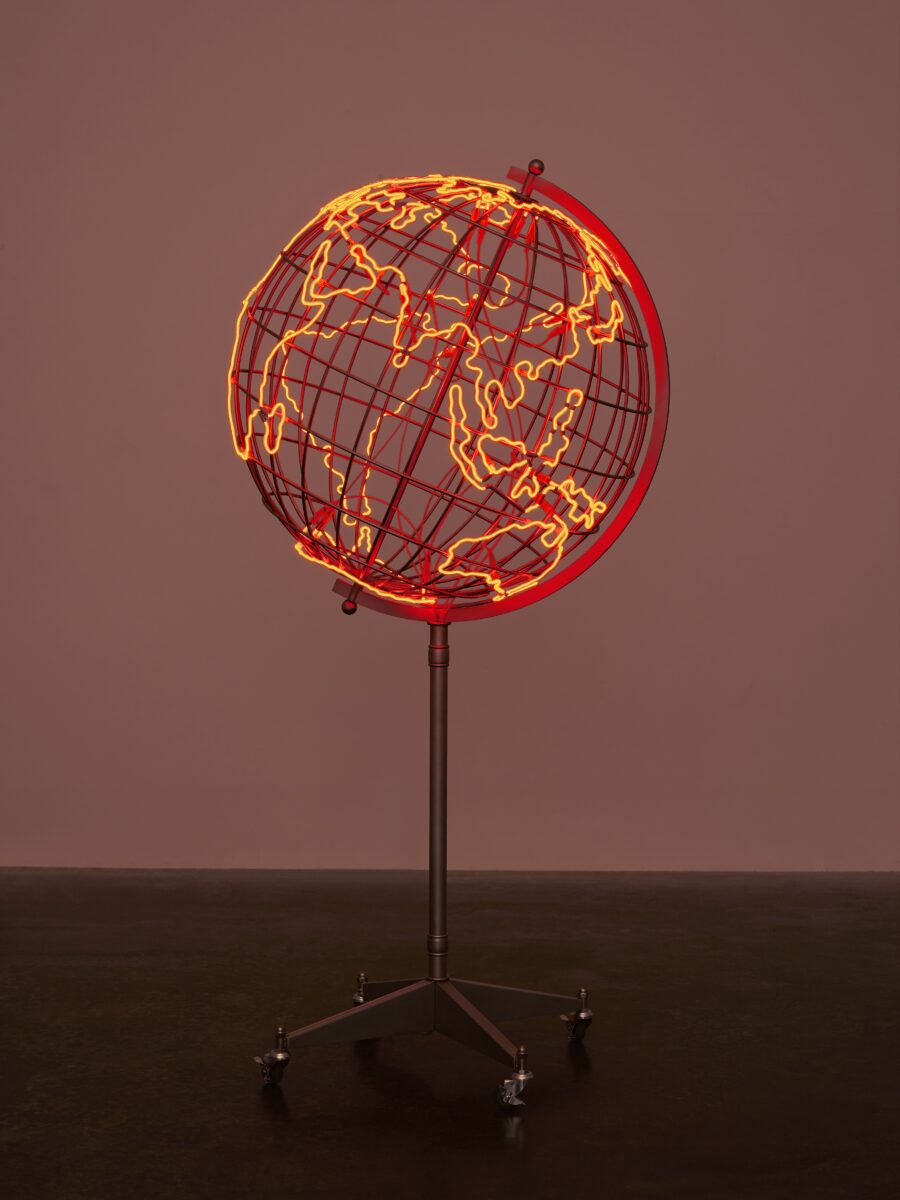
1&5. Mona Hatoum, Hot Spot (stand), 2018. Stainless steel, neon tube and rubber. 172 x 83 x 80 cm. © Mona Hatoum. Photo © White Cube (Photo: Ollie Hammick).
2. Mona Hatoum, Cube, 2006. Mild steel, 174 x 174 x 174cm. © Mona Hatoum. Courtesy Rennie Collection, Vancouver. (Photo: Site Photography).
3. Mona Hatoum, Inside Out, 2019. Broze, 103 cm diameter. © Mona Hatoum. Photo © White Cube (Theo Christelis).
4. Mona Hatoum, Orbital, 2018. Concrete and steel reinforcement bars. 140 cm diameter. © Mona Hatoum. Photo © White Cube (Theo Christelis).


