

Contemporary culture is increasingly defined by spectacle, self-performance and the circulation of images that shape how identity is imagined and consumed. Museums now grapple with the challenge of presenting art that not only critiques these forces but also inhabits their visual language. The exhibition A Whole New World at Mudam Luxembourg – Musée d’Art Moderne Grand-Duc Jean embraces precisely this tension, transforming the gallery into a theatrical terrain of attractions and immersive encounters. Spanning nearly two decades, the show surveys the practice of Simon Fujiwara through environments that echo the dramaturgy of theme parks. Fantasy and critique become inseparable as visitors move through colourful installations, sculptural characters and media-saturated narratives. In doing so, the exhibition foregrounds the complex mechanisms through which images shape who we believe ourselves to be.
Within this context, Fujiwara’s art has consistently probed the strange territory where authenticity collides with performance. His works examine the construction of identity through cultural narratives, advertising imagery and the endless reflections of social media. Rather than positioning himself strictly as a critic of late capitalism, the artist has emphasised an interest in the emotional atmosphere of the present. As he remarked in 2022: “I’m often asked if my work is a critique of capitalism and modern society, but my work is actually about feeling. I try to absorb what it feels to be alive today and translate that feeling into a visual language.” The statement provides a key to understanding the exhibition’s underlying tone. Beneath the bright surfaces and theatrical staging lies a persistent investigation into how the contemporary subject navigates an environment saturated with images and expectations.
Born in London in 1982 to a Japanese father and British mother, Fujiwara emerged in the late 2000s as one of the most distinctive voices of his generation. Educated at the University of Cambridge and later at the Städelschule in Frankfurt, he quickly gained recognition for installations that merge autobiography with broader cultural commentary. His early projects often drew from personal experience yet unfolded as elaborate narratives that blurred fact and fiction. Museums and biennials across Europe and Asia soon embraced his work for its unusual combination of humour, theatricality and intellectual rigour. Over time Fujiwara developed a visual language that moves fluidly between sculpture, video, drawing and immersive installation. This versatility allows him to construct entire environments in which visitors encounter stories about identity, sexuality, history and the commodification of experience.
Throughout the past two decades, Fujiwara has staged works that operate like narrative ecosystems, each exploring the ways images construct meaning. Projects such as The Mirror Stage (2009–2013) reflected on the contemporary subject’s encounter with endless digital reflections, while Fabulous Beasts (2015–2016) invoked mythological creatures to examine moral ambiguity in modern culture. In Joanne (2016) he turned to the idea of self-reinvention within celebrity culture, probing the fragile boundary between persona and person. Later works extended these concerns into increasingly immersive installations that mirror the logic of media spectacle. The breadth of these projects forms the foundation for the survey at Mudam, which gathers works from across nearly 20 years of practice. The exhibition emphasises how Fujiwara’s investigations have gradually expanded into a fully realised conceptual universe.
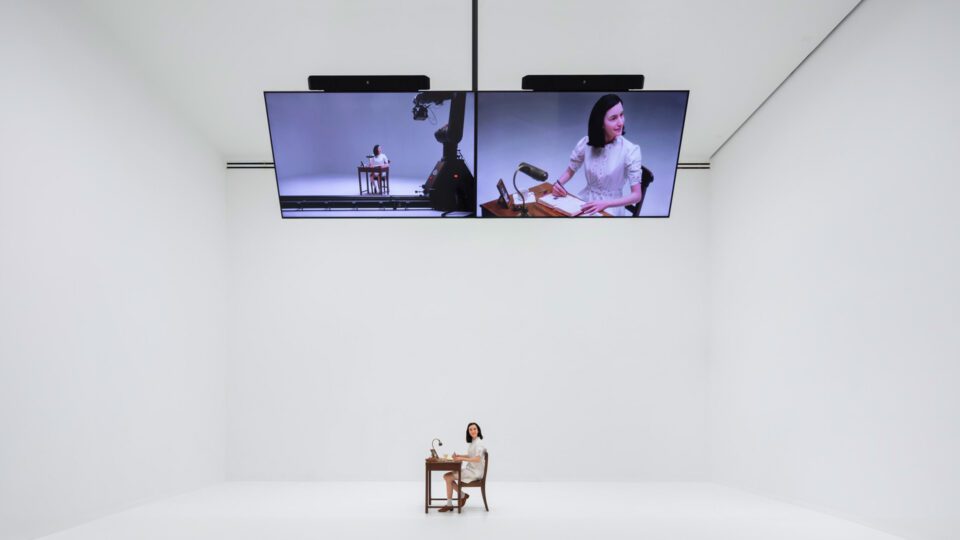
Central to the exhibition is the title A Whole New World, a phrase borrowed from the musical Aladdin in which Fujiwara once performed the lead role during his school years. In the original story the protagonist travels across fantastical landscapes on a magic carpet, collapsing time and space into a sequence of wonder-filled scenes. The exhibition echoes this structure by guiding visitors through a series of what the artist calls his own “worlds of wonder.” Each section functions like an attraction within a theme park, complete with carefully orchestrated scenography and narrative framing. Yet these attractions do not merely entertain. Instead, they confront visitors with questions about how spectacle shapes collective imagination and how personal identity becomes entangled within mass culture.
Elsewhere in the galleries, audiences encounter the colourful universe of Who the Bær, Fujiwara’s cartoon mascot introduced in 2020. The character embodies a deliberately unstable identity, existing without fixed race, gender sexuality or nationality. Perpetually searching for an image of its “true” self, Who the Bær becomes a playful yet incisive allegory for contemporary self-branding. Visitors navigate installations where the character appears across sculptures animations and merchandise-like displays, echoing the language of corporate mascots and theme-park icons. The result is both charming and quietly unsettling. Through this invented figure Fujiwara highlights the cultural obsession with authenticity within a digital environment that constantly flattens difference into shareable imagery.
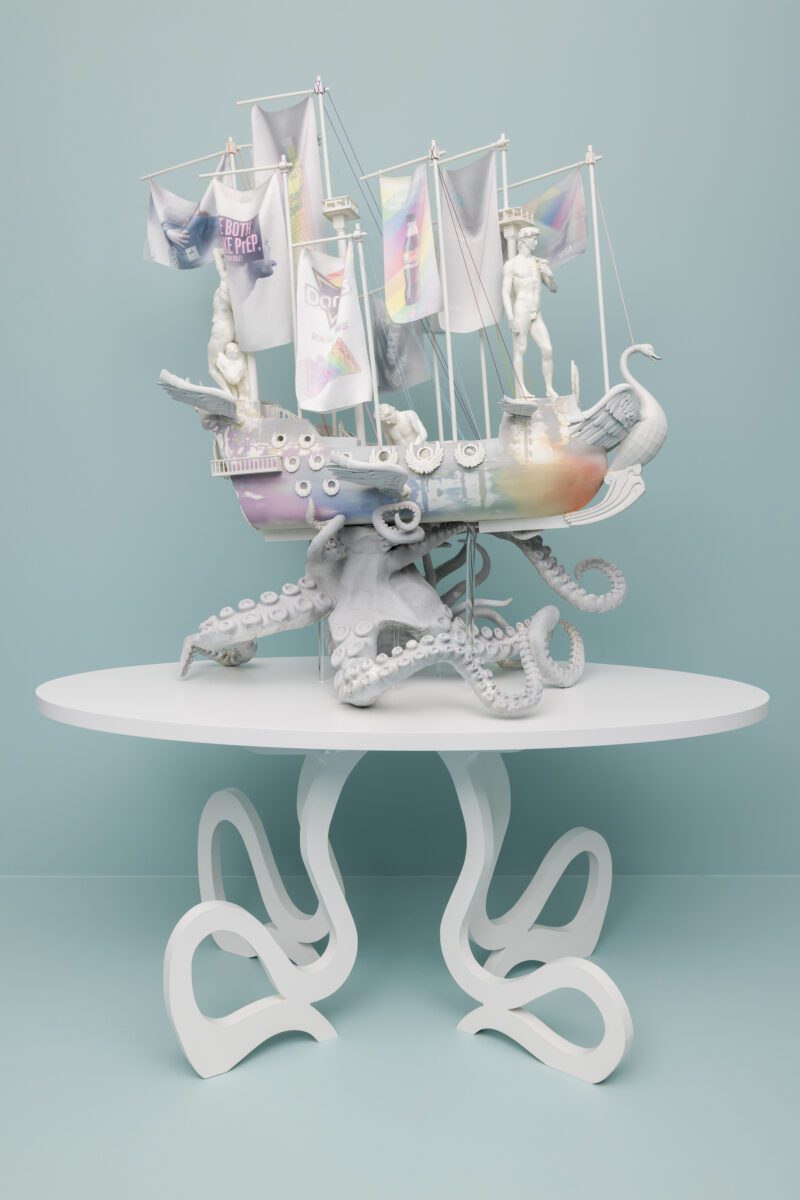
Crucially, the exhibition also revisits some of the artist’s most conceptually layered installations, many of which confront the uneasy relationship between history and spectacle. In Syphilis: A Conquest (2020) Fujiwara transforms his own experience of illness into a surreal postcolonial fantasy that interrogates narratives of disease exploration and empire. Meanwhile The Way (2016) and Fifty Shades Archive (2019) explore how sexuality and desire are mediated through mass entertainment pornography and popular literature. Hope House (2017–2020), focuses on the transformation of the Anne Frank House into a global site of remembrance and tourism. After purchasing a cardboard model of the building in the museum shop, Fujiwara reconstructed the journey through which Anne Frank’s story became an international symbol of hope. The project raises questions about how historical trauma is packaged for public consumption.
Alongside Fujiwara’s practice, several contemporary artists have similarly interrogated the intersection of spectacle technology and identity. Hito Steyerl examines the circulation of digital images and their entanglement with global systems of power. Jon Rafman explores internet culture and virtual environments that reshape human perception. Meanwhile Cao Fei constructs immersive narratives about virtual life consumer culture and technological fantasy. Fujiwara’s work resonates with these artists yet maintains a uniquely theatrical sensibility rooted in storytelling and personal narrative. Together their practices reveal how art has turned toward immersive forms to analyse the psychological effects of digital capitalism. They also demonstrate how artists employ the language of entertainment as a tool for critique.
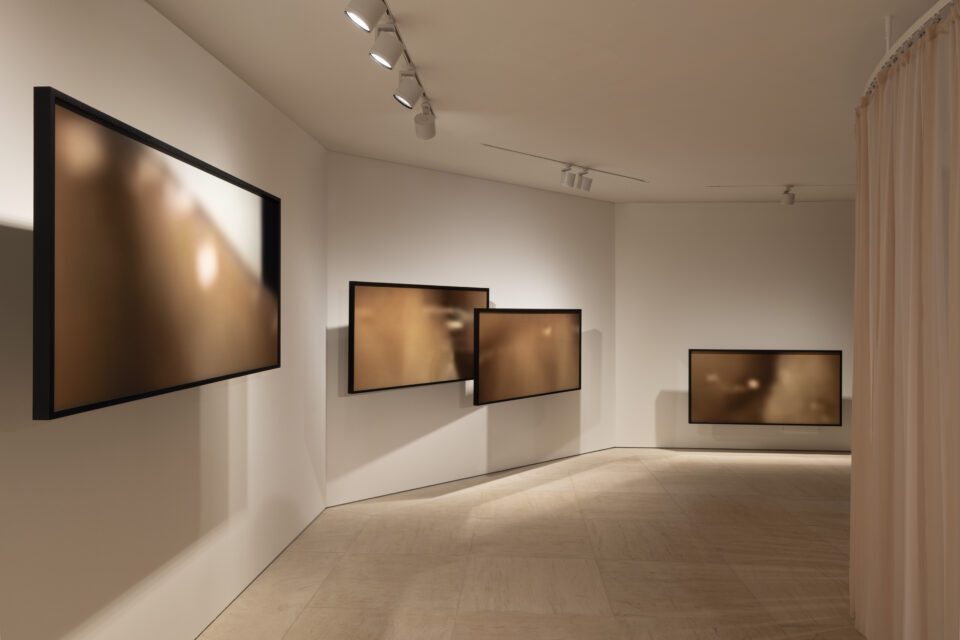
Ultimately, Fujiwara’s contribution lies in his ability to hold humour vulnerability and conceptual precision within the same artistic framework. His installations rarely deliver straightforward arguments but instead create spaces where contradictions become visible. Visitors may feel delight when encountering colourful mascots or elaborate sets yet that delight quickly shifts into reflection on the forces shaping contemporary identity. Advertising entertainment and social media appear not merely as subjects but as structural elements within the work. By adopting the visual strategies of these industries Fujiwara exposes how thoroughly they shape collective imagination. In this sense his practice expands the possibilities of installation art, positioning the exhibition space as a psychological landscape as much as a physical one.
A Whole New World reveals the evolution of a practice that has consistently interrogated the emotional atmosphere of its time. Moving through the exhibition feels less like walking through a traditional retrospective and more like travelling across a sequence of imaginative territories. Each environment invites enchantment while quietly questioning the systems that produce it. The show is both seductive and disconcerting, tracing the development of Fujiwara’s visual language across nearly twenty years. At the same time, it reaffirms the enduring capacity of art to challenge dominant narratives and provoke dialogue. In an era defined by the relentless production of images, Fujiwara’s work reminds us that the most powerful images are often those that reveal the strange feelings underlying everyday life.
Simon Fujiwara: A Whole New World is at Mudam, Luxembourg until 23 August: mudam.com
Words: Simon Cartwright
Image Credits:
1. Simon Fujiwara Joanne, 2016/2018 Exhibition view, Simon Fujiwara – Joanne, ARKEN Museum of Modern Art, Ishøj, 2019 Courtesy the artist and Esther Schipper, Berlin, Paris and Seoul Photo: David Stjernholm.
2. Exhibition view Simon Fujiwara: A Whole New World, 20.03 — 23.08.2026, Mudam Luxembourg – Musée d’Art Moderne Grand-Duc Jean. Courtesy of the artist; Gió Marconi, Milano; TARO NASU, Tokyo; Dvir Gallery Paris, Tel Aviv, Brussels and Esther Schipper Berlin/Paris/Seoul Photo: Andrea Rossetti © Mudam Luxembourg.
3. Simon Fujiwara, Likeness, 2018 Exhibition view, Simon Fujiwara, Hope House, Blaffer Art Museum at the University of Houston, Texas, 2020-21 Photo: © Sean Fleming.
4. Simon Fujiwara A Conquest, 2020–ongoing Exhibition view: Simon Fujiwara, It’s a Small World, Museum of Contemporary Art Kiasma Helsinki, 2024 Courtesy the artist, Kiasma Museum of Contemporary Art, Helsinki, Gió Marconi, Milano; TARO NASU, Tokyo, Dvir Gallery Paris, Tel Aviv, Brussels and Esther Schipper Berlin, Paris and Seoul Photo: © Andrea Rossetti.
5. Exhibition view Simon Fujiwara: A Whole New World, 20.03 — 23.08.2026, Mudam Luxembourg – Musée d’Art Moderne Grand-Duc Jean. Courtesy of the artist; Gió Marconi, Milano; TARO NASU, Tokyo; Dvir Gallery Paris, Tel Aviv, Brussels and Esther Schipper Berlin/Paris/Seoul Photo: Andrea Rossetti © Mudam Luxembourg.


