

Mongolia is seeing a huge surge in tourism right now. Around 850,000 people visited in 2025 – a 44% rise since 2019 – and the country is aiming to attract one million by 2026. One of southern Mongolia’s most popular destinations is the Gobi Desert, which is the sixth largest in the world, and spans parts of northern China. It is home not only to desolate sands and rocky plains, but also surreal traces of human activity: reconstructions of ancient religious sites which were once film sets; the remains of abandoned towns and oil extraction plants; and graves as old as the Han Dynasty. These sites are the subject of Chinese photographer Zhang Kechun’s (b. 1980) latest series, The Yellow Desert, on view at Huxley-Parlour, London.
Kechun works within the canon of topographics, in which scenes – primarily landscapes – are viewed from a distant, often elevated viewpoint. In the 1970s, artists Bernd and Hilla Becher, Nicholas Nixon, Lewis Baltz and Robert Adams popularised the idea of “New Topgraphics” by capturing man-made structures from a detached perspective. They drew attention to the way in which natural environments were being eroded by industrial developments. Today, these ideas are central to Kechun’s work. His previous series, The Yellow River, documented the effects of modernisation along the third longest river in Asia – a waterway which is often called “Mother River”, which is regarded as the “cradle of Chinese civilization.”
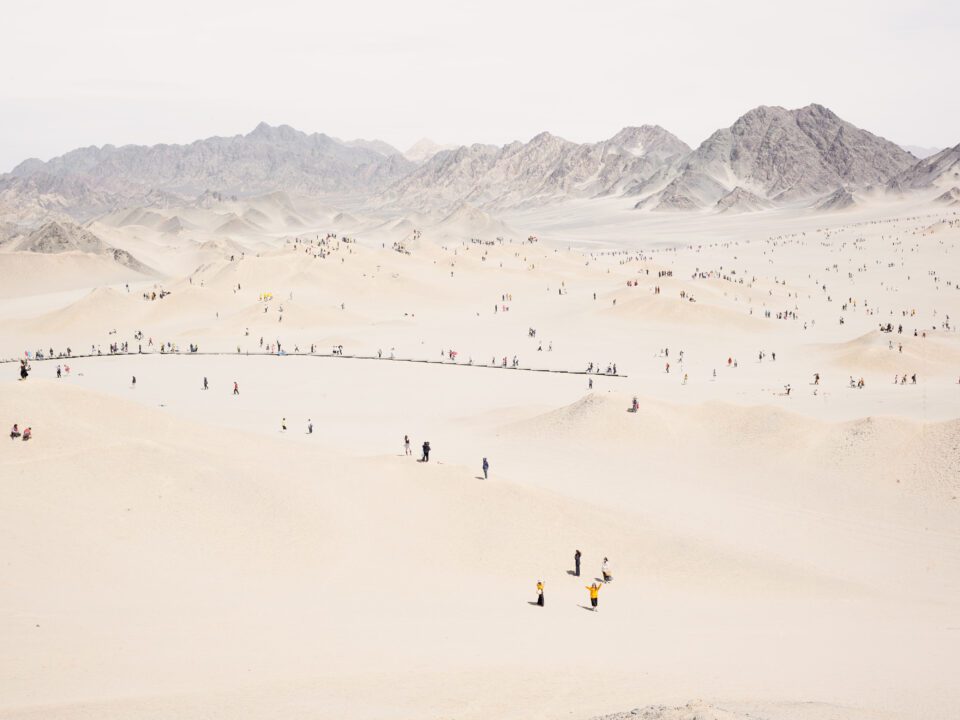
In The Yellow Desert, which Kechun began in August 2025, the artist combines a New Topographic approach – including a 5×4 format and stripped back colour palette – with motifs found in traditional Chinese landscape art. Long, sweeping lines created by mountains rising from the sand evoke the gentle, calligraphic washes of ink that thirteenth and fourteenth-century artists applied to silk. Elsewhere, the images show swathes of tiny tourists punctuating the dunes. These diminutive figures – who are captured climbing mountains, taking pictures and gazing at monumental structures – likewise recall those depicted by early painters. The colour yellow, which punctuates the images, is laden with cultural significance in China; in ancient times, it represented integrity and nobility. Later, it came to be known as “the colour of the earth”, in reference to geographic features such as the Loess Plateau and the Yellow River. Perhaps most poignantly, Kechun’s images centre the human footprint in the Gobi Desert – reminding viewers of the ever-encroaching ubiquity of our presence in even the vastest, most remote of spaces.
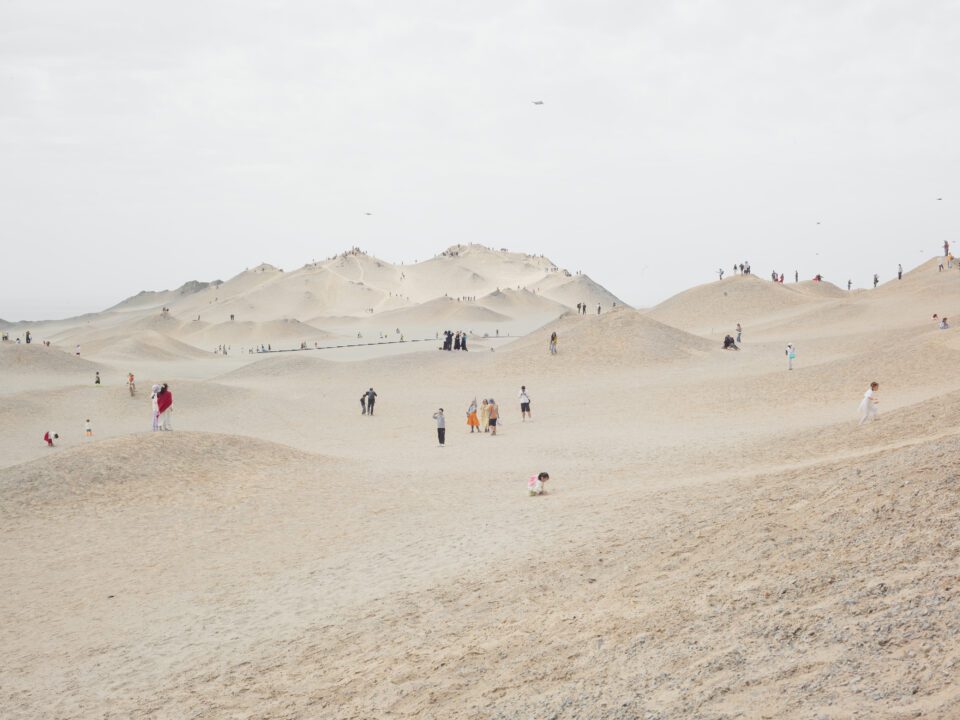
The Yellow Desert is at Huxley-Parlour Gallery, London, from 30 January – 28 February.
Words: Eleanor Sutherland
Image Credits:
1. People Taking Photos at Heidushan, 2025, Zhang Kechun, image courtesy Huxley-Parlour.
2. People Singing in the Desert, 2025, Zhang Kechun, image courtesy Huxley-Parlour.
3. People Travelling in Heidushan, 2025, Zhang Kechun, image courtesy Huxley-Parlour.
4. People Climbing Mountains, 2025, Zhang Kechun, image courtesy Huxley-Parlour.


