

The Argentine artist Adrián Villar Rojas unveiled a new sculpture in Switzerland this month, co-commissioned by the art programme of Swiss watch manufacturer Audemars Piguet and the Aspen Art Museum. Now on view at Audemars Piguet’s headquarters in Le Brassus to mark the watchmaker’s 150th anniversary, the work will travel to Aspen next spring for Villar Rojas’s solo exhibition at the art museum.
The untitled piece is part of Villar Rojas’s series The Language of the Enemy, in which he examines the fraught relationships between species amid global crisis. The sculpture features a bronze Triceratops skull displayed on a fluorescent-lit white plinth overlooking the Jura Mountains in the Vallée de Joux, the historic centre of Swiss horology.
“Language is technology that we use to address and name things, a tool we use to communicate,” Villar Rojas said at the sculpture’s unveiling. “But what happens when language isn’t enough to communicate with someone else? When you cannot address this ‘other’? I think that’s when conflict appears. When you can’t really communicate, you start to speculate on the intelligence of that person. So language is the enemy.”
The shape of Venus of Lespugue can be see on the right-side horn. Courtesy Audemars Piguet Contemporary
Emerging from one of the fossil’s horns is a rendering of the Venus of Lespugue, a prehistoric female figurine discovered in a French cave in 1922. Scientists date the statuette to as early as 26,000 years ago, making it one of the oldest forms of figurative art known. Villar Rojas imagines the element as a speculative collaboration between Neanderthals and early Homo sapiens—a symbol of “the first thing someone wanted to make to say something to someone else that was impossible to say in any other way”, he says, prompting questions about the origins of artistic expression.
The sculpture was produced using digital modelling, which allowed Villar Rojas and his team to design every aperture found in a natural fossil before the bronze was cast at a local Swiss foundry.
This is the first time Audemars Piguet Contemporary, the company’s art programme, has premiered a commission at its headquarters. Several offices in the spiral-shaped Musée Atelier Audemars Piguet overlook the installation. The brand’s long history with timekeeping aligns with Villar Rojas’s ongoing interest in “deep time”, a concept describing the vast, non-human scale of geological history.
In much of Villar Rojas’s earlier work, “deep time was always looking at the moment after extinction—imagining these worlds of what happens when it’s the end of species, the end of human life”, says Audrey Teichmann, co-art curator at Audemars Piguet Contemporary. “Now we’re seeing a shift toward pre-history, toward the moment before arrival, and the speculation of an encounter.”
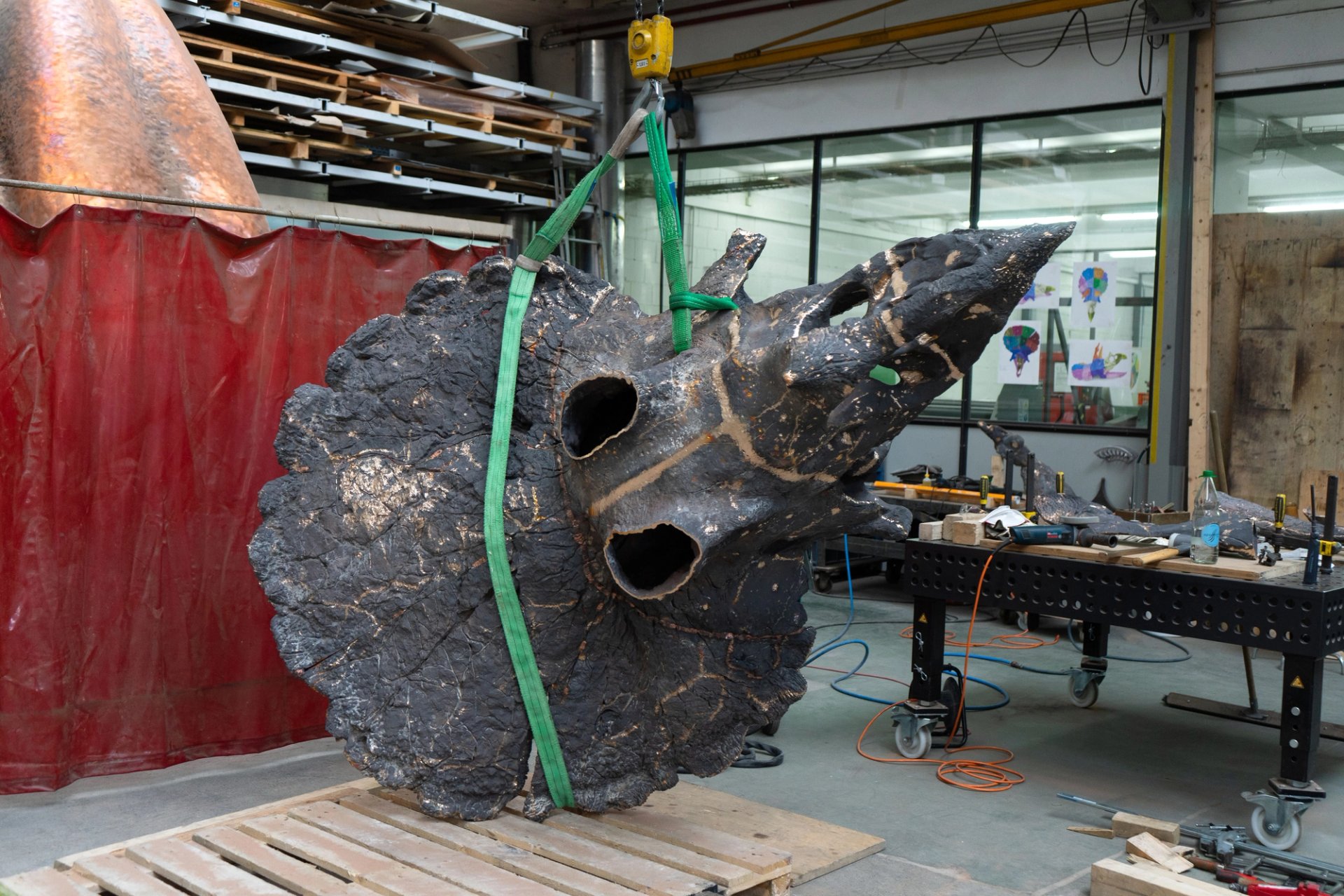
The work under construction at a local foundry. Courtesy Audemars Piguet Contemporary
Teichmann declined to disclose the project’s budget. According to Morgan Stanley, Audemars Piguet generated an estimated SFr2.4bn (almost $3bn) in 2024. Next summer, the sculpture will be transported to the Aspen Art Museum, where Villar Rojas will stage an exhibition across two floors of the museum.
“This work will be part of our exhibition in Aspen, but it’s also connected to a whole series of shows Adrián has recently presented—the Aichi Triennale, his exhibition in Seoul,” says Aspen Art Museum curator-at-large Claude Adjil. “For Adrián, exhibitions don’t begin and end; they form bodies of work that bleed into one another.”
Visitors to Villar Rojas’s takeover of a decommissioned primary school in Seto City, Japan, during the Aichi Triennale saw an early glimpse of the new sculpture, which appeared in the wallpaper covering the building’s interior. Although the piece imagines a distant, prehistoric scenario, Villar Rojas sees parallels with contemporary anxieties.
“Look at what’s happening in politics—I think we may still be using technology and language in our political and socioeconomic relationships in ways that haven’t kept pace with the speed of change,” he says. “I have frustration with our species and our lack of imagination. We are living through an extremely traumatic moment.”
- Adrián Villar Rojas: Untitled (The Language of the Enemy), until 31 March 2026, Audemars Piguet, Le Brassus, Switzerland
- Adrián Villar Rojas, 11 June-4 October 2026, Aspen Art Museum


