

Côte d’Ivoire, located on the southern coast of West Africa, is the first country to be recognised by Latitudes, a new programme developed by the Fondation d’entreprise Hermès, in partnership with the International Center of Photography (ICP) in New York and the Fondation Henri Cartier-Bresson, Paris. The scheme is dedicated to shining a light on artists from regions underrepresented on the international stage, assisting in making and disseminating new works through exhibition and publication. Côte d’Ivoire has been selected for its “incredibly dynamic cross-generational photographic scene,” explains David Campany, Creative Director at ICP.
The two photographers exhibiting as part of the inaugural edition are Nuits Balnéaires and François-Xavier Gbré. In 2023, Gbré (b. 1978) set out to follow and document the railway that runs from north to south through Côte d’Ivoire. The line was built during the French colonial era – the country gained independence in 1960 – to extract natural resources and transport them to the port of Abidjan, then on to France.
Multidisciplinary artist Balnéaires, meanwhile, presents EBORO – meaning boundary, or border. The staged, often cinematic series is set against the backdrop of the Gulf of Guinea, where Côte d’Ivoire has its south coast, exploring the relationship between his ancestors’ experiences in exile and his own perspective on travel and migration. The artist’s late uncle, the journalist, poet and playwright Noël X Ebony (1953-1986), is central to the installation – as are Ebony’s ideas surrounding the culture and politics of African independence. We caught up with Balnéaires to discuss the significance of this project, as well as the artist’s wider practice.
A: Where does your interest in photography come from?
NB: Artistic creation has always been an intrinsic part of me. I was born into a family of authors, journalists and writers, so literature and writing were present from my childhood. I grew up immersed in music from across the globe – thanks to my father’s passion – and I learned to play the piano during my adolescence. Very early on, I became drawn to animation, architecture and video. I discovered photography at the end of high school, starting out with a small Sony compact camera my mother brought back from her pilgrimage to Mecca. I photographed friends, family and my immediate environment, eventually creating a Facebook page to share the work. I then started receiving commissions from fashion magazines. The camera soon became a means of documenting and archiving history and cultural transformation across our region.
A: What’s the story behind EBORO, now on view at ICP?
NB: It’s about exploring the concept of destiny through a genealogical lens, by engaging in dialogue with a particular figure: my uncle Noël X Ebony. He was a journalist, poet and playwright who died in unresolved circumstances in Senegal. I sought to uncover the similarities between our trajectories, across the cultural, geographical, temporal and socio-political landscapes we have navigated: I experienced the necessity of living abroad due to the war in Côte d’Ivoire, whilst both my uncle and father endured exile for political reasons. It was a vulnerable process that compelled me to confront painful parts of my personal history. Yet, it is also an act of storytelling and repair that belongs to our shared narrative.
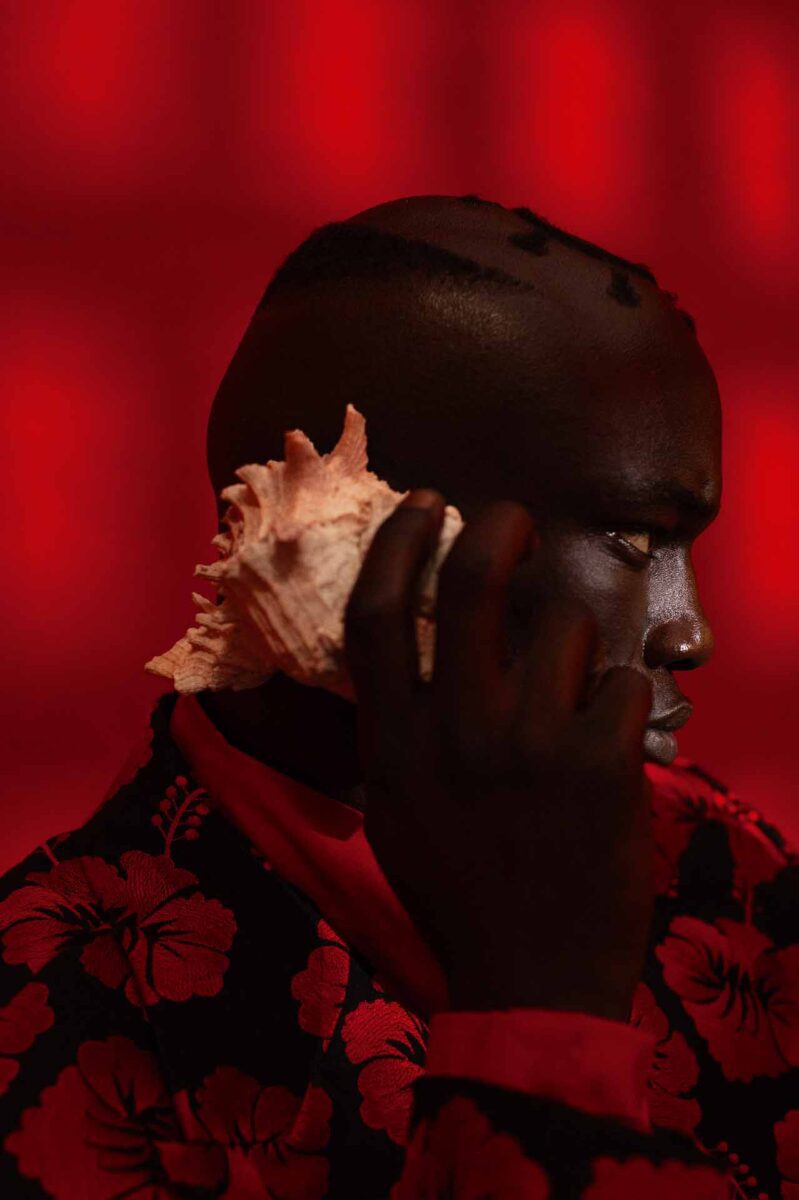
A: You took inspiration from your uncle’s writing for this project. What did you learn? How did it shape the series?
NB: EBORO is partly inspired by Déjà Vu, a seminal 1980s collection of poems by Noël X Ebony. In this work, as in much of his oeuvre, one finds a relationship to places with borders almost erased, navigating geographies and eras as if without boundaries. From one poem to another, the reader moves from Pennsylvania to Apapa in Lagos, from Bondoukou to Stockholm. Being born in this part of the world can evoke a sense of confinement, given the profound difficulties of mobility. It is as if people from this region are denied the freedom and ease of traversing the globe. Referring to Noël X Ebony and his global experience was liberating, allowing me to embrace ideas of a free and shared human experience.
A: What perspectives on Côte d’Ivoire do you hope to introduce or challenge by presenting EBORO in New York?
NB: EBORO offers an artistic perspective on a chapter of our collective history, marked by shadows and wounds. I am part of a generation that is demanding accountability in the face of historical injustices, striving for a recalibration of human relationships. This work draws its inspiration from a period when freedom of expression and irreverent writing had no place in the face of existing authority. As such, it becomes a space for reflection on our shared past, echoing a vision of freedom and a celebration of multiculturalism in a new era.
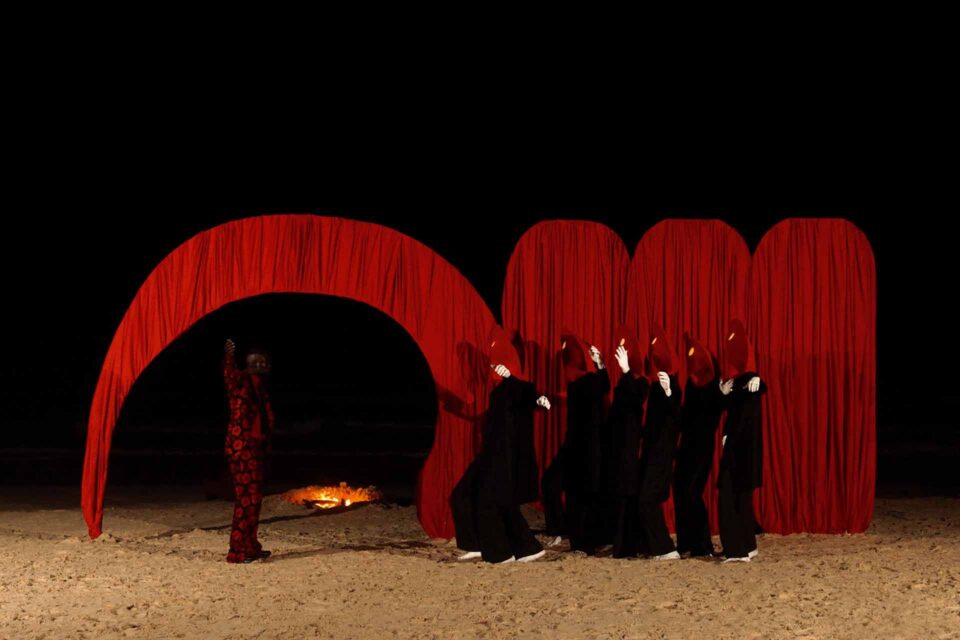
A: Can you talk us through the visual symbols used?
NB: The work draws from my Akan Agni-bona heritage and from Adinkras – which are visual symbols that represent concepts, proverbs and aphorisms. The shells featured in EBORO were collected at the Phare des Mamelle lighthouse, the site of the tragedy that claimed the life of Noël X Ebony. The series also references the iconography of tarot cards, where the arrangement of pictographic elements evokes destiny and possible paths. It layers literary and cinematic references with West African Akan symbolism, which condenses philosophy, proverbs and history into visual form. Amongst these, Gye Nyame, a key Adinkra symbol, recurs to underscore a quest for transcendence, representing ultimate divinity and the essence of life. Other figures enrich the narrative: the python mediates tension between religious readings, the chameleon embodies adaptability, and the baobab represents permanence, resilience and ancestral wisdom. Shades of blue convey calm, particularly in seascapes, whilst black and red mark transition and tension, echoing Akan funeral traditions and the boundary between the visible and invisible.
A: How does EBORO connect with, or diverge from, your previous bodies of work in terms of ideas and approach?
NB: There are recurring themes, such as transgenerational transmission, the memory of water, the correlations between life and death, exile and cultural mutations. What is new in EBORO is the framework provided by the Latitudes programme. This project brings together a wide range of cultural influences and draws from multiple artistic genres, giving it a strong, multidimensional character. Another distinctive aspect is the scale and presentation: it unfolds through a photo series, a book and a film, with the journey spanning three continents. Finally, EBORO carries an almost biographical dimension that sets it apart from my other work, whilst also bringing back the figure of my uncle in a significant way.
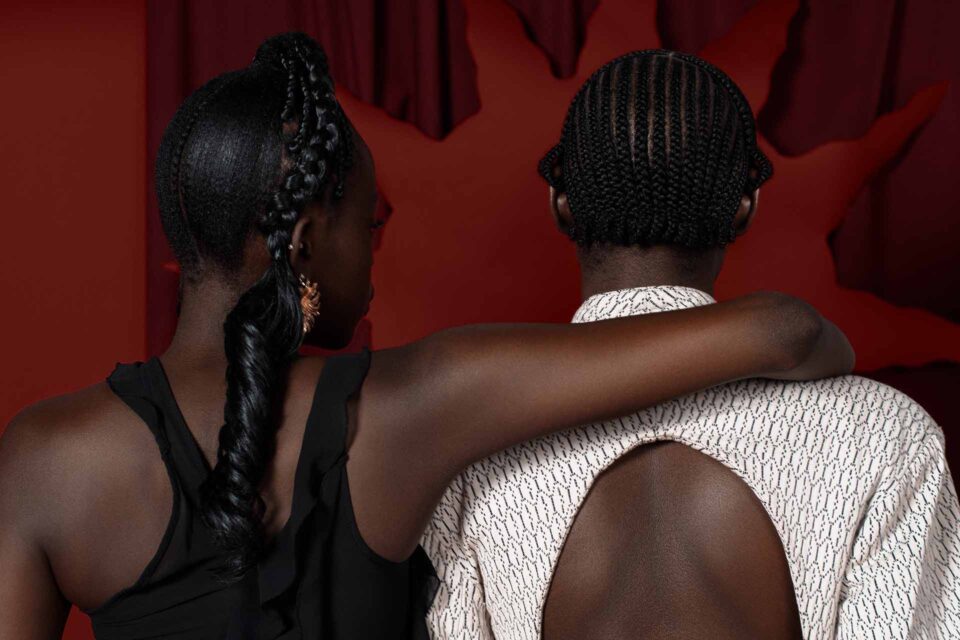
A: Let’s talk about some of these other projects. Which has been your most transformative endeavour to date?
NB: I created The Power of Alliances (2021) as part of the World Press Photo Foundation fellowship. It was the first series I made after settling in Grand-Bassam, and it marked the beginning of my use of large-scale sets, props and collaborations with local artisans. In a way, it started my investigations into the transmission and preservation of transgenerational memory. It is one of my most significant projects.
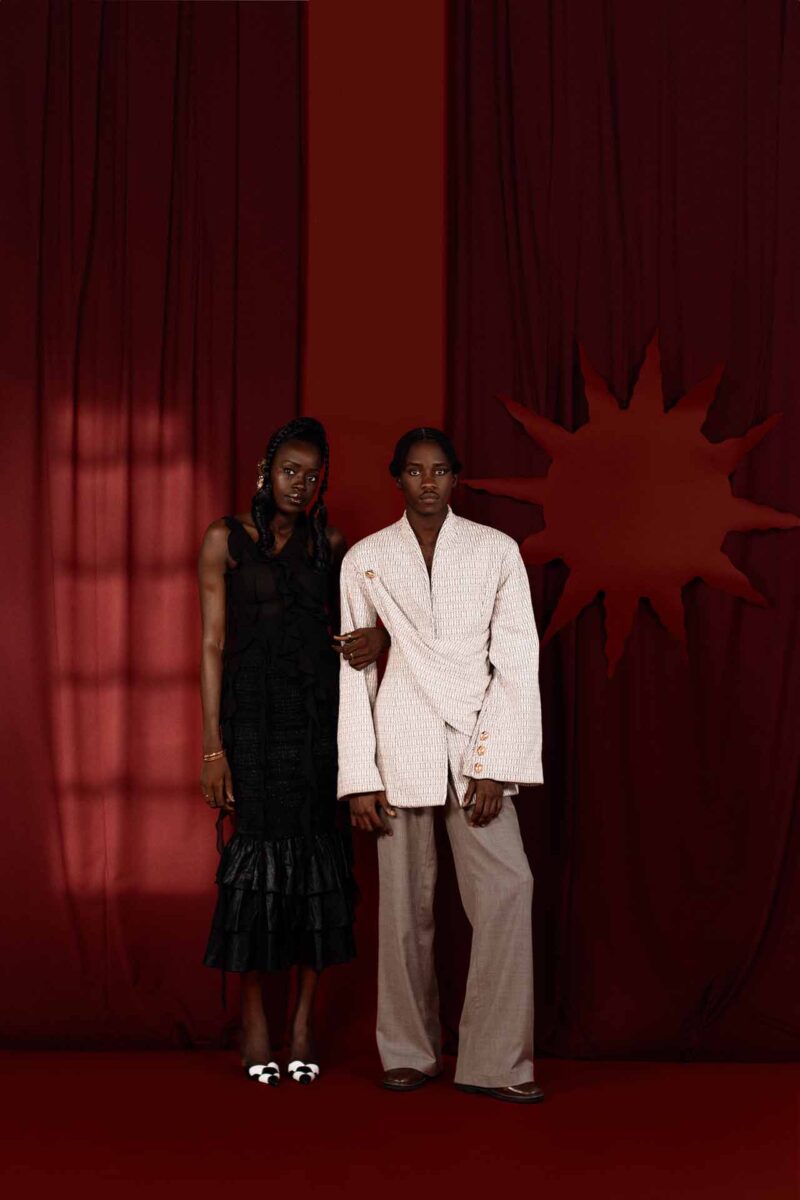
A: Can you tell us some more about Infinite Stories, in which the colour red also seems to be of key importance?
NB: It was made in collaboration with Marie-Céline Agossa, a friend and visionary, collaborator and founder of Yua Hair – a pioneering creative platform and studio that centres textured hair in conversations about self-expression, culture, celebration and African development at-large. For this first campaign, which launched the platform, we drew inspiration from African studio photography and icons such as Malick Sidibé, Paul Kodjo and Seydou Keïta, whilst playfully reinterpreting their visual codes. Red dominates one of the scenes, amplifying the romanticism we wanted to convey. The images elevate style and textured hair as a bold statement of African identity: fluid, evolving, yet deeply rooted in history.
A: Who, or what, are your biggest creative influences?
NB: Above all, it is my values that inform my inspirations, along with my father and mother, my grandmother who raised me, and my uncle Noël X Ebony for his work and ethical approach. Family occupies a central place in my journey, it is my compass. The ambition to dissolve barriers between our lives through the reclamation of our shared history profoundly informs me. Aside from this – the ocean, nature, light, textures and forms are enduring sources of inspiration.
A: You’ve previously described yourself as a multidisciplinary artist. How do different media inform your process?
NB: Sound is central to the way I perceive and convey narrative. Music, through its ability to evoke atmospheres with intensity, nourishes my imagination. Poetry shaped me from childhood; I often expressed myself through writing. I have also drawn from cinema and architecture, and later from sculpture and painting. These mediums interweave naturally in my storytelling. Above all, the tale I wish to tell guides my choice of medium; each one serves the story with integrity.
A: In Latitudes, your work appears with that of François- Xavier Gbré. How do the projects speak to each other? And what do you hope audiences will learn from the show? NB: Beyond the sensibilities we share, particularly in terms of our attention to light, texture and composition, there is also a clear common interest in our relationship to history and the human condition. Gbré and I are both reflecting upon how our identities have been shaped by the passage of time. I believe that, beyond fully inhabiting our present, we need to understand our ancestry and its influence on our contemporary experience. The EBORO project emerged from an inward quest, aiming to illuminate the strength and significance of personal histories. It addresses the necessity for each of us to understand why we are who we are, and how previous trajectories can influence, or even predetermine, our own paths. Ultimately, EBORO seeks to heal transgenerational wounds.
Latitudes, ICP, New York Until 4 May
Words: Eleanor Sutherland
Image Credits:
1. I, myself am the sun. Creative direction and styling: Marie-Céline Agossa. Photography: Nuits Balnéaires. Hair: Yua Hair x Institut Adiss Abidjan. Set design: Nahoua Sorho. Model : Efsane. Production management: Félix-Édouard Kouassi. Location: La Manzane – Yoanh Azema. Special thanks to Olooh Concept.
2. Passages 12, Eboro, (2026). © Nuits Balnéaires, ADAGP, Paris, 2026.
3. Le Messager 8, Eboro, (2026). © Nuits Balnéaires, ADAGP, Paris, 2026.
4. Chérie, regardes mon dos. Creative direction: Marie-Céline Agossa. Photography: Nuits Balnéaires. Set design: Nahoua Sorho. Model: Fat Seck, Jones. Hair: Yua Hair x Institut Adiss Abidjan. Production management: Félix-Édouard Kouassi. Location: La Manzane – Yoanh Azema. Special thanks to Lafalaise Dion.
5. Le grand soir. Creative direction & styling: Marie-Céline Agossa. Photography: Nuits Balnéaires. Set design: Nahoua Sorho. Model: Lauryn Seba, Fat Seck, Fatima Kouamé. Hair: Yua Hair x Institut Adiss Abidjan. Production management: Félix-Édouard Kouassi. Location: La Manzane – Yoanh Azema. Special thanks to Hybride Studio & Lafalaise Dion.
The post A Legacy Visualised appeared first on Aesthetica Magazine.


