

The Belgian painter Luc Tuymans draws on found images to fuel his art, turning our overstuffed world of random photos, countless screens and myriad video fragments into a private archive of raw material. Now the 65-year-old Antwerp resident is using a new installation to comment on a lost image—his own 1990 painting, The Orphan, which has gone missing. And he is doing it under the grandiose auspices of Paris’s Louvre Museum, which has asked Tuymans to create a year-long temporary installation in the space of his choosing.
Opening to the public on May 22, The Orphan, created in an octagonal gallery joining up the Sully and Richelieu wings, is now also the name of Tuymans’s new Louvre series, comprised of four, 4.5m-high murals fashioned out of theatre paint. In May 2025 those murals will be painted over and disappear entirely behind reinstalled works from the Louvre’s permanent collection.
The 1990 work was a 32cm x 34cm oil painting, based on a photo of a German doll head. The new Louvre installation, which recreates that work on a much larger scale, also incorporates three works related to Tuymans’s 2022 show at David Zwirner gallery in Paris, in which he grabbed fragmentary images from a YouTube video that shows a New Zealand painter cleaning his supplies.
Known for helping to bring figuration back to painting in the early decades of his career, Tuymans manages to draw out an illegible, near-abstract quality to a few of these new works, which situate his eerie pastels in black backgrounds.
A hallmark of the Louvre invite was the artist’s ability to select this particular gallery, which serves as a transitional space between the museum’s French and Flemish schools, and is therefore symbolic of Belgium’s own fusion of languages and traditions. Once used to display a landscape series by 17th-century French classicist Nicolas Poussin, it was recently hung with works by Poussin’s contemporary, the French Caravagesque painter Valentin de Boulogne.
I didn’t want to make anything about the Louvre, because that would be kind of stupid
Luc Tuymans
Tuymans chose not to address the Old Masters in his new installation. “I didn’t want to make anything about the Louvre,” he said last week at the museum, sitting behind a scrim that blocked his work from passersby. “Because that would be kind of stupid.”
Then again, he considered, maybe there is a connection after all.
Tuymans’s original painting—and now its much larger wall version—“reminds you of a decapitated head”, he said. And the conversion of the Louvre from a royal palace to a public museum, like the first widespread use of the guillotine, dates to the French Revolution. “So that’s the link with the Louvre.”
Tuymans is known for addressing historical atrocities in his work, from the Holocaust to Belgium’s colonial legacy in Africa, and The Orphan has a few violent implications of its own.
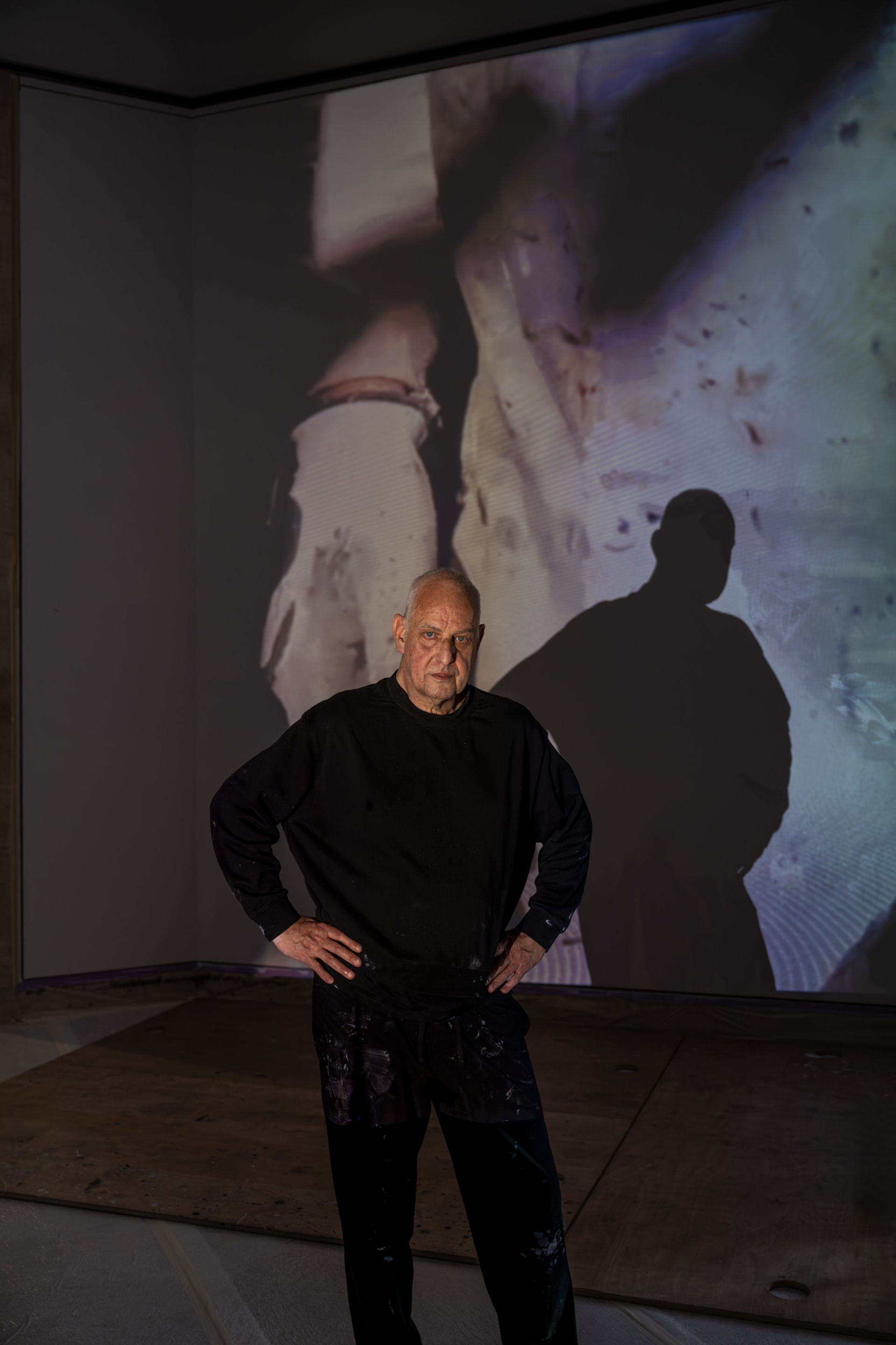
Luc Tuymans in front of The Orphan at the Louvre © Museé du Louvre
In the murals grafted from YouTube, there is an immense and sinister hand adjacent to a red-spotted smock. (Tuymans relied on a scissor lift to get to the works’ upper reaches.) Those spots might suggest blood, said the artist—or a crime scene, or even an operation.
Some artists might view the eradication of their work as a violent act, but for Tuymans it is all but felicitous. He has often created temporary paintings, which are meant to linger for fixed periods before vanishing into the photographic record, or just back into the mind of the artist himself. “I think it’s great,” he said. “It goes into memory.”


