

Correggio’s Madonna of St Sebastian shares a distinction with Raphael’s Sistine Madonna: it is one of the standout High Renaissance paintings at Dresden’s Gemäldegalerie Alte Meister. But unlike the Raphael, the altarpiece, which Correggio painted on panel around 1524 for a confraternity in Modena, has the dubious honour of being among the museum’s most fragile artworks, undergoing centuries of well-meaning if counterproductive restorations, retouching, overpainting and rebuilding. Now, to prevent Correggio’s original paint from further degrading and breaks in the surface itself from worsening, restorers in Dresden have removed layers of old varnish and vast areas of other artists’ overpaint, allowing the acclaimed work to be seen anew.
Too fragile to relocate even a few blocks away to the main conservation facilities of the Gemäldegalerie’s parent organisation, the Staatliche Kunstsammlung Dresden (SKD), the work was reinstalled a few hundred meters from its home near the Sistine Madonna and treated in a specially constructed studio that allowed passersby to glimpse the painstaking process. The treatment lasted nearly four years and wound down in late 2025. The rejuvenated work will get star treatment in the upcoming exhibition Correggio: Movingly Human (19 September-10 January 2027), the first full career survey about the artist (1489-1534) held outside Italy and including rare loans from the Musée du Louvre and the Museo del Prado, among others.
A transformative treatment
Correggio’s Madonna of Saint Sebastian (around 1524) prior to its recent restoration (left) and afterward (right) © Gemäldegalerie Alte Meister, Staatliche Kunstsammlungen Dresden. Photos: Laura Princzess, Jacob Franke
A spatially refined grouping of billowing angels and dynamic saints, presided over by a downward-glancing Virgin and a delighted and delectable Christ Child, the painting required interventions within decades of its completion. Executed on a series of vertically arranged poplar panels that were curiously augmented by strips of canvas, the original surface quickly proved unstable. Over time, restorers did everything from thinning out the panels themselves to painting over the many emerging cracks.
In preserving the work, while finally researching the scope and causes of the longstanding damage, the Dresden conservation team has also managed to recover the artist’s original palette. Before, the Virgin’s cloak appeared almost green, with a dim, brown lining; now it is a rich Marian blue with a deep-green lining. The once grey-on-grey drapery belonging to St Sebastian, at lower left, and an elderly St Geminianus, Modena’s patron saint, are now marmoreal shades of white. The shirttails of a sleeping St Roch, at lower-right, were scarcely visible before, nearly undifferentiated from his grey-brown limbs; now this bit of glistening-white drapery notably contrasts with the chiaroscuro of his flesh-coloured legs.
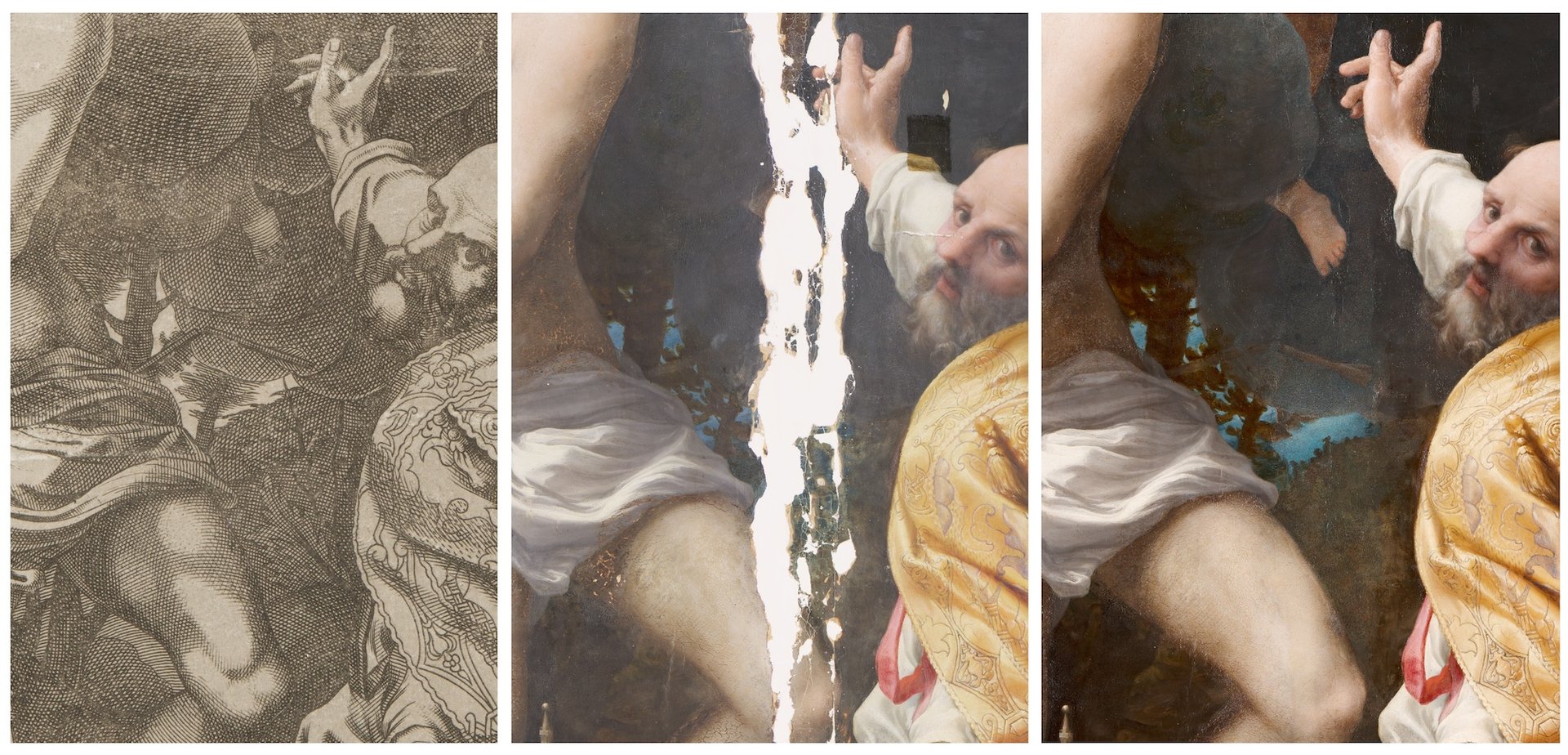
This photomontage shows the arrow in Sebastian’s hip, which could be reconstructed with the help of the copper engraving. The image at right shows the section after the treatment © Gemäldegalerie Alte Meister, SKD. Photo und montage: Laura Princzes, Steffi Bodechtel
Looking at the work before “was like seeing it through a discoloured veil”, says the British art historian David Ekserdjian, whose 1997 monograph about Correggio is still a standard reference work. Now, he says, “it’s much more visually exciting and dramatic”.
In order to imagine their way past the distorting varnish layers and obscuring overpaint, the restorers relied on a print by the Modenese engraver Cristofano Bertelli that dates to the second half of the 16th century. The team was able to access it in the SKD’s Kupferstich-Kabinett collection and then kept a digital copy close at hand during the treatment. Consequently, says Steffi Bodechtel, lead restorer of the team that worked on the altarpiece, it was possible to recover much of what past restorers had managed to conceal. St Sebastian is not only being pierced by a thin arrow—which might have been mistaken for a tree branch before—but the symbolic injury leaves drops of now-visible blood. And what had seemed like part of the distant landscape behind St Roch is now shown to be his dislodged pilgrim’s hat, bearing an emblematic seashell. “While Bertelli certainly has his own style,” Bodechtel says of the print, “it was extremely important for us to know what he could still see” before whole areas of the altarpiece were marked by losses and retouching.
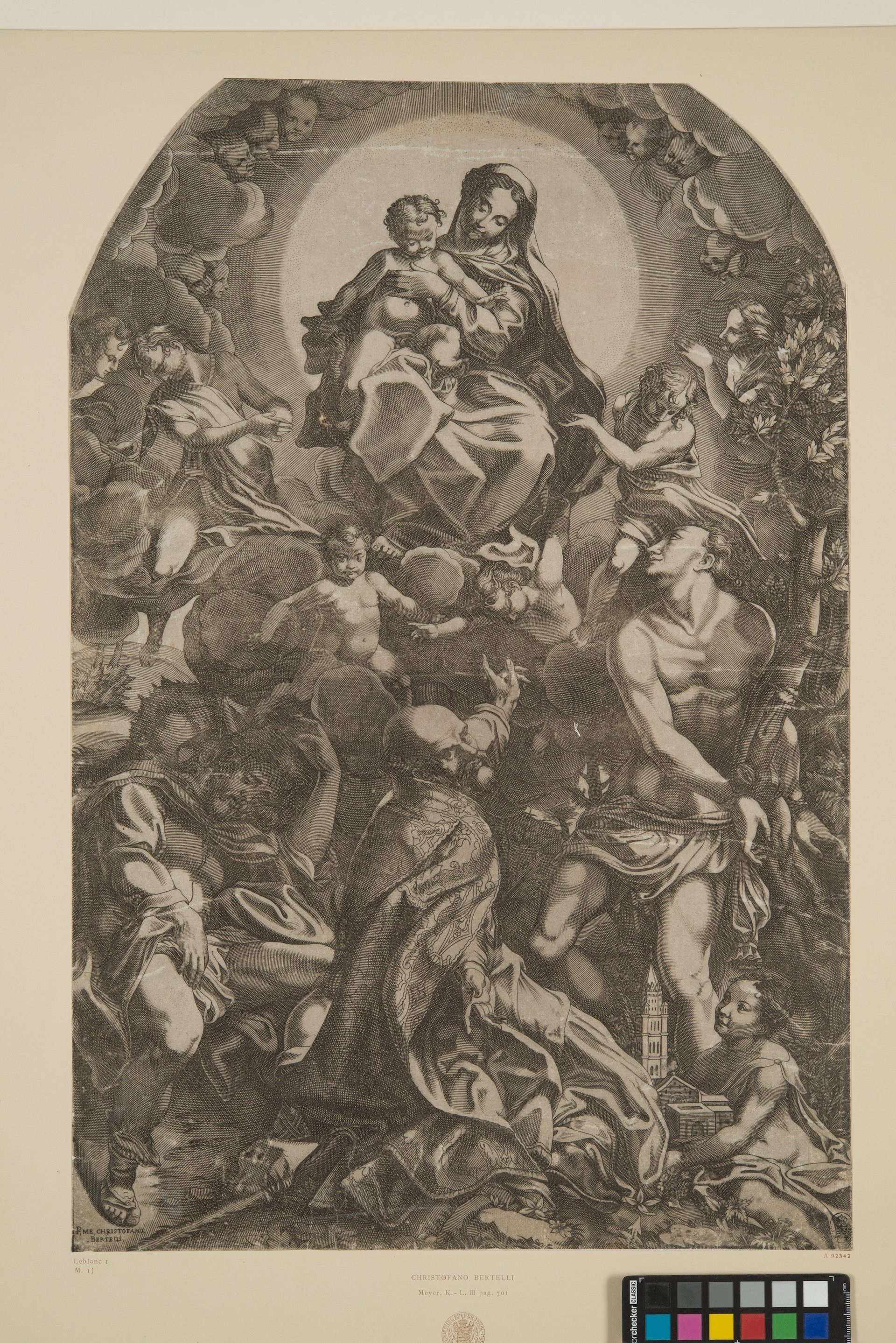
Cristofano Bertelli, Madonna of St Sebastian, after Correggio, second half of the 16th century © Kupferstich-Kabinett, SKD
Correggio, born Antonio Allegri in the small Emilian town that became his artist’s name, made his career in Parma and had his breakthrough with a number of early fresco cycles that later gave way to spatially mature paintings, such as Dresden’s nighttime nativity scene, known as La Notte (around 1522-30). The Madonna of St Sebastian, with its restored sense of depth, now seems connected to these later works, says Andreas Plackinger, the Gemäldegalerie’s curator of Italian painting, who is also curating the new Correggio show.
Correggio: Movingly Human will bring together 40 works by the artist, along with 90 other works and objects that consider the artist’s initial influences as well as his subsequent followers. It will seek to conjure up the visual culture of his time with examples of paint pigments and period textiles.
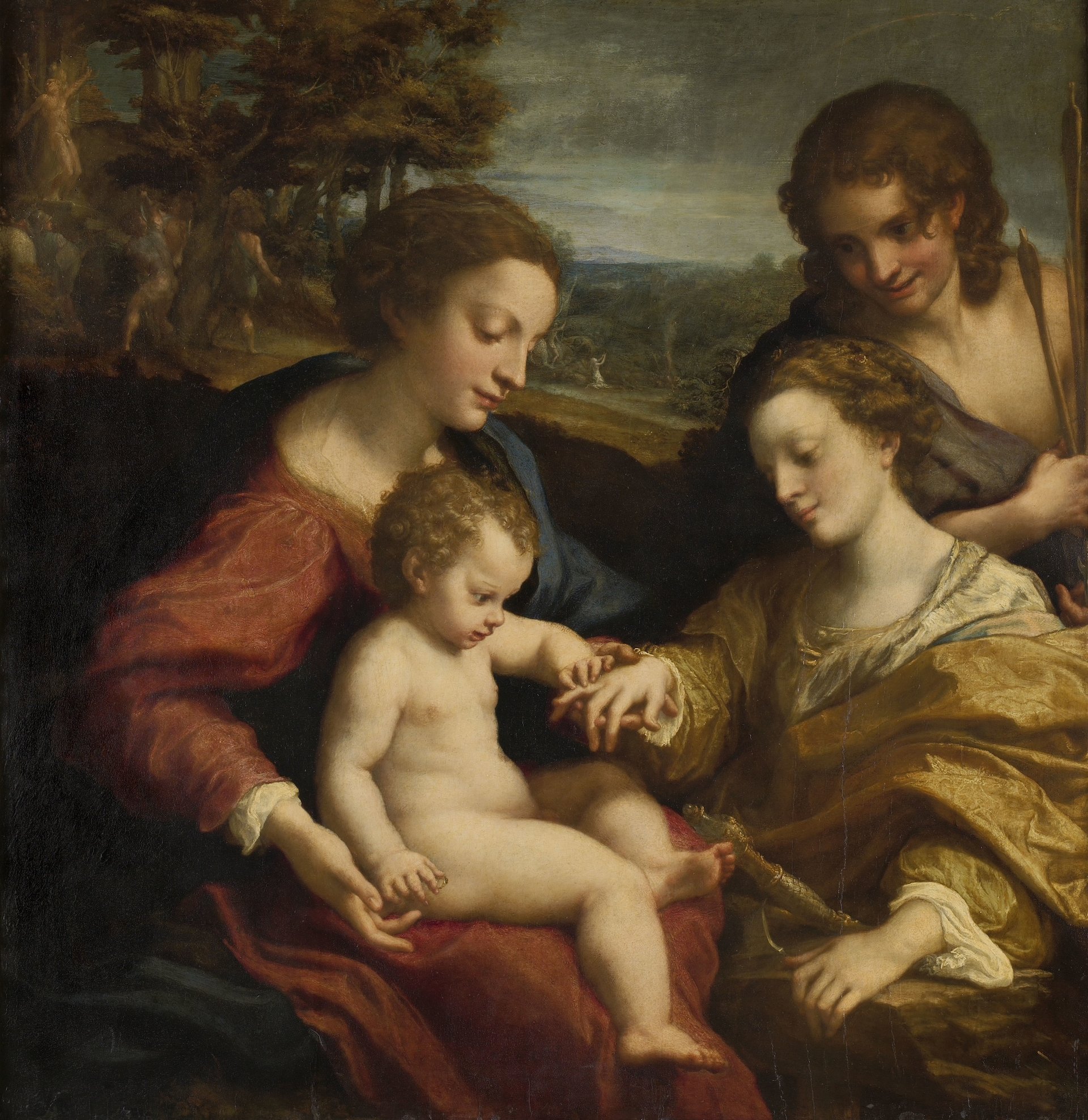
Correggio, Mystic Marriage of Saint Catherine, around 1525/27 © GrandPalaisRmn (Musée du Louvre) / René-Gabriel Ojeda
The centrepiece of the show, says Plackinger, is an impressive display of roughly contemporary Correggio paintings that he calls “a triptych”. The Madonna of St Sebastian will be joined on one side by the Louvre’s The Mystical Marriage of St Catherine, featuring a Virgin with the same features as the Dresden altarpiece—and on loan, stresses the curator, for the first time ever. On the other side: the Prado’s Noli me tangere, with the resurrected Christ appearing to a Mary Magdalene in profile, who has the same features as the St Sebastian figure in the Dresden altarpiece.
The new Dresden show, Plackinger says, also addresses Correggio’s complicated afterlife. For over two centuries he was considered on a par with Raphael and far ahead of Leonardo da Vinci and Michelangelo, who ended up coming out way ahead in the High Renaissance sweepstakes following the Romantic revolution in the arts. Raphael and Correggio “were the big guys”, says Ekserdjian, recalling their long tenure on top, “then it slips away”. The revived Madonna of St Sebastian, and the show that it has inspired, may remind 21st-century museumgoers what all the fuss was about.
- Correggio: Movingly Human, 19 September-10 January 2027, Gemäldegalerie Alte Meister, Dresden


