Sites in some of the world’s most conflict-affected countries, including Iran, Lebanon and Palestine, are among 25 new properties inscribed onto Unesco’s World Heritage List this month—a decision that, for Lebanon and Palestine, came with simultaneous placement on the World Heritage in Danger List and angered Israel. The additions were announced at the 48th session of the World Heritage Committee in Busan, South Korea, which began on 19 July and will run until 29 July.
Iran
Despite the collapse of the ceasefire between the US and Iran, and the recent renewed US bombing campaign against the country, a senior Iranian delegation—including the country’s deputy minister of cultural heritage, tourism and handicrafts, Ali Darabi—was in Busan. Video footage of the ceremony showed them struggling to contain their excitement at the inscription of Alamut Castle and its related fortifications, which includes Lambesar, Navizarsah, Sams Kelayeh, Qosṭinlar, Sirkuh and Ilan.
Located in the Alborz mountains in Qazvin province, northern Iran, the Alamut Castle complex served as the political, military and intellectual centre of Nizari Isma’ilis—a branch of Shia Islam—from the 11th to 13th century.
Hamideh Choubak, the director of the Alamut World Heritage base, who was present in Busan, told local news that the top priority following the global inscription will be protecting the site’s authenticity and integrity.
According to Choubak, excavations and historical sources reveal that the complex was one of the Islamic world’s most important scientific centres. The presence of the 13th-century Persian polymath Khwaja Nasir al-Din Tusi, the settlement of scholars from China, Egypt, Armenia and the Levant, and evidence of astronomical activity all point to Alamut’s role as a hub for the exchange of knowledge.
The inscription brings Iran’s total number of World Heritage Sites to 30.
The Church of St. John the Baptist in Sebastia
Photo: Danita Delimont
Palestine
Despite objections from Israel that urged the committee to reject the Palestinian nomination of Sebastia—one of the West Bank’s most significant archaeological sites, with more than 3,000 years of history—the site was inscribed on Unesco’s World Heritage List under emergency procedures whilst being simultaneously placed on its World Heritage in Danger List. The site is one of six to be placed on the Danger List by the committee.
Unesco says on its website that the emergency procedure reflects a global context of crises—including armed conflict and climate change—that are seriously threatening heritage sites.
Jehad Yasin, the assistant deputy minister at the Palestinian ministry of tourism and antiquities, tells The Art Newspaper that the site was inscribed under the emergency procedures “due to the grave threats it faces from the Israeli occupation”. He cites land confiscation plans, efforts to alter the site’s historical character and restrictions imposed on protection and conservation among those threats.
Yasin says that Sebastia’s layered archaeology and clear historical sequence reflect more than 4,000 years of continuous urban, political and religious development, giving the site exceptional universal value that warrants protection under the World Heritage Convention. He adds that safeguarding this value demands intensified international efforts.
Israel condemned the committee’s decision. Nina Ben-Ami, the deputy director general for UN and international organisations at Israel’s foreign ministry, said that under “Israel’s longstanding position”, the Palestinian membership of Unesco has no legal effect under international law and “accordingly, Israel does not recognise nominations submitted by the Palestinian delegation”.
Meanwhile, Alon Arad, an archaeologist and chief executive officer of Emek Shaveh, an Israeli non-governmental organisation that works to prevent the politicisation of archaeology in the Israeli-Palestinian context, congratulated the Palestinian people. He tells The Art Newspaper that Sebastia’s inclusion on the World Heritage List is a “highly professional, moral and legally sound decision”—and an obstacle to settler and Israeli government efforts to annex the West Bank.
Israel, he says, has long used heritage sites to claim exclusive ownership over land, but the new listing, “which recognises the biblical heritage alongside the site’s other histories and the region as a whole, stands in complete opposition to these efforts”. He adds that he hopes Israel—which he says has consistently failed to honour its international commitments—will “respect the the institution of World Heritage this time—if only out of its obligation to the 1972 World Heritage Convention”.
The inscription brings the Palestine’s properties on the World Heritage List to six. It comes amid heightened Israeli settler violence against Palestinians in the West Bank and growing concern over the expansion of Israeli settlements there, which are considered illegal under international law. The ongoing violence reportedly prompted around 600 former senior Israeli officials from the military, Mossad, Shin Bet, police and diplomatic service to write to US President Donald Trump on Monday (27 July), ahead of his meeting with Israel’s prime minister Benjamin Netanyahu, urging him to raise concerns over escalating violence and the deteriorating security situation in the West Bank.
Lebanon
Using emergency procedures, the committee also inscribed Lebanon’s Mount Amel Castles—Qalaat Al Chakif (Beaufort Castle), Qalaat Tibnin (Toron Castle), Qalaat Chakra (Dubieh Castle), Qalaat Deir Kifa (Maron Castle), and Qalaat Chama’ (Chama’ Castle)—located in southern Lebanon, and placed them on the World Heritage in Danger List. Developed between the medieval period and the 19th century, they illustrate successive phases of occupation and adaptation by Crusader, Ayyubid, Mamluk, Ottoman and local feudal rulers.
Samar Karam, the director of archaeological sites at Lebanon’s Directorate General of Antiquities (DGA) and the official responsible for World Heritage and Hague Convention matters, tells The Art Newspaper the simultaneous inscription reflects the sites’ grave and immediate threats. “Ongoing [Israeli] military occupation of part of the serial property, together with the wider impact of armed conflict and regional insecurity, creates serious risks for the conservation of the castles, limits access for monitoring and management, and jeopardises their long-term preservation,” Karam says.
Currently, three of the five castles—Beaufort, Chama’ and Dubieh—are under Israeli army occupation and inaccessible to Lebanese authorities, Karam says, while the other two are “located adjacent to the limits of the area commonly referred to as the Yellow Line, established by the Israeli army in South Lebanon”.
Karam notes that while the inscription is a source of pride for the Lebanese team, their “feelings are mixed”—the achievement is tempered by several castles remaining under Israeli military occupation and ongoing threats from armed conflict and regional instability.
The castles were granted Unesco’s enhanced protection in 2024, a designation that prohibits sites from being targeted or used for military purposes, with violations potentially constituting serious breaches of the 1954 Hague Convention and grounds for criminal responsibility. A total of 73 sites, most of the country’s major heritage landmarks, have been given enhanced protection at Lebanon’s request.
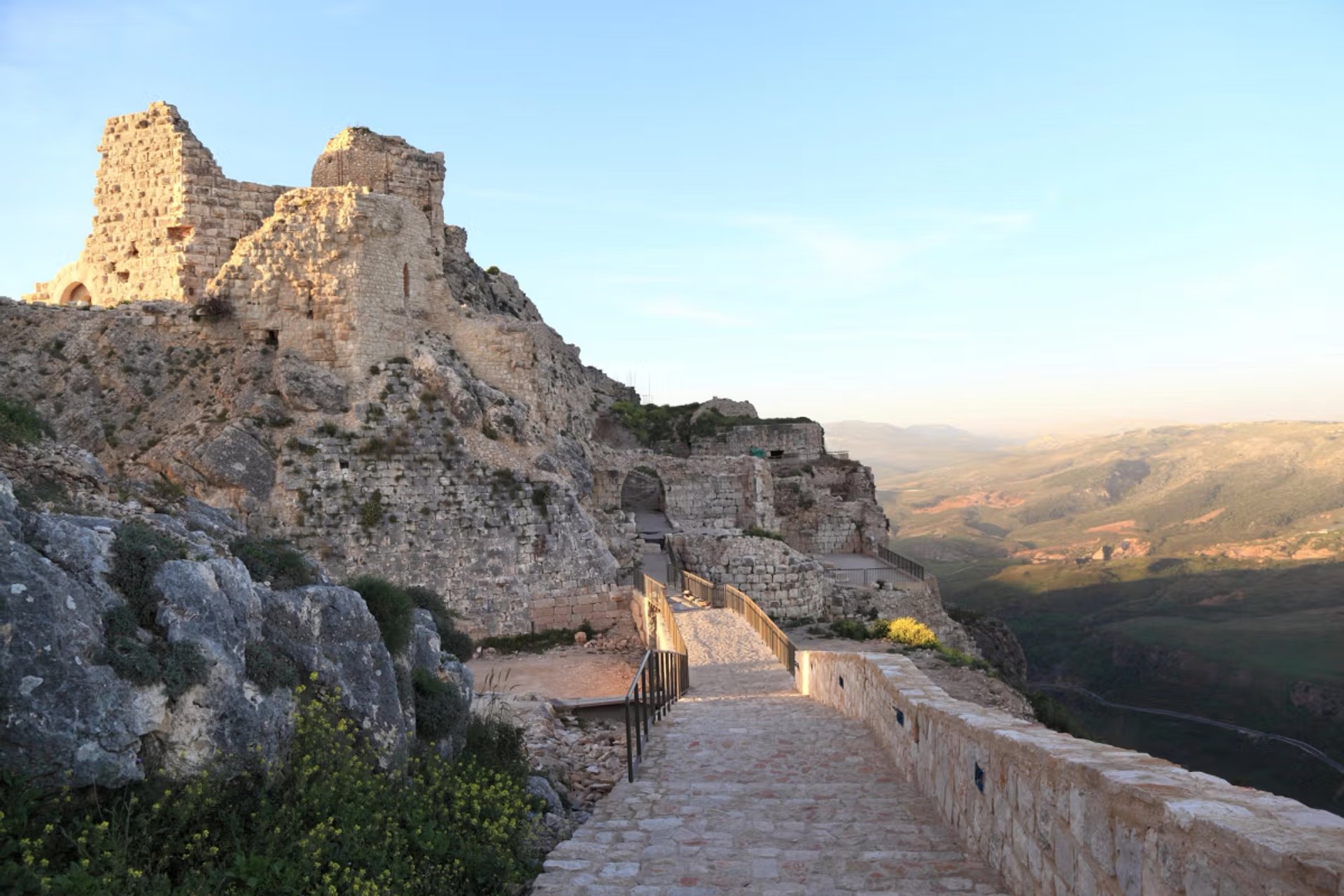
The Crusades-era fortress Beaufort Castle, or Qalaat al-Chqif, in southern Lebanon
Photo: Diak; Courtesy Adobe Stock
The ancient city of Tyre has also been inscribed on Unesco’s list of World Heritage in Danger. In June, reports emerged that the site, located in southern Lebanon, had suffered damage from Israeli bombardments. Karam says that assessments by experts from the DGA have confirmed that the site has suffered “significant damage”. Notable impacts, she says, include damage to the archaeological site entrance and visitor facilities, destroyed technical infrastructure and damage to the DGA offices and storage areas used to manage and conserve archaeological material. Within the archaeological zones, several ancient architectural elements, including columns, capitals and masonry remains were damaged or displaced by the explosions, and mosaic pavements were affected, requiring urgent documentation and conservation.
Karam hopes the inscription “will help mobilise international attention and technical support for emergency documentation, damage assessment, and recovery planning”. Cultural heritage, she adds, “must never become a casualty of armed conflict”.
The inscription brings Lebanon’s properties on the World Heritage List to seven.
Other sites inscribed to the World Heritage in Danger List
South Sudan’s Boma-Badingilo migratory landscape was also added to the World Heritage List and placed on the World Heritage in Danger List following an emergency procedure.
The other two sites placed on the list are the ancient city of Taurica Chersonese and its chora (Ukraine) and the historic inner city of Paramaribo (Suriname).
Other sites inscribed to the World Heritage List
The 25 inscribed properties consist of 19 cultural, five natural and one mixed site.
France’s beaches of the D-Day landings in Normandy were also inscribed on the World Heritage List. The roughly 80km stretch of land spans the Normandy coastline—Utah, Omaha, Gold, Juno and Sword beaches, plus Pointe du Hoc—along with remains of the German Atlantic Wall and wartime memorials such as the American Cemetery at Colleville-sur-Mer.
More than 150,000 Allied soldiers were involved on D-Day on 6 June 1944. Although the battle did not end the Second World War, it was a significant moment associated with Allied forces beginning to free parts of Europe that were under Nazi control.
The other cultural sites listed include: Aalto Works(Finland), Amazonia Theaters(Brazil), Ancient Buddhist Site of Sarnath (India), Ancient Capitals of Asuka and Fujiwara (Japan), Gdynia Modernist City Centre (Poland), Jingdezhen Handicraft Porcelain Industry Sites (China), Rock Mosques and Associated Sacred Sites of Mangystau (Kazakhstan), Royal Capetian Fortresses of Languedoc (France), Tashkent Modernist Architecture. Modernity and Tradition in Central Asia (Uzbekistan), The Cemetery Complexes of the Xiongnu Nobility (Mongolia), The Medinas of the Historic Sultanates of the Comoros (Comoros), The Roças of Sao Tome and Principe: Colonial Agricultural System and Forced Migration (Sao Tome and Principe), The system of Italian-style condominio theatres of the 18th and 19th centuries in Central Italy (Italy), Village of Sidi Bou Saïd (Tunisia), and Wat Phra Mahathat Woramahawihan, Nakhon Si Thammarat (Thailand).
The new inscribed natural properties are: Aqaba Marine Reserve (Jordan), Boma–Badingilo Migratory Landscape (South Sudan), Okefenokee National Wildlife Refuge (USA), The Bony Fish Fossils of the Western Limfjord – Evolution and Climate Adaptation in the Earliest Eocene (Denmark), and Wadi Wurayah (UAE).
The new inscribed mixed property is The wider area of Mount Olympus (Greece).