

Banner image: BASAMT’S Times Square billboard films @zaz10ts
“Whether creating an intimate portrait or a monumental installation, my work is driven by the same desire: to connect with people.”
The Human Face as a Living Threshold
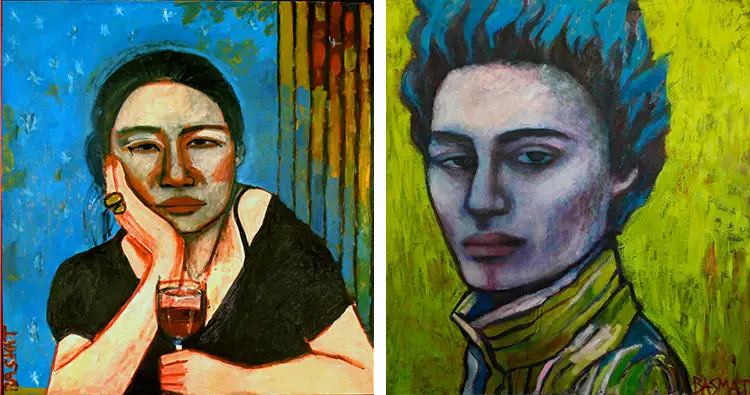
Basmat approaches portraiture as a search for presence, not simply likeness. Based in New York City after more than fifteen years of living and working in Shanghai, she has built a practice shaped by travel, cultural encounter, and an enduring fascination with the human face. For Basmat, the face becomes a point of entry into identity, memory, and inner life. Her vivid palettes, energetic brushwork, and layered surfaces create paintings that feel emotionally direct while inviting viewers to recognize the shared human experience beneath cultural difference.
Basmat’s biography adds depth to this visual language without narrowing it into autobiography. Born in Jerusalem, educated across several art institutions, and shaped by long periods in New York, Italy, and China, she brings a broad technical and cultural foundation to her work. Her studies included drawing, painting, sculpture, video, and computer graphics at institutions such as the New York Studio School of Drawing and Painting, the International School of Art in Todi, the Fashion Institute of Technology, the School of Visual Arts, and the Center for the Media Arts in New York. This wide-ranging education allows her practice to move fluidly between painting, installation, and architectural environments while maintaining a distinctive visual language. The Charles Revson Fellowship from the New York Studio School further reflects the discipline behind her expressive approach, where intuition and structure exist in balance.
Basmat: Between Portrait and Pattern
During her years in Shanghai, Basmat maintained a studio in the M50 Art District, a period that profoundly shaped her understanding of culture and human connection. Living in China offered her more than visual inspiration. It changed the way she saw people, place, and the shared emotional patterns that cross national borders. She has described living abroad as a humbling experience that reinforced her belief that people are fundamentally similar across the world. This realization continues to inform her portraits, which emphasize connection rather than separation.
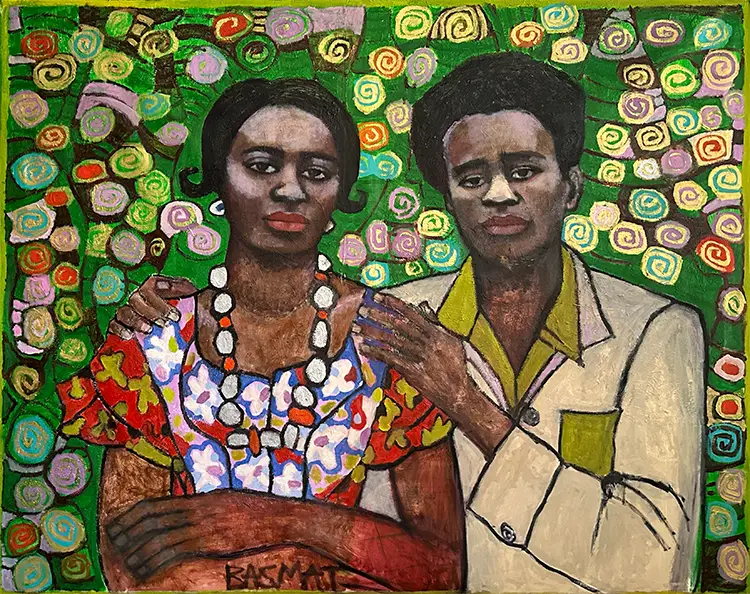
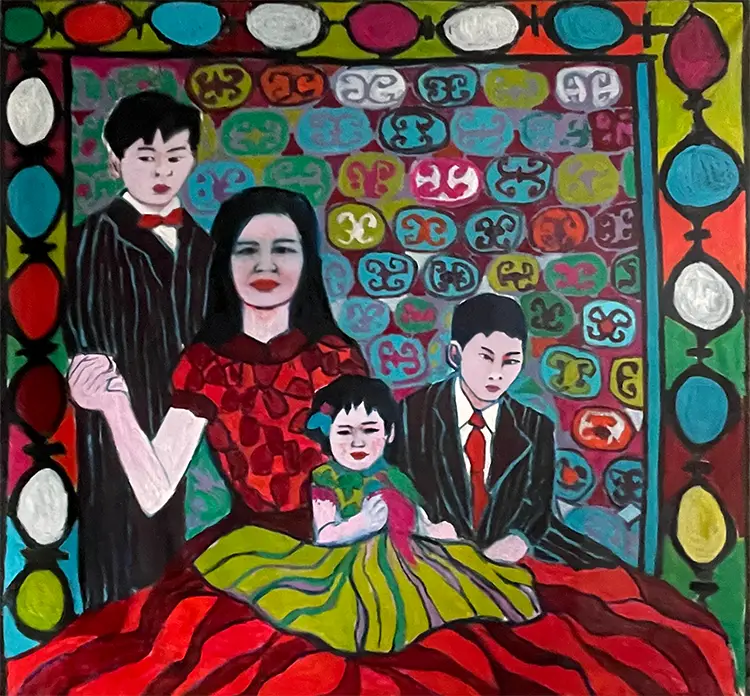
Her paintings move between portraiture, abstraction, and pattern, allowing figuration to coexist with rhythm, gesture, and saturated color. Faces emerge through expressive layers that balance observation with imagination, creating works that feel both personal and universal.
Explore Basmat’s portrait and abstract works:
https://www.basmatlevin.com/portraits
https://www.basmatlevin.com/abstract
Her paintings have appeared in films including Dinner Rush, Suburban Girl, Morning Glory, Wonderstruck, The Upside, and A Journal for Jordan, placing her visual language within cinematic spaces where atmosphere plays an essential role. Her work has also been exhibited across galleries, museums, art fairs, and public venues in New York, Shanghai, Miami, Hong Kong, Beijing, Tel Aviv, Singapore, Belgium, Costa Rica, and beyond, demonstrating the international reach of her practice.
Color Expanding Into Space
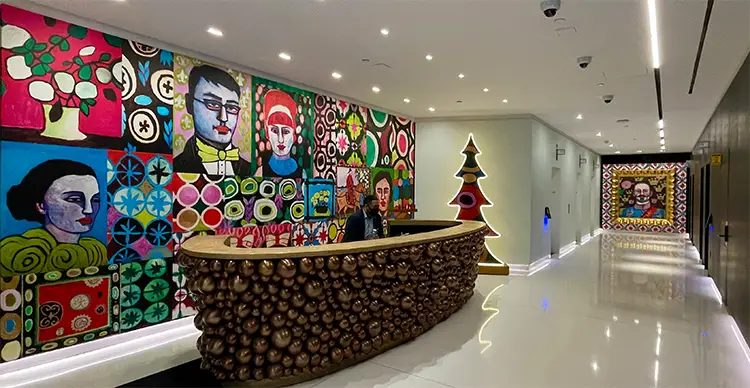
Basmat’s practice extends beyond the canvas through large-scale installations that translate her painterly language into architectural settings. Using materials including metal, wood, wallpaper, canvas prints, and recycled fabrics, she creates immersive environments that invite viewers to experience color and gesture physically. These projects expand the central ideas found in her paintings, transforming public spaces into places of visual energy and human connection.
One especially significant project took place at 1410 Broadway in Times Square, New York City, a forty-two-story office building. Basmat transformed the lobby, seven elevators, and forty-two bathrooms by adapting her paintings into wallpaper, metal prints, canvas prints, and wood panels. Rather than simply decorating the building, the installation reshaped its atmosphere through bold imagery, vibrant color, and rhythmic composition, bringing a sense of vitality and harmony into the workplace.
Other installation projects have appeared in a wide range of public and cultural settings, including KuBe Art Center in Beacon, ZAZ10TS in New York City, MOCA Museum Pavilion, Pujiang Country Park, The Glam Bar in Shanghai, Yi Ou Lai Village in Suzhou, Zhujiajiao Water Town in China, Madam Fu in Hong Kong, Art Stage Singapore, Tel Aviv Opera House in Israel, and Juan Santamaría International Airport in Costa Rica. Together, these projects demonstrate the international scope and adaptability of her installation practice, showing how her visual language can transform a wide variety of architectural and public environments.
View Basmat’s installation projects:
Basmat: A Practice Built on Connection
At the heart of Basmat’s work is a belief that art can reveal something essential about human experience. Whether through portraiture or immersive installation, her practice explores how color, form, and space can foster emotional connection. Rather than separating personal feeling from collective experience, she treats art as a shared language capable of crossing cultural boundaries.
Her works have entered private collections in New York, Israel, and Shanghai, with public placements in Shanghai including a permanent collection at Dunhill Twin Villa.
What gives Basmat’s art its lasting force is the way it joins intensity with openness. Her paintings remain visually bold without limiting interpretation, while her installations expand those same ideas into spaces people inhabit every day. Across portraiture, abstraction, pattern, and mixed-media environments, she continues to explore how color can hold memory, emotion, and cultural experience. Whether painting an imagined figure, responding to a photographed face, or transforming an entire building, Basmat creates work grounded in the desire to connect with others.
Website: https://www.basmatlevin.com
Instagram: https://www.instagram.com/basmat.levin
The post Basmat: Painting the Pulse Between Cultures appeared first on AATONAU.


