

Marking the United States’ semiquincentennial, the World Monuments Fund (WMF) has selected ten heritage sites to highlight across the country that reflect “both the breadth of American history and the range of preservation challenges these places face”. Part of its new Irreplaceable America programme, the locations were chosen from 75 public nominations. The sites span all 250 years of US history, with some even dating from before the signing of the Declaration of Indiependence in 1776. WMF will provide each site with a year of consultation services and advocacy-focused support, as well as a possible future partnership on a preservation project.
The ten sites include a number of national milestones—the US’s oldest surviving botanical garden (Bartram’s Garden in Philadelphia) and Black church (African Meeting House in Boston), what is left of the country’s first smallpox hospital (on New York City’s Roosevelt Island) and the Wright Brothers’ workshops and surrounding fields where they invented the airplane in Dayton, Ohio. The entire city of New Orleans also appears on the list. And a special mention goes to the National Park Service for its ongoing devotion to protecting 433 of the US’s most important natural and historic sites, even in the face of budget cuts and political meddling.
“After decades of work at more than 700 sites in 112 countries, WMF has seen what communities gain when they can protect the places that matter and what is lost when they cannot,” Bénédicte de Montlaur, the president and chief executive of WMF, said in a statement. “As the nation approaches its 250th anniversary, Irreplaceable America is a call to protect the places that reflect the richness of that history, and the role heritage plays in education, community memory and civic life.”
San Estévan del Rey, Acoma Pueblo, New Mexico Photo: Hasselblad500CM, via Wikimedia Commons
Among the oldest sites on the list are two 17th-century Spanish mission churches in the neighbouring towns of Laguna and Acoma Pueblo in New Mexico, about an hour west of Albuquerque. San Estévan del Rey in Acoma and San José de Laguna are prime examples of a unique hybrid of Spanish colonial and traditional Pueblo architecture. As WMF puts it, the structures “embody the complex and contested history of colonisation, evangelisation and Indigenous resilience in the American Southwest”.
To this day, both churches have active Catholic congregations while remaining intertwined with the local Pueblo communities and their traditions. San Estévan del Rey is the oldest surviving European church in the state. And San José, one of the best preserved of the Pueblo mission churches, is famous for its colourful interior—painted by hand and featuring a mix of traditional Pueblo and Catholic symbols. Both churches have appeared on the National Register of Historic Places since the 1970s, but they remain threatened by limited funds, depopulation and the gradual loss of adobe-construction skills needed to conserve them.
A couple of the more recent sites highlighted by WMF have art-historical ties: Watts Towers in Los Angeles and Black Mountain College in North Carolina.
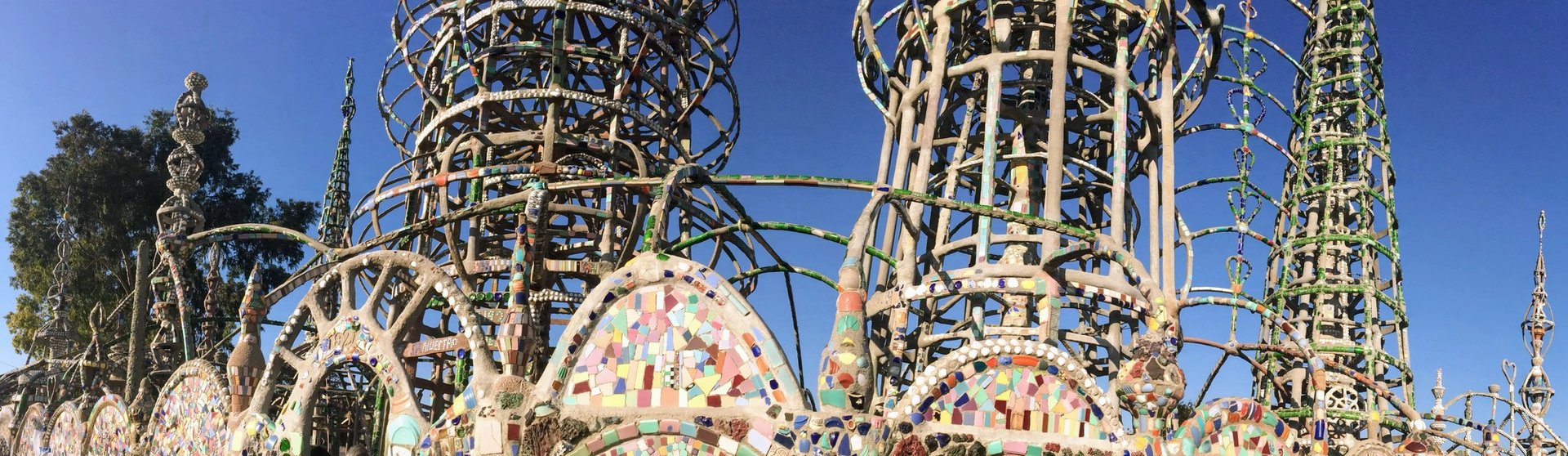
Simon Rodia’s Watts Towers, Los Angeles Photo: Bjlee2020, courtesy World Monuments Fund
The Italian American outsider artist Simon Rodia started building what would become Watts Towers in 1921, adding to his giant series of handmade sculptures for more than 30 years. Among the 17 towers, the largest of which is almost 100ft tall, are labyrinths covered in mosaics of broken pieces of tile and found objects. Abutted by the community-centric Watts Towers Arts Center, the site has been on the National Register since 1977. But the Watts Towers are especially vulnerable to earthquakes, climate change and deterioration, as well as dwindling financial resources.
On the opposite side of the US, the famously experimental Black Mountain College has counted among its students, faculty and staff the visual artists Josef Albers, Anni Albers, Ruth Asawa, Willem de Kooning, Robert Rauschenberg and Cy Twombly. Founded in 1933, it was a legendary site for artistic exploration of all kinds—the composer John Cage, the choreographer Merce Cunningham and the architect Walter Gropius were there, too. The college’s Studies Building is specifically pinpointed by WMF as “the academic and social heart” of its legacy.
Designed by the architect A. Lawrence Kocher, the Bauhaus-inspired Studies Building is a distinctive structure built in the early 1940s by the college’s own community of students, faculty and staff using local materials and—in WMF’s words—“wartime ingenuity”. While Black Mountain College closed more than 60 years ago, the Studies Building still stands. In fact, it serves as administrative offices for a local summer camp. But the structure suffers from water infiltration, and its materials are quickly deteriorating from age and weather exposure. While the Black Mountain College Studies Building Foundation continues raising awareness and funding, WMF hopes that the building will be conserved and once again serve as community space for creative experimentation.


