

“Abstraction became the most useful direction because it allowed the work to focus on form itself.”
Primary Relations (2026)
The Art of Thinking Through Structure
Dennis H Miller has spent decades moving between disciplines, building a creative practice that connects music, animation, photography, and digital media through a shared commitment to composition. Based in the United States, he first established himself as a composer, studying at Columbia University before embarking on a long academic career at Northeastern University in Boston. There, he taught composition, electronic music, and multimedia art, helping shape generations of students while refining his own understanding of artistic structure. Although his professional roots lie in music, his contemporary work increasingly occupies the visual sphere, where abstract animation and still imagery provide new ways to investigate ideas of form, development, and resolution. Throughout these transitions, a consistent concern has remained at the center of his practice: the careful organization of material over time. Whether creating a musical composition or constructing an animated sequence, Miller approaches each work as an evolving system whose elements must interact meaningfully and ultimately arrive at a satisfying conclusion.
The relationship between music and visual art in Miller’s work is often misunderstood as a search for direct correspondences between sound and image. Instead, his interest lies in compositional thinking itself. He treats visual elements much as a composer treats musical motifs, allowing forms to emerge, transform, interact, and develop across a structured duration. Color, movement, density, and spatial relationships become equivalent to musical materials in the sense that they participate in a larger organizational framework. This perspective allows him to build abstract works that unfold with a sense of purpose and progression. Rather than illustrating music through imagery, he creates visual experiences guided by the same principles that shape a carefully composed score. The result is work that rewards sustained attention, encouraging viewers to follow the evolution of forms as they shift and respond within a carefully designed visual environment.
Over time, Miller’s growing fascination with visual media expanded naturally from his background in composition. The transition was not driven by a desire to abandon music but by a curiosity about how compositional principles could operate within a different medium. Through experimentation with animation, photography, and digital tools, he discovered new possibilities for exploring structure through visual means. His later involvement with the Visual Music Marathon further broadened this investigation, exposing him to a rich international tradition devoted to abstract moving imagery. While this experience deepened his appreciation for the field’s history and diversity, his own artistic direction had already emerged from years of thinking about form, pacing, contrast, and development. These concerns continue to guide his practice, creating a strong conceptual bridge between his musical origins and his visual present.

Spring Awakening_1 (2025) [Link to animation]
Dennis H Miller: Building Meaning Through Abstraction
Miller’s visual language is rooted in abstraction, a choice that allows formal relationships to take precedence over recognizable subjects. Many of his works begin with photographs drawn from an extensive personal archive accumulated over many years. These images serve as raw material rather than finished statements, providing starting points for transformation through digital processes and experimentation. By removing emphasis from representation, Miller creates space for viewers to engage directly with composition, movement, color, and spatial organization. This approach shifts attention away from narrative interpretation and toward the internal dynamics of the artwork itself. Every element must justify its presence through its contribution to the overall structure, creating compositions that depend on balance, clarity, and visual coherence rather than descriptive content.
Central to Miller’s practice is the belief that an artwork must undergo meaningful development. He seeks visual experiences that introduce ideas, transform them, and guide them toward a distinct resolution. This process reflects his longstanding engagement with musical form, where progression and variation are essential components of a successful composition. In his animations, movement becomes a critical agent of change, enabling forms to evolve while maintaining continuity. Color relationships intensify, spatial arrangements shift, and visual densities fluctuate, creating a sense of motion that extends beyond simple animation techniques. Each work is designed to arrive somewhere different from its point of origin, making transformation itself a key component of meaning. Through this emphasis on progression, Miller creates abstract works that feel purposeful and alive without relying on literal imagery.
Music continues to play a significant supporting role within many of these projects. Rather than functioning as decoration, sound contributes atmosphere, structure, and emotional character. In some cases, musical material is created before the animation process begins, helping establish a framework for visual development. More often, however, the music is composed afterward, responding to the evolving needs of the imagery. This flexible relationship allows each medium to influence the other while maintaining its own identity. The resulting works demonstrate a sophisticated balance between visual and sonic elements, reflecting Miller’s deep familiarity with both disciplines. Through this integrated approach, he creates experiences that are unified not by direct illustration but by a shared commitment to compositional integrity.
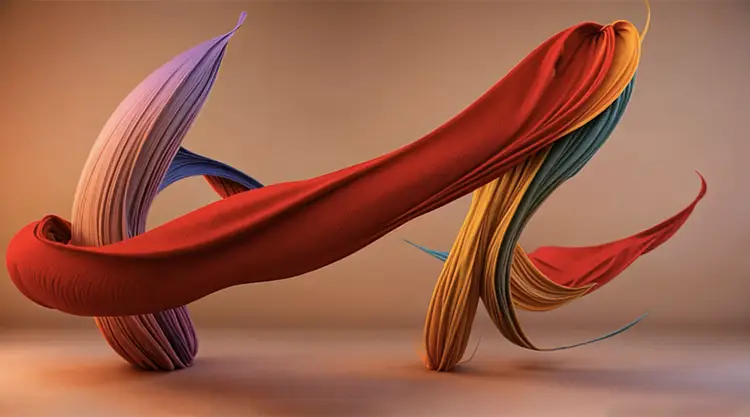
Fabrication_1 (2026) [Link to animation]
Influences Shaped by Observation and Experience
Among the many influences that inform Miller’s practice, music composition remains the most significant. Years spent constructing musical works cultivated an awareness of continuity, proportion, and formal organization that now informs every aspect of his visual production. These concerns transfer naturally into animation, where duration and progression are fundamental components of the medium. Instead of approaching moving images as isolated visual events, Miller treats them as evolving structures whose effectiveness depends on the relationships between their parts. This perspective gives his work a distinctive sense of cohesion, allowing abstract forms to communicate through development rather than representation. The influence of composition is therefore not merely historical within his career but an active force that continues to shape his artistic decisions.
Teaching also played a profound role in refining his artistic outlook. Decades spent evaluating student work encouraged close observation and rigorous critical thinking. Repeated exposure to projects with strong concepts but weak execution, or visually appealing surfaces lacking structural depth, sharpened his ability to recognize what makes a work succeed. This experience reinforced the importance of revision, editing, and refinement within his own creative process. Rather than treating first ideas as finished solutions, Miller embraces an iterative approach that tests, adjusts, and strengthens material until it achieves coherence. The discipline developed through teaching remains visible in the precision of his visual constructions and in his willingness to discard ideas that fail to meet his standards.
Another important influence emerged through his work producing and curating the Visual Music Marathon. Engaging with hundreds of submissions from artists around the world revealed the remarkable breadth of approaches within abstract moving image practice. Exposure to both contemporary and historical works expanded his understanding of what visual music could encompass and confirmed the significance of the field as a serious artistic tradition. This experience reinforced his commitment to abstraction while demonstrating the many ways artists approach movement, rhythm, form, and visual expression. Although the field remains less visible than some other areas of contemporary art, Miller’s participation in this international conversation strengthened his appreciation for its depth and possibilities.
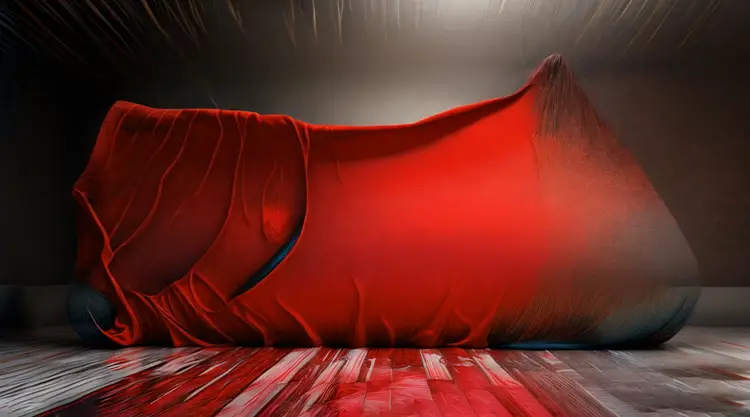
Fabrication_3 (2026) [Link to animation]
Dennis H Miller: Expanding the Future of Animata
The Animata series, developed during 2025 and 2026, represents the most important current focus of Miller’s artistic practice. This body of work brings together decades of experience across composition, digital media, photography, and abstraction while incorporating contemporary AI-assisted image generation techniques. Although digital animation serves as the primary medium, the process begins from a wide range of sources. A project may originate from generated imagery, a photograph from his archive, an existing animation, or a specific conceptual impulse. These starting points are subsequently transformed through extensive experimentation, editing, and refinement. The finished works emerge through a layered process in which pacing, sequencing, color relationships, and visual transitions are continually adjusted until the overall structure achieves clarity and balance.
What distinguishes Animata is its exploration of abstract forms that appear active and dynamic without becoming representational. The animations evoke sensations of growth, pressure, movement, and transformation while avoiding direct references to recognizable subjects. Meaning arises from the behavior of the forms themselves and from the relationships that develop over time. This emphasis aligns closely with Miller’s compositional background, where thematic development and structural progression are central concerns. The works unfold gradually, introducing visual ideas before altering and expanding them through carefully controlled transformations. Their power comes not from narrative content but from the cumulative effect of visual evolution and formal interaction.
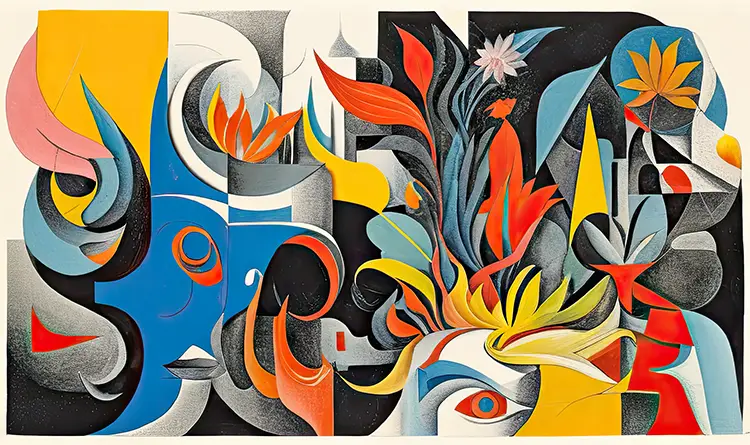
Chromatic Garden (2025)
Miller’s daily process reflects the same disciplined methodology that characterizes the finished work. He routinely moves between animation experiments, still imagery, and musical sketches, generating large quantities of material before selecting only a small portion for further development. Digital technologies make production increasingly efficient, yet he remains focused on quality rather than volume. Careful editing, simplification, and revision guide each project toward greater coherence. Looking ahead, he plans to expand Animata into a larger body of work capable of functioning across diverse contexts, including public installations, theatrical presentations, home displays, and large-scale screens. At the same time, he continues to investigate ways of using AI with greater intentionality and authorship, seeking approaches that remain connected to his own visual language rather than defaulting to familiar outcomes. Through these ongoing explorations, Miller continues to extend a lifelong inquiry into structure, transformation, and the possibilities of abstract form.
Dennis H. Miller’s work is available from Sedition (Dennis H. Miller – Sedition), LED.ART Dennis H. Miller – LED.ART, NIIO (Dennis H. Miller – NIIO) and other sites and can be found at his web site, www.dennishmiller.com.
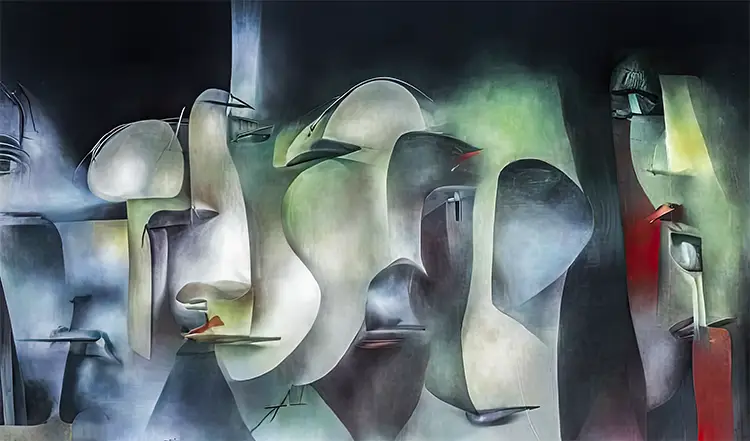
Silent Witness (2025)
The post Dennis H Miller: Shaping Visual Form Through Time appeared first on AATONAU.


