

The Serpentine Pavilion is one of the most anticipated events in the international architecture calendar. Since 2000, the annual commission in London’s Kensington Gardens has invited leading architects to design a temporary pavilion on the Serpentine Galleries’ lawn. Its inaugural structure was designed by the late Zaha Hadid, with subsequent contributions coming from the likes of Herzog & de Meuron, Oscar Niemeyer, Sou Fujimoto and others. The project has become a leading platform for experimentation and innovation, offering visitors the chance to experience cutting-edge design in a public setting. 2026 is a landmark year for the Serpentine, marking a quarter of a century since Hadid’s first commission opened.
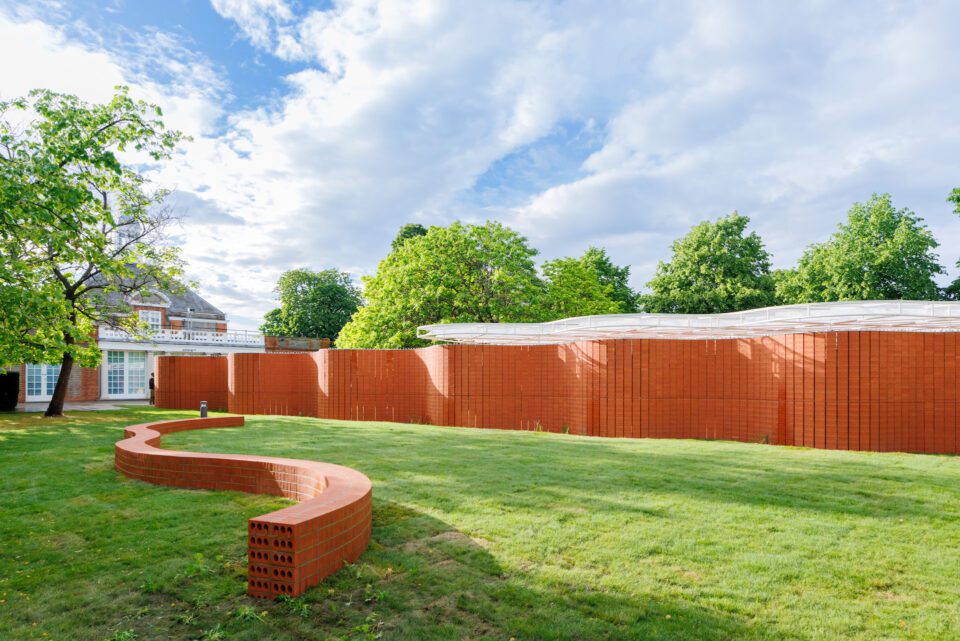
This year’s pavilion, which launched on 6 June, has been erected by Mexican architecture studio LANZA atelier, founded by Isabel Abascal and Alessandro Arienzo in 2015. Over the past decade, the duo have established a reputation for employing hands-on methods, which they use to reinterpret familiar materials and forms in to something new. This design is no different. It takes inspiration from the type of wall known as a “serpentine” or “crinkle-crankle” – composed of alternating curves, commonly found in the county of Suffolk. Its roots, however, are more complex: the architectural feature originated in ancient Egypt and was later introduced to England by Dutch engineers. What sets it apart is its stability – a one-brick-wide serpentine requires fewer individual blocks than a regular straight wall. The eponymous structure, which forms one side of the pavilion, also nods to the nearby London lake, so named for its gentle curves that evoke the form of a serpent. LANZA atelier have named the project simply: a serpentine.
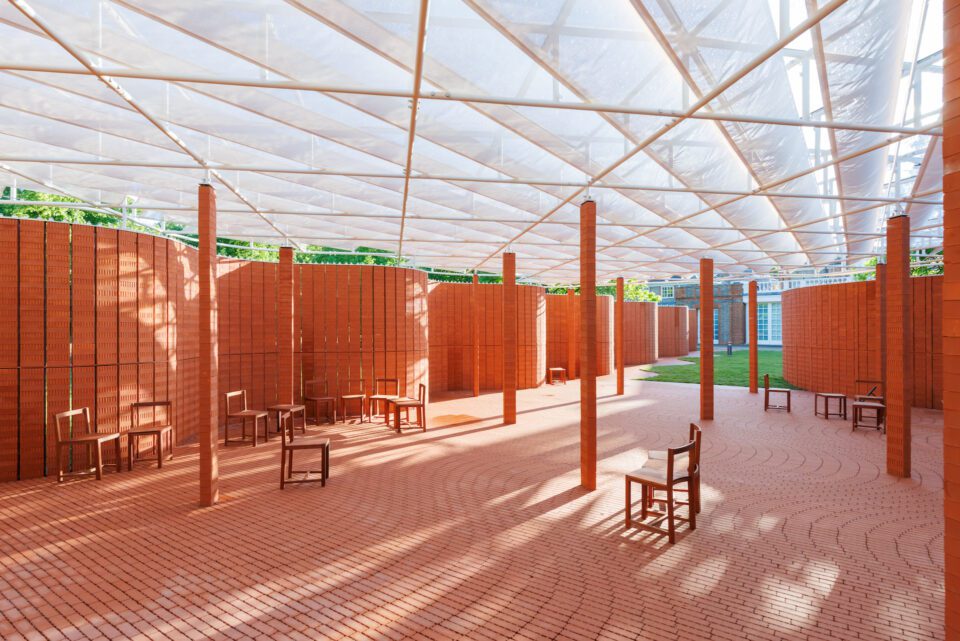
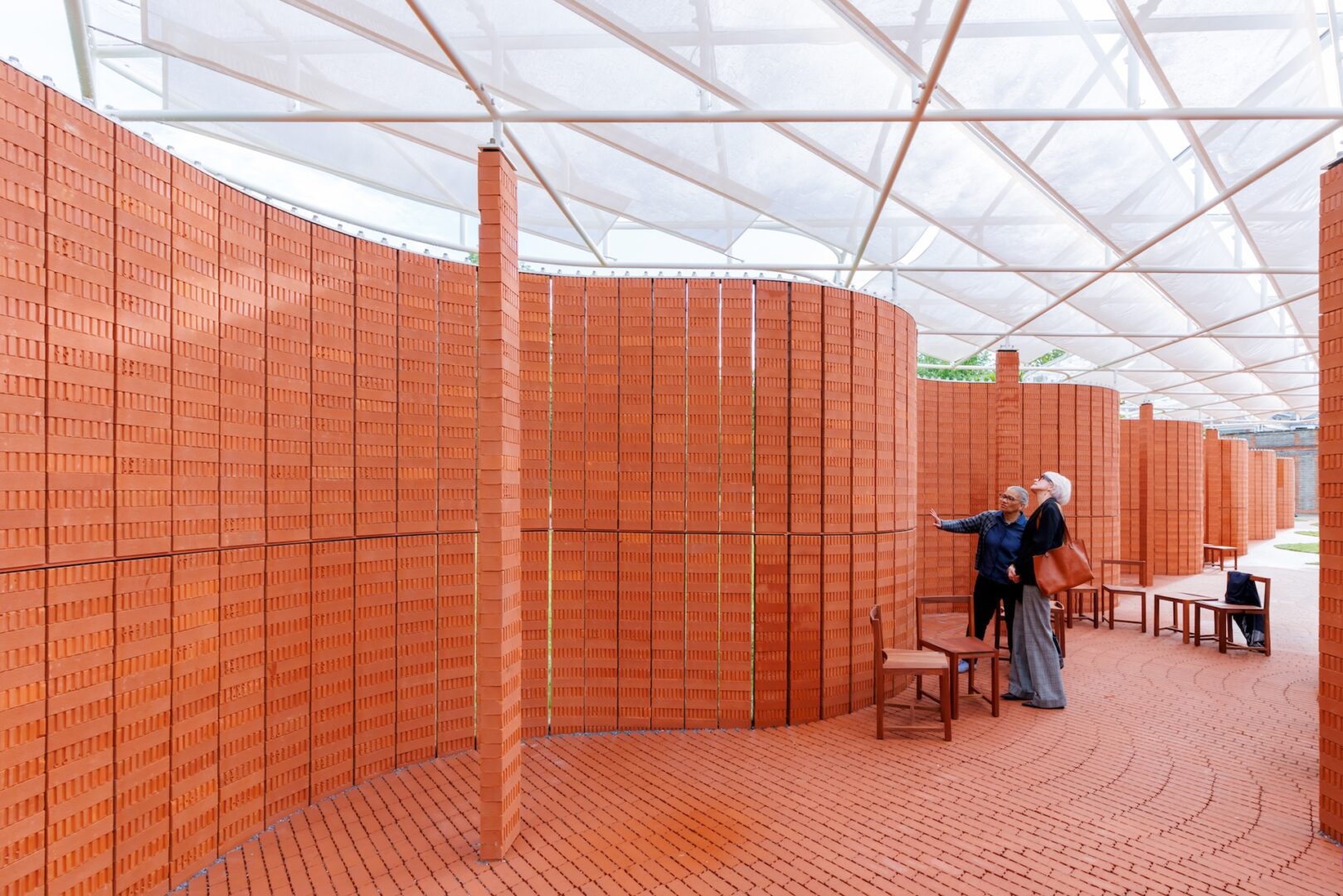
The design comprises bricks inside and out: for walls, flooring and ceiling supports, as well as an outdoor bench. The contrast between these great swathes of terracotta and Kensington Gardens’ bright green lawn is immediately striking. But why 30,000 bricks? The duo chose this material to “celebrate the English garden tradition”, whilst establishing a conversation with the existing façade of the Serpentine South Gallery (currently hosting an exhibition of Cecily Brown) – which was once a tea pavilion itself. Moreover, the architects aim to use them to “challenge the idea of walls as features of division.” Gaps between the blocks allow light and air permeate the space – as well as visitors to see through – inviting connection and “softening the boundary between enclosure and openness.” A translucent roof adds to this effect, resting lightly on columns and “evoking a grove of trees.” Abascal and Arienzo also worked on the chairs and stools for inside the pavilion; the duo sees furniture and architecture as part of the same process. The seating is constructed locally from sapele hardwood and blends seamlessly into the overall blueprint.
The architects say: “It is an honour to be selected as the architects of the 25th Serpentine Pavilion, a milestone year for the commission. We are deeply grateful for the opportunity to share our work with a wider public and to contribute to the Pavilion’s ongoing legacy of spatial experimentation and collective encounter. Set within a garden, an evocation of the natural world, the project takes the form of a serpentine wall, conceived as a device that both reveals and withholds; shaping movement, modulating rhythm, and framing thresholds of proximity, orientation and pause. Inspired by the figure of the serpent as a generative and protective force, we draw a parallel with England’s winding fruit walls, which are structures that temper climate, create shelter, and enable growth. From this idea emerges a pavilion built of simple clay brick, foregrounding vernacular craft and the elemental capacity of architecture to bring people together. The 2026 Pavilion proposes built forms that are permeable, shaped and held by a gentle geometry, and continually responsive to those who move through it.”
The Serpentine Pavilion’s alumni includes Bjarke Ingels, Frank Gehry and Rem Koolhaas – some of the biggest names of their respective generations. But, in recent times, it has also grown into a launchpad for a new wave of architects, welcoming Lina Ghotmeh, Marina Tabassum, Minsuk Cho and more. Hans Ulrich Obrist, Artistic Director at Serpentine, recognises the importance of this development. “Over the last 10 years the Serpentine Pavilion has increasingly focussed on giving opportunities to younger architectural practices … act[ing] as a catalyst for architects at pivotal moments in their careers.” He also nods to the legacy of Hadid, who gave the Serpentine Galleries its motto: “there should be no end to experimentation.” From summer through October, LANZA atelier’s a serpentine promises to hold to that message, playing host to a series of live events and performances, whilst becoming a stage for public engagement.
The Serpentine Pavilion, London, runs until 25 October.
Words: Eleanor Sutherland
Image Credits:
1. Serpentine Pavilion 2026 a serpentine, designed by Isabel Abascal and Alessandro Arienzo, LANZA atelier. Exterior view © LANZA atelier, Photo Iwan Baan, Courtesy Serpentine.
2. Serpentine Pavilion 2026 a serpentine, designed by Isabel Abascal and Alessandro Arienzo, LANZA atelier. Exterior view © LANZA atelier, Photo Iwan Baan, Courtesy Serpentine.
3. Serpentine Pavilion 2026 a serpentine, designed by Isabel Abascal and Alessandro Arienzo, LANZA atelier. Interior view © LANZA atelier, Photo Iwan Baan, Courtesy Serpentine.
4. Serpentine Pavilion 2026 a serpentine, designed by Isabel Abascal and Alessandro Arienzo, LANZA atelier. Exterior view © LANZA atelier, Photo Iwan Baan, Courtesy Serpentine.
5. Serpentine Pavilion 2026 a serpentine, designed by Isabel Abascal and Alessandro Arienzo, LANZA atelier. Interior view © LANZA atelier, Photo Iwan Baan, Courtesy Serpentine.


