

Marianne Rosenberg grew up with art for “breakfast, lunch and dinner”, she jokes. The Upper East Side dealer comes from a family of storied gallerists. Her great-grandfather, Alexandre Rosenberg, was a major art world figure in Paris in the late 19th century, acquiring works by artists like Paul Cézanne and Vincent van Gogh at a time when the market for Impressionist painting was still nascent. Anticipating a shift in taste that would later define Modern art history, his sons expanded that vision, but one son in particular, Paul Rosenberg, transformed the family name into a cornerstone of the 20th-century art market.
With galleries in Paris and London, Paul cultivated relationships with artists that were both commercially astute and deeply personal. He represented figures like Henri Matisse, Fernand Léger and Pablo Picasso, shaping their markets and institutional legacies, and becoming one of the most important dealers in the industry.
War would interrupt Paul’s trajectory when the family was forced to flee Nazi-occupied France in 1940. “Everything was stolen,” Marianne says. “That included things that were unimportant in the scheme of history, like pots and pans, as well as artwork, books and archival materials.” Settling in New York, Paul re-established his gallery and was later joined by his son Alexandre P. Rosenberg in 1946. The two worked together until Paul’s death in 1959, when Alexandre continued the business.
Installation view of Giacomo Manzù: The Artist and his Dealer
© Adam Reich
Over the years, Alexandre (Marianne’s father) built his own connections with artists, including Giacomo Manzù. Alexandre represented the Italian artist known for his bronze sculptures and reliefs, including the Door of Death (1961-64) for St Peter’s Basilica in Vatican City, forming a close relationship until the dealer died in 1987. At that time, Paul Rosenberg & Co. closed.
While she absorbed the art world through osmosis—attending auctions and events with her mother and building a collection of her own—Marianne spent the first part of her career as an attorney in international aviation finance law. It wasn’t until 2015 that she started her gallery, Rosenberg & Co.
“There was always a push and pull for me with the art world,” Marianne says. “I’ve always been in it in ways, but I became very good at my job as a lawyer. At some point being on the hamster wheel was no longer fun, and the art world pulled stronger.”
Marianne has since continued her family’s focus on Impressionist and Modern art, and she also works with contemporary artists. Like many families whose possessions were stolen by Nazis, she has also been trying to recover missing artworks, following in her grandfather and father’s footsteps. Paul recovered around 300 works before his death and Alexandre was a lieutenant in the Free French Forces, helping to stop a train full of Nazis and looted artwork days after Paris was liberated.
“We’re very fortunate because my grandfather, Paul, was extraordinarily meticulous and kept records of every work that came through the gallery with an inventory number, measurements, even a little photo,” Marianne says. The family was recently successful in the restitution of a painting by Camille Pissarro, but Marianne estimates there are still more than 50 works missing.
Many of the records her grandfather kept are now in the Paul Rosenberg Archives at the Museum of Modern Art, a rich collection that offers insight into the inner workings of the art world in the first half of the 20th century and the lives of the famous figures Paul worked with.
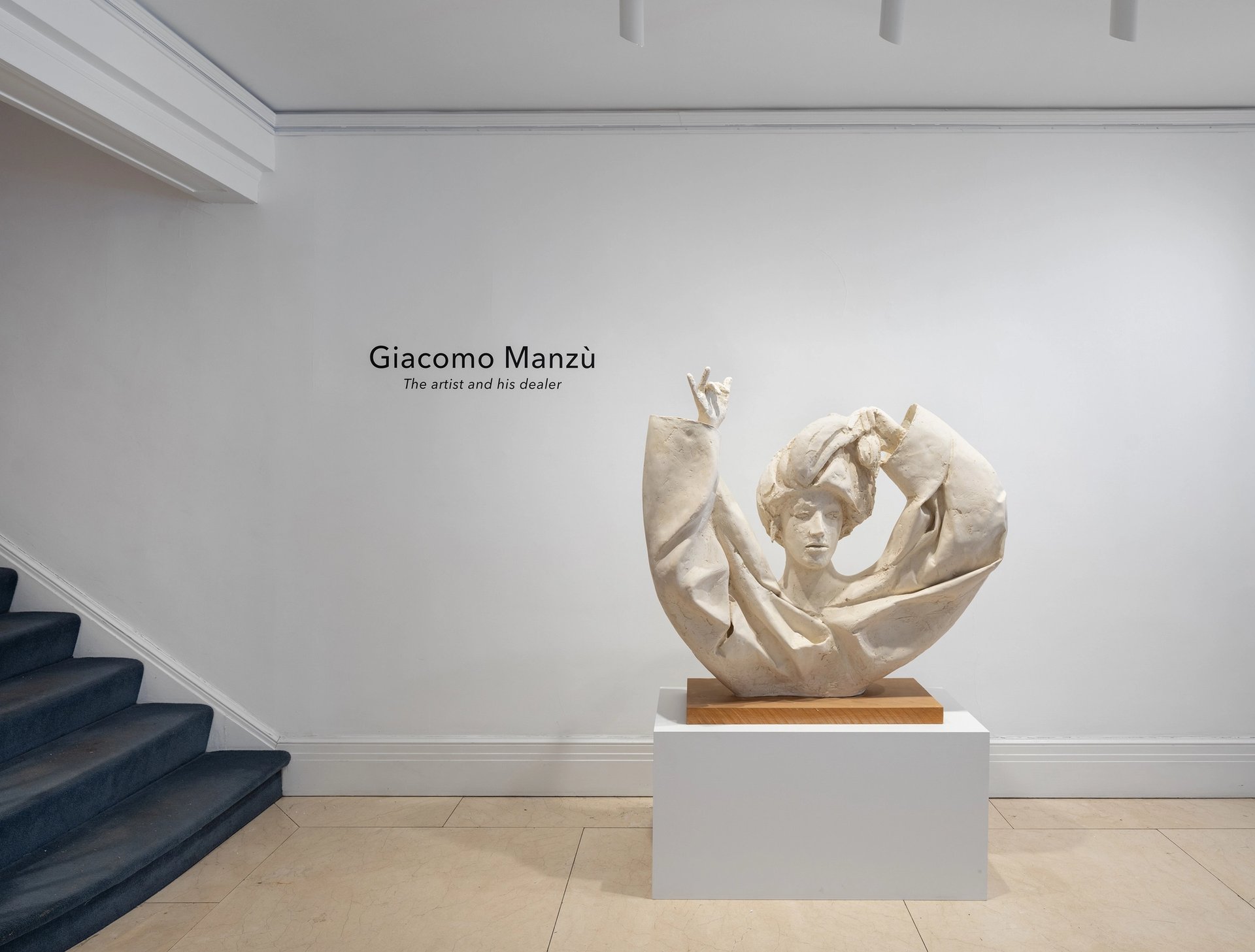
Installation view of Giacomo Manzù: The Artist and his Dealer
As Marianne rebuilds the family’s material legacy, she has also been reflecting on the intangible, looking to revive the memory and influence of her father. To this end, she opened Giacomo Manzù: The Artist and his Dealer (until 27 June), a show of sculptures, works on paper and archival letters that explores the decades-long relationship between Manzù and Alexandre. The exhibition is Manzù’s first in New York since 1985 when Alexandre presented a show of bronzes.
“We spent almost every summer visiting Giacomo Manzù and his family when I was a child,” Marianne says. “I am around the same age as his daughter, Giulia, and we built a beautiful friendship as children despite her speaking Italian and me speaking French.”
The families lost touch after Alexandre’s death but reconnected years ago when Marianne reached out to Manzù’s foundation in search of a certificate of authenticity. The person who responded was Giulia.
“We realised we were both restoring the memories of our fathers through our work and eventually we had the idea for the exhibition,” Marianne explains.
Key works in the show include Standing Cardinal (1972), one of many depictions of cardinals conveyed with authority and introspection, as well as Cestino (1984), a gilt bronze basket of fruit. A favourite sculptor of Pope John XXIII, Manzù often featured ecclesiastical subjects, though without reverence.
Yet it is the archival material that gives the exhibition its particular resonance. Letters between Manzù and Alexandre reveal a relationship built on trust and mutual regard.


