

A blizzard shrouded New York in February and the city ground to a halt. But the artist Lotus Kang hardly noticed; she was ensconced in a gigantic industrial warehouse in Brooklyn, tinkering with super joists (the lightweight, cold-formed steel support structures have become a leitmotif in her work), industrial rubber and tarp, among other materials. Kang rented the space temporarily to build out the work she has installed at the Bvlgari pavilion in Venice. It is her third studio, in addition to a light-flooded spot in Dumbo and a rural retreat upstate. “It’s been full steam ahead since the Bvlgari invitation; it’s been exciting,” she says on the phone from these new premises.
Molt (Woodridge-New York-Berlin-) (2024-25) Photo: © Andrea Rossetti; courtesy the artist
Bvlgari’s pavilion is part of a wider commitment to contemporary art: the Italian fashion house will sponsor the next three editions of the Venice Art Biennale. “Supporting the Biennale is not simply a sponsorship for us; it is an evolution of Bvlgari’s idea of patronage,” says Laura Burdese, currently Bvlgari’s deputy chief executive (and chief executive from July). “The house was born in Rome, surrounded by layers of history, and for decades our commitment has focused on safeguarding and restoring cultural heritage. But heritage alone is not enough. If you truly believe in culture, you must also believe in its future. Supporting living artists and free expression is as essential as restoring monuments.”
I kind of hate the idea that anything has a single meaning. Objects are not fixed
Lotus Kang
Kang describes herself as “a maker of objects and spaces”. She is known for creating “unpindownable” installations, photograms and sculptures, often combining organic and industrial or off-the-shelf architectural materials, to produce work with a defiantly indefinable quality. At the Whitney Biennial in 2023, she presented In Cascades, undulating large sheets of light-sensitive film that she “tanned” in her upstate greenhouse with summer sunlight and hung from super joists. Rippling and glistening in the space in resplendent hues of crimson, pink and yellow, Kang was interested in evoking a sense of porosity and permeability. At her Chisenhale solo show in London the same year, she made rat-pup sculptures after seeing the local vermin that live near the canal next to the gallery. Cast in glass to look both precious and fragile, she wanted to rethink the notion of parasites, or those that are considered that way.
Overlapping and merging
Kang’s proclivity for code-switching stems from her experiences growing up with Korean parents in Toronto. “It’s the undercurrent driving the work, it fuels the compulsions I have all the time—a quality that helplessly emerges because it’s who I am”. But she actively resists labels. She explains that since her work aims at “multiplicity, at the least”, she doesn’t want it to be too legible. “I kind of hate the idea that anything has a single meaning. Objects are not fixed to their origins; we can untether them.”
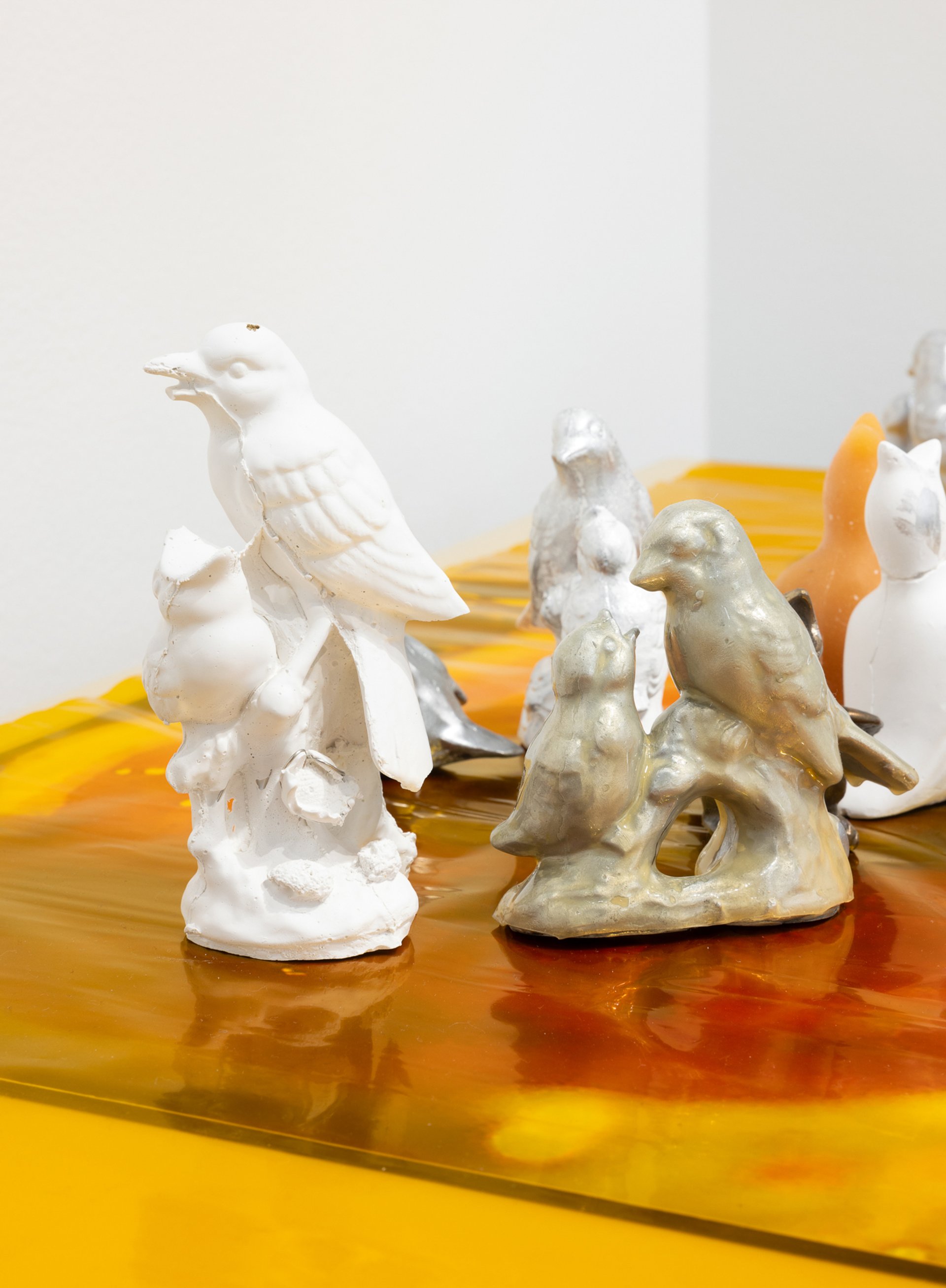
Receiver Transmitter (Borne) (2025) Photo: © Andrea Rossetti; courtesy the artist
Sensations of overlapping and merging will abound in Venice, where Kang will cover the façade of the Spazio Esedra in the Giardini with 35mm unfixed film, shot in mud flats in Korea, to create a filter over the space within. The viewer experience will depend on the natural light and the time of day they visit. Inside the pavilion, Kang has made new sculptures: plaster casts of crying baby birds, inspired in part by photographs her mother sent her from Toronto of a bird for which she was preparing elaborate meals. Baby birds, with their void-like mouths, are the perfect liminal figures for Kang; cast in plaster they look, she says, “so alive but so desperate they’re almost dead”. She has also wrapped tatami mats—a frequent material employed in recent work—in industrial rubber and tarp, creating dense, dark and light-absorbing contrasts, alongside new cast-aluminium works. All of these sculptures will serve as screens for the film imagery filtering through from the façade.
The title of the pavilion, inspired by the poet Lara Mimosa Montes’s book Thresholes, is The Face of Desire is Loss. “Desire is an intense expression of liminality,” Kang muses. “I’m extremely driven by desire as an artist. When you’re working towards something that is never clear, you surrender to a constant state of pursuit. It’s like pursuing someone you’re really attracted to. Sure, there’s satisfaction when you get it, but attainment also destroys the feeling of the chase. There’s an inherent aspect of loss in that.”
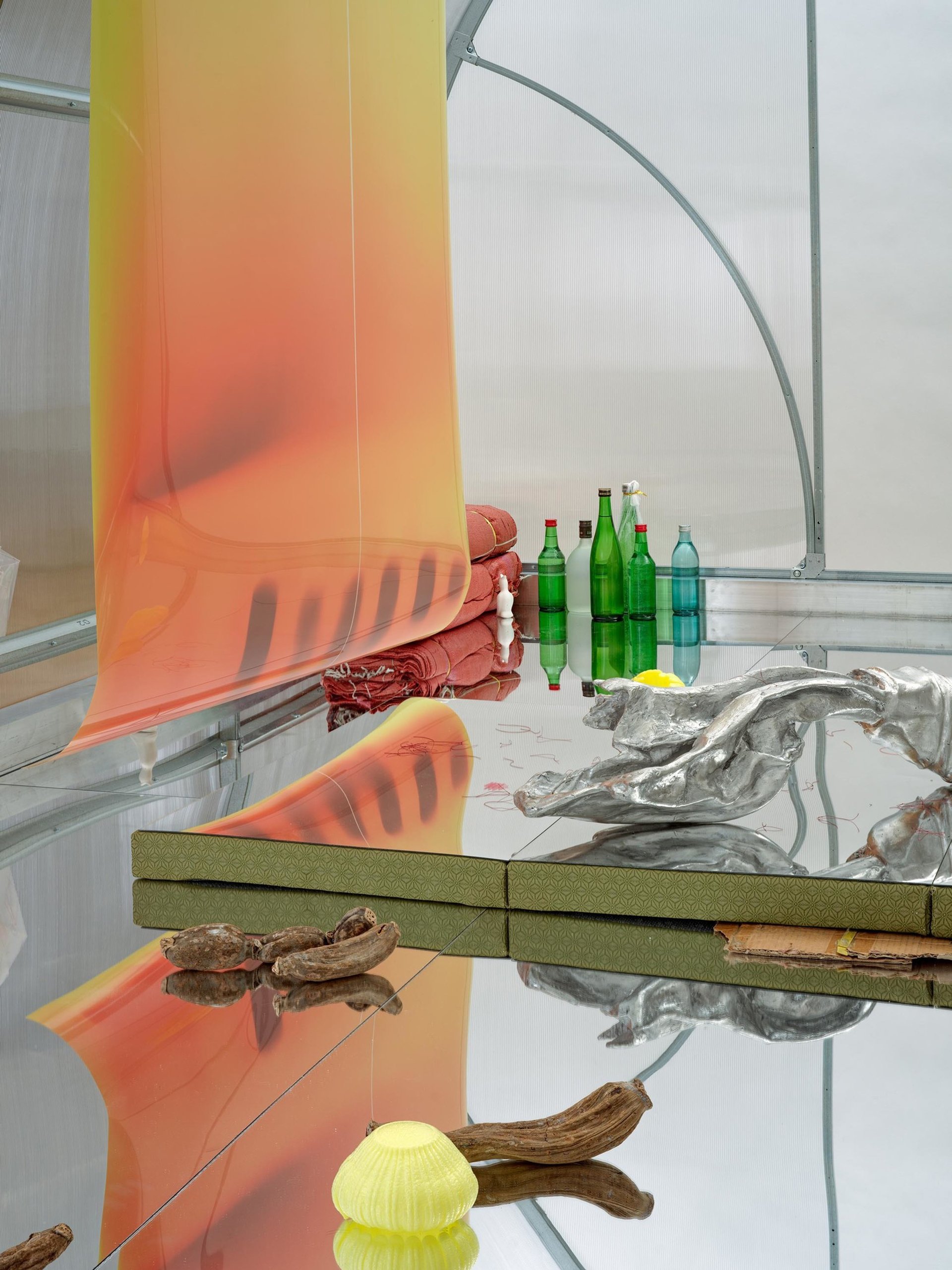
Receiver Transmitter (49 Echoes II) (2025) Photo © Kerry McFate and Chase Barnes; courtesy the artist
Burdese selected Kang for the pavilion for the “quiet intensity in her work, an attention to material, time and transformation, that aligns with our belief that true luxury is also about measure, depth and intention”. She sees Kang as a leading voice in a new generation who approach “form and narrative with subtlety and courage. That is precisely the kind of artistic presence we feel responsible to stand behind: not the loudest, but the most resonant.”
• Venice Biennale, 9 May-22 November


