

2026 marks a double anniversary for Alexander Calder, whose lyrical, perfectly balanced kinetic sculptures left an indelible mark on twentieth-century art. Fifty years since his death and a hundred since he first arrived in France, the Fondation Louis Vuitton is celebrating with a major retrospective. “Calder. Rêver en Équilibre” (“Calder. Dreaming in Balance”) brings together nearly 300 works. They include the mobiles and stabiles (or moving and static sculptures) that brought him international fame, along with large-scale public works, paintings, woodcarvings, works on paper, and even jewelry.
Born in Philadelphia in 1898 to a family of artists, Calder earned a degree in mechanical engineering before attending the legendary Art Students League of New York, where his tutors included Ashcan School stalwarts John Sloan and George Luks. He briefly pursued a career as an illustrator and painted scenes of urban life, but his departure for Paris in July 1926 marked a new beginning.


Calder arrived at the height of the Roaring Twenties, when the city was the artistic capital of the world. He quickly established himself as a central figure in the Montparnasse avant-garde alongside close friends such as Joan Miró, Jean Hélion, and Piet Mondrian. Calder began making innovative sculptures, which often incorporated unconventional or found materials like wire, string, broken glass, buttons, and fragments of wood, and he emerged as one of modernism’s most distinctive figures. As Suzanne Pagé, the exhibition’s head curator, told Artsy, “What was very important for him [in Paris] was that other major avant-garde figures immediately recognized this extraordinary artist who used very unusual, very humble materials, and who showed that sculpture, which was traditionally about mass, about volume, could become a kind of drawing in space.”
The Nazis’ rise to power forced Calder to return to the U.S. in 1933, yet he remained an ardent francophile. He returned to Paris for a 1946 exhibition at the Galerie Louis Carré, for which Jean-Paul Sartre wrote the famous essay “Les mobiles de Calder.” Calder subsequently established a studio in Saché in the Loire Valley, France, sharing his time between Roxbury, Connecticut, and his adopted home. Throughout his career, he continued to give many of his works French titles, regardless of where they were created or displayed.

Calder never stopped rethinking the possibilities of sculpture. He explored scale and negative space, embracing both delicate assemblages and monumental constructions that dwarfed spectators. What united these works was a complex dialogue with nature. While many of Calder’s sculptures evoke organic forms, they remain patently artificial and resistant to any attempt at interpretation. They leave us, above all, with a sense of wonder. Alexander Rower, president of the Calder Foundation and the artist’s grandson, explained to Artsy: “He’s not trying to tell you what to think or feel. He’s just inviting you to feel something. It’s up to you. He’s really trying to enliven us.”
As Calder’s work makes a welcome return to Paris, Artsy highlights seven key works from the exhibition, which is on view through August 12, 2026.
Le Cirque Calder (1926-31)

Calder was fascinated by the energy of the circus from an early age, and he frequently painted it while still in New York. Shortly after arriving in Paris, he began creating his own miniature version, cobbled together from everyday materials and studio debris, including wire, wood, paper, cardboard, cloth, leather, string, buttons, rubber tubing, cork, pipe cleaners, and bottle tops. By 1931, it had grown to fill five suitcases, boasting a cast of 69 characters and animals, 8 mechanical systems, and some 90 props.
The artist gave carefully choreographed performances, animating the figures while his wife Louisa provided music and sound effects. The events offered a unique blend of sculpture, theater, and performance art that dazzled audiences including Fernand Léger, Theo Van Doesburg, Le Corbusier, and Marcel Duchamp, who had never witnessed anything like it. “There was no precedent for this,” Rower explained. “There was no such thing as performance art when he made this thing.”
As an exploration of scale, mechanical innovation, and movement, Le Cirque Calder prefigures much of the artist’s later work. But it was also a thoroughly enchanting spectacle. Pagé said that during these performances, “he was like a child. And I think that every one of us looking at the circus rediscovers our childhood gaze."
Josephine Baker IV (c.1928)

Calder built a reputation in Paris with his groundbreaking sculptures made from taut, hand-shaped wire. They dramatically broke with sculptural conventions as they omitted mass almost completely; instead, they offered a form of three-dimensional drawing as they projected lines into space.
Critics dubbed Calder the “King of Wire” for these pieces, which showcased his astonishing manual dexterity and acute powers of observation. His subjects ranged from acrobats and athletes to remarkably realistic portraits of contemporary figures like Fernand Léger, Kiki de Montparnasse, and legendary dancer, singer, and actress Josephine Baker (pictured here).
Object with Red Discs (1931)

Calder visited Mondrian’s studio in 1930 and was deeply struck by its simple and precise arrangement of paintings and furniture. He was immediately inspired to embrace abstraction, first in painting and then in a series of experimental kinetic sculptures. The artist drew on his background in mechanical engineering to devise elaborate systems of movement to animate these works, either by motors and gears, or by counterbalances and wind.
While the use of wire provides a connection to Calder’s earlier work, he completely eliminated the figure, leaving nothing but an arrangement of lines and colors hovering in space. In Object with Red Discs, a pyramidal base supports a steel rod and a series of thin wire branches with small red spheres at their tips. They move and float in response to the slightest air current. As Pagé noted, “What is extraordinary is that when he becomes abstract, the sculptures are once again, but very differently, alive. Of course, they don’t actually live. But they live.”
When Duchamp first saw these works in late 1931, he famously dubbed them “mobiles”—a term now synonymous with Calder’s name.
Constellation (1943)
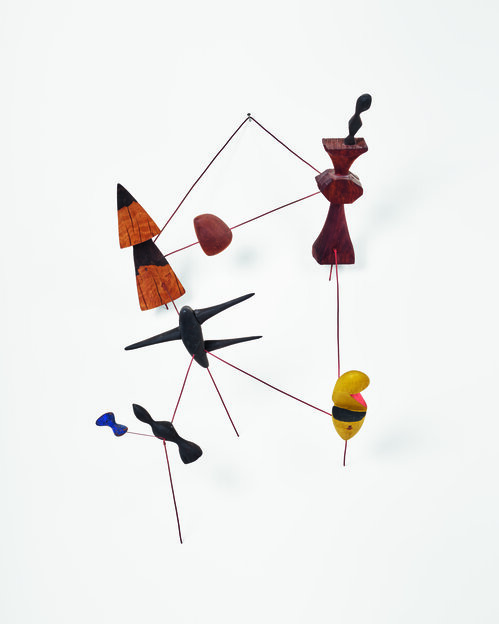
During World War II, the aluminum sheet metal that Calder used in his mobiles became increasingly hard to find, forcing him to improvise with new materials. What eventually emerged were the Constellations, small arrangements of biomorphic wood—some painted, some with the grain exposed—linked together by thin metal rods. Although entirely abstract in conception, they nevertheless suggest a fascination with the cosmos and the poetry of space; some were even designed to be hung high on a wall, inviting viewers to gaze upwards, as if to the heavens.
These works have often been compared to the Constellations of Joan Miró, a series of paintings created between 1939 and 1941 which depict similar arrangements of abstract forms connected by thin, wire-like lines. However, although they were lifelong friends, neither was aware of what the other was working on at the time, as Miró was unable to leave Europe during the war.
Black Widow (1948)

Black Widow is a quintessential Calder mobile, and it’s the first work to greet visitors at the exhibition. The sculpture, which measures 11.5 by 6.5 feet, is a remarkable marriage of art and engineering; its enormous size contrasts with the flowing delicacy of its 19 leaf-like metal panels, some pocked with holes, which seem to hover effortlessly in the air. “I love this idea of opening the show with what you think you know about Calder: a mobile,” said Rower. “And it also happens to be one of the most incredible structures he made in his whole life.”
Since 1948, Black Widow has hung in the São Paulo offices of the Instituto dos Arquitetos do Brasil (IAB) and rarely leaves Brazil. This is its Paris debut.
La Grande vitesse (1:5 intermediate maquette) (1969)

As a trained engineer, Calder always believed his work could exist on any scale. In the mid-1930s, he began to test this theory with large-scale outdoor sculptures. Towards the end of his career, he became a master of monumental form, widely celebrated for both his private and public commissions. La Grande vitesse is a prime example.
Calder designed the piece to occupy the plaza in front of the City Hall and County Administration Building in Grand Rapids, Michigan. The finished work is nearly 50 feet in length, its flowing, organic forms and vibrant red hue evoking a palpable sense of motion, even though it’s stubbornly rooted to the ground. In this sense, the French title (which translates to “High [or Great] Speed”) is both entirely apt and somewhat ironic, while also alluding to the name of Grand Rapids itself.
This 1:5 scale maquette was one of three that Calder used in the process of enlarging the original design to full-size. Technicians completed the finished work under Calder’s close supervision, but he considered these intermediate models to be sculptures in their own right. This particular example was the first civic sculpture in the U.S. to receive funding from the National Endowment for the Arts.
Critter innommable (1974)

Even for Calder, who never stopped experimenting with new ideas and forms, the Critters still stand out. He created these large-scale, free-standing creatures two years before his death, harnessing sheet metal and making a surprising return to figuration after decades of explorations into the abstract.
Their phantasmagorical appearance suggests beings in a state of flux or metamorphosis. Disjointed limbs and other appendages sprout from their torsos at bizarre angles. They feature empty mouths and eyes and walk a fine line between menace and joy.
These pieces unite the looseness and spontaneity of paper cutouts with the weight and solidity of industrial metal. Like all of Calder’s work, they exist in a liminal state between nature and artificiality. As Pagé explained, at this point in his career, “he was completely free. And he was always trying to do something different.”


