

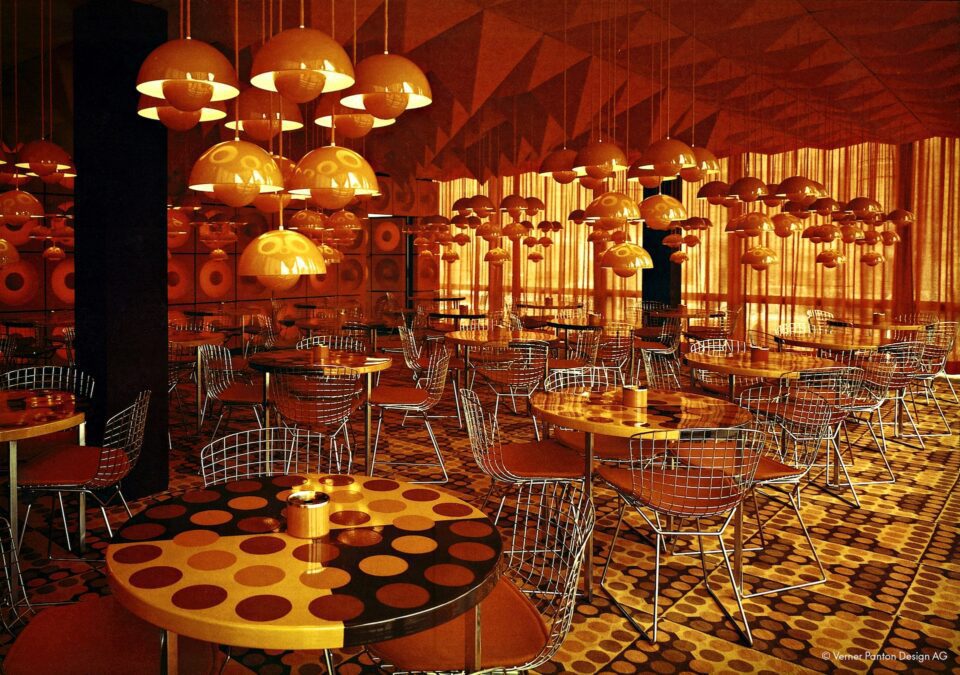
Chairs hung from the ceiling. Colourful playgrounds as interior spaces. Two-metre-high seating towers. This is the world of Danish designer Verner Panton (1926–1998), who is being celebrated by Vitra Design Museum this spring. The retrospective exhibition, Form, Colour, Space, opens in line with the 100th anniversary of Panton’s birth – a centenary which is also to be marked by other major destinations, including the Museum of Decorative Arts in Berlin and Designmuseum Danmark. Panton is recognised for shaping design in the second half of the 20th century, by taking a playful, sculptural approach to domestic space. This show is a chance to be immersed in his vision, to which colour, textiles and light were central.
Panton emerged from the mid-century tradition of Danish furniture design, in which simplicity, functionality and high-quality craftsmanship reigned supreme. He gained his first professional experience in the office of renowned architect Arne Jacobsen, but soon turned in a completely different artistic direction. From the late 1950s onwards, he developed radically new spatial concepts and unconventional living environments, which reflected the changing conventions and lifestyles of the post-war years.
Audiences can expect to see iconic objects such as the Panton Chair, which is regarded as a technical marvel: the first seat without black legs to be made from a single piece of plastic. The Cone Chair and Flowerpot Lamp, both notable Panton designs, are also on display. In addition, there are rarely-shown furniture and architectural projects to discover, drawn from the Verner Panton Archive at the Vitra Design Museum, which includes experiments, models and prototypes, as well as 20,000 plans and drawings.
Another highlight is a walk-in reconstruction of Panton’s legendary Fantasy Landscape (1970), also called the “living cave” – a tunnel-like, organic-shaped structure in which undulating shades of blue give way to a red, orange and yellow core. It was realised in collaboration with the chemical company Bayer, which commissioned him to demonstrate the possibilities of new synthetic materials. The result was classic Panton: a multisensory environment with a distinctive, club-like feel, where hues dictated the atmosphere. “The colour planning is of vital importance,” the designer said of his approach. “It is not enough to say that red is red and blue is blue. I, myself, normally work with parallel colours, whose shades follow each other in the spectrum. Thus, I can control the colour temperature in the room and so create a certain mood.”
The 1960s and 1970s were a moment of change in the worlds of art and design. “It was a time when materials, colours and technologies made ideas possible that would not have been possible before,” says Curator Nina Steinmüller. Form, Colour, Space speaks to this spirit of innovation. “Panton always thought out of the box and broke with design conventions,” she continues. “We want people to leave with a sense of who this unique person was, and to take away the stories behind famous designs like the Panton Chair.”
Verner Panton: Form, Colour, Space is at Vitra Schaudepot from 23 May – 9 May.
Words: Eleanor Sutherland
Image Credits:
1. Fantasy Landscape by Verner Panton at the exhibition Visiona II, International Furniture Fair Cologne, 1970. © Verner Panton Design AG
2. Verner Panton, pendant lamp Topan, 1959, Manufacturer : Louis Poulsen © Verner Panton Design AG, © photo: Vitra Design Museum, Andreas Jung
3. Canteen of the Spiegel publishing house in Hamburg, 1969 © Verner Panton Design AG


