

From Father’s Toolbox to Elemental Abstraction
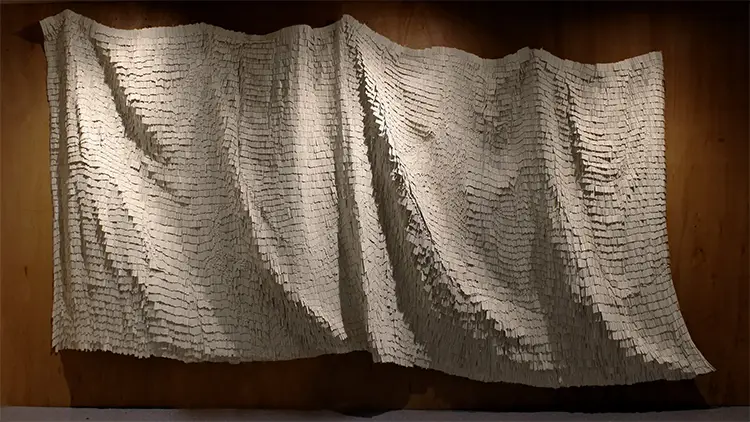
The quiet intensity of Wycliffe Stutchbury’s work begins with an abiding fascination for wood, a material he regards not simply as substance but as witness. His intricate compositions, formed from thousands of handmade miniature shingles, transform salvaged timber into sweeping landscapes that hover between sculpture and relief. These works feel at once architectural and intimate, echoing geological formations while remaining rooted in the scale of the hand. Drawing from materials such as bog oak, holly, and ash, Stutchbury arranges each fragment into elemental configurations that suggest valleys, ridgelines, and shifting ground. The results are immersive surfaces that invite prolonged looking, revealing subtle variations in grain, tone, and texture. Within contemporary art discourse, his practice stands apart for its commitment to provenance and process, insisting that material carries memory. Every piece carries the imprint of weather, soil, and time, turning reclaimed wood into a record of lived landscape.
This devotion to timber traces back to childhood, when a simple encounter with his father’s toolbox left a lasting impression. The careful order of tools nestled in dedicated compartments offered an early lesson in craft, structure, and respect for materials. Stutchbury later trained under master furniture designer Rod Wales, refining technical precision and gaining a deep understanding of joinery and form. For twenty five years he built a successful career as a furniture maker, yet over time he recognized a growing dissonance. The object of furniture no longer held his attention; the wood itself did. After graduating in 3D craft from the University of Brighton, he shifted his focus toward abstract landscapes and sculptural explorations in timber. Early works took the form of highly detailed miniature models displayed in expansive white gallery spaces, but eventually he felt compelled to return to direct engagement with woodworking, guided less by utility and more by material curiosity.
A pivotal moment occurred during an ordinary walk home when he noticed a neighbor’s house being re roofed. Discarded battens lay exposed to the elements, their surfaces altered by rain and sun. Stutchbury requested the timber and carried it away, captivated by the unexpected colors and textures etched into the wood. With his imagination still attuned to miniature scale, he envisioned a small tiled roof. That vision evolved into a textured wall panel clad with diminutive shingles, setting the foundation for the language that now defines his practice. Weathered timber, with its stains, irregularities, and tonal shifts, became his preferred source material. Rather than sanding away its character, he preserves it, seeking wood that tells a story of wind, moisture, and time. The repetition of cutting and placing each shingle establishes rhythm, yet the process remains open ended, responsive to what the timber reveals when split and examined.
Wycliffe Stutchbury: Editing Nature’s Narrative
Central to Stutchbury’s philosophy is the belief that he functions less as a maker imposing vision and more as an editor collaborating with nature. He describes wood as miraculous, citing its capacity to register passing years through rings, density changes, and subtle color shifts. Each cut exposes evidence of growth conditions, environmental pressures, and quiet endurance. In the studio, he approaches timber with attentiveness, allowing grain direction or tonal contrast to dictate the next decision. Design, concentration, and technical skill guide his hand, yet he acknowledges the inevitability of human fallibility. Lines waver, curves resist perfection, and moments of indecision alter intended plans. Rather than correcting every deviation, he embraces this vulnerability. The process begins to resemble stacking firewood, where structure must hold yet variation gives vitality. Through repeated gestures, a pattern emerges that balances intention with surrender.
This tension between control and unpredictability mirrors a broader preoccupation with humanity’s relationship to landscape. Stutchbury reflects on the persistent urge to impose order on the natural world and the simultaneous refusal of nature to conform. His compositions embody that friction. Shingles align into cohesive surfaces, yet subtle distortions and tonal fluctuations disrupt strict geometry. Wood darkens, splits, or bends, quietly asserting its autonomy. Over time, he has learned to relinquish rigid expectations of form and function, allowing the timber to suggest its own presentation. In many design contexts, the inherent beauty of a tree becomes secondary to a predetermined blueprint. Stutchbury resists that hierarchy. He removes distracting elements while highlighting compelling features, carving and cutting with restraint so that the material’s narrative remains legible. The final surface becomes a dialogue between human aspiration and organic insistence, shaped by both discipline and acceptance.
Wood, in his understanding, embodies paradox. It is resilient yet fragile, robust yet susceptible to change. Unlike steel or plastic, it refuses uniformity, offering instead a spectrum of densities, scents, and tactile responses. This variability fuels his commitment to working exclusively with timber gathered from a single location for each piece. Provenance anchors the work, ensuring that soil, climate, and history remain embedded within the composition. He searches for fallen or forgotten trees, drawn to those already marked by exposure and time. The act of harvesting becomes an act of listening, identifying wood that carries visible evidence of its surroundings. In the studio, machining becomes a form of editing, removing certain elements to reveal others, much like a painter selecting from a limited palette. What remains is his medium, a constrained yet expressive vocabulary capable of articulating terrain, memory, and human presence.
Shingles as Topography and Time
From a distance, Stutchbury’s wall works resemble abstract landscapes viewed from above, their surfaces rising and falling in subtle relief. Approaching closer reveals an intricate mosaic of hand cut shingles, each fragment contributing to a cumulative rhythm. Light moves across the angled pieces, generating shifting shadows that animate the composition throughout the day. The repetition of small units creates cohesion, yet no two shingles are identical. Grain lines diverge, knots interrupt smoothness, and color variations introduce quiet drama. This granular complexity rewards sustained attention, encouraging viewers to consider how incremental differences produce expansive visual fields. The works evoke folded hillsides, eroded cliffs, and layered sediment, inviting associations with geology and the passage of deep time. Through modest scale and humble materials, Stutchbury constructs surfaces that feel vast in implication.
The finished pieces operate as explorations of landscape in both physical and metaphorical terms. Ridges, valleys, and contours emerge not through literal depiction but through accumulation and adjustment. Beneath the visible surface lies an implied substratum, suggesting what rests below soil or stone. The annual rings embedded in each shingle speak to growth cycles and environmental conditions, transforming the work into a study of temporal layering. His background in furniture making remains evident in the structural intelligence of these assemblies. Panels hold together with quiet assurance, despite their apparent fragility. Over time, his practice has expanded from modest wall panels to larger multi part installations and even architectural interventions, yet the core language persists. Whether scaled for gallery walls or integrated into buildings, the shingle remains his fundamental unit, a small gesture repeated until it becomes a terrain.
Among his most significant architectural undertakings is the project titled “The Craig,” derived from the Gaelic word for rock. This work reimagined the exterior cladding of a seventeenth century stone barn in Abergavenny, Monmouthshire. Following the contours of the original masonry and the covered aisle running through its center, Stutchbury applied hundreds of shingles in a gently undulating pattern. The intervention responded to the barn’s existing structure rather than obscuring it, tracing its lines and honoring its history. Material for “The Craig” was gathered exclusively from fallen branches in adjacent woodland, reinforcing his commitment to site specificity. By aligning the shingle arrangement with the barn’s architectural rhythm, he created a surface that echoed surrounding hills and stone formations. The project exemplifies his capacity to translate intimate studio methods into broader spatial contexts without losing sensitivity to origin and place.
Wycliffe Stutchbury: Sense of Place as Creative Compass
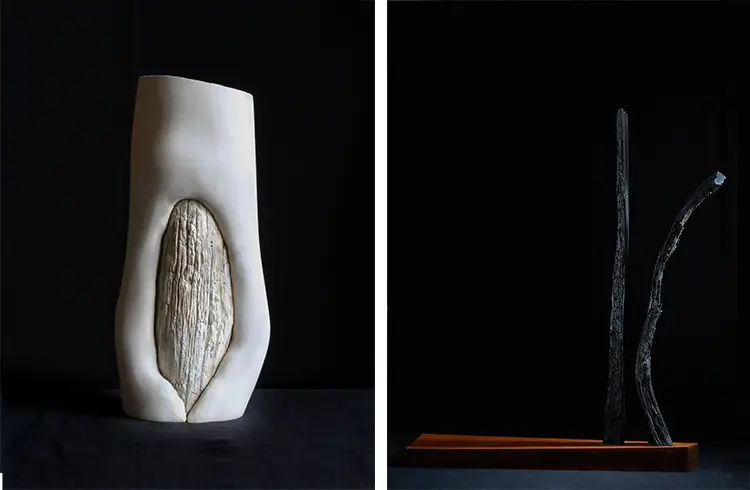
Naming forms an essential component of Stutchbury’s practice. Each work takes its title from the location where the timber was sourced, underscoring his conviction that material and geography are inseparable. Using wood from a single site ensures consistency of environmental influence, binding the piece to specific soil, weather patterns, and shared history. Sense of place becomes more than inspiration; it functions as structural principle. The timber has grown under the same conditions, endured the same storms, and absorbed the same light. These shared experiences generate cohesion within the finished composition. By foregrounding provenance in the title, he invites viewers to consider the journey from landscape to artwork. The name operates almost as a coordinate, anchoring abstraction to tangible ground. In this way, his sculptures and panels serve as cartographic impressions, mapping not through lines on paper but through grain and texture.
Commissions continue to extend this philosophy into diverse contexts, including projects abroad such as a coastal house in Maine, a region known for Shingle Style architecture. There, he plans to clad one elevation using his distinctive approach, allowing local timber and maritime climate to inform the outcome. Despite increasing scale and recognition, his guiding principles remain consistent. He follows where the work leads, accepting that concentration may falter and plans may shift. Through editing rather than domination, he reveals what already exists within the wood. The final compositions stand as studies in narrative beauty, affirming that fallen and weathered material retains vitality. By positioning timber as collaborator rather than raw resource, Wycliffe Stutchbury constructs landscapes that honor both human intention and the enduring agency of the natural world.
The post Wycliffe Stutchbury: Editing Nature into Form appeared first on AATONAU.


