

Five video works by Angelica Mesiti (b. 1976) are now on view at Museum Tinguely in Basel. It’s the first comprehensive solo show of the Paris-based artist to open in Switzerland. Mesiti has worked at the intersection of performance, sound and video since the early 2000s, creating pieces that explore the ways in which nonverbal communication – like dance, music and movement – can build connections between people. It’s an approach that has led to international recognition, including representing Australia – her home country – at the 58th Venice Biennale in 2019. Museum Tinguely’s exhibition is, fittingly, called Reverb – in reference to both acoustic reverberation, and the way human relationships endure across time.
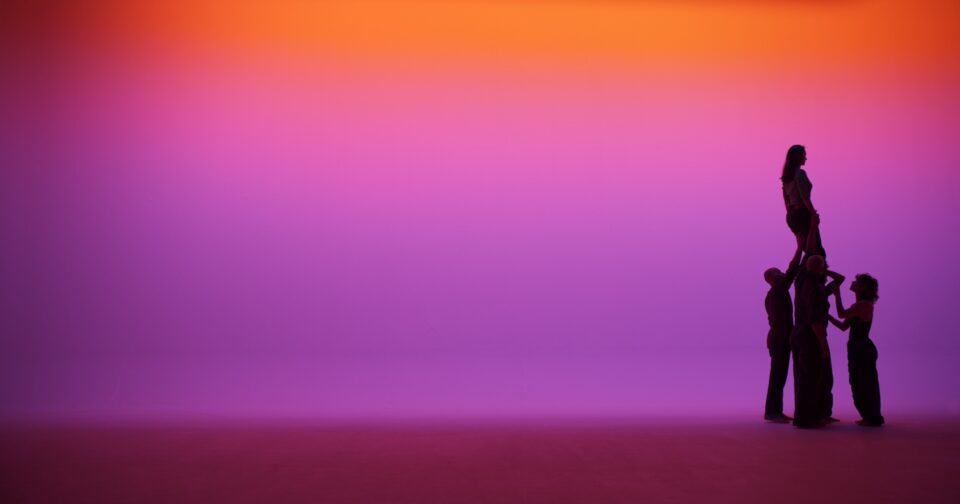
It features her most recent work, The Rites of When (2024), a seven-channel installation that draws on a long tradition of musical tributes to the changing seasons (think Vivaldi, Tchaikovsky or Stravinsky for classical references, or Lana del Rey and Taylor Swift for contemporary touchpoints). The immersive experience pulls inspiration from the Nebra sky disc, a 3,600-year-old artefact that may have served as an agricultural calendar. But that’s not all. Its seven screens represent the primary stars of the Pleiades constellation, central to numerous myths surrounding humanity’s connection with the natural world.
Finally, the video itself is divided into two acts – one representing the winter, the other referencing the summer solstice. They feature choirs, dance and electronic compositions, with the goal of exploring what rituals might look like in an ecologically uncertain future. Mesiti explains: “Our hyper-capitalist, Western, urban, technological way of living has led us adrift. With this work, I was making a quasi-science fiction, utopian, speculative adventure about our out-of-sync world. What would it look like if we made up new rituals and communal activities for the present that were about trying to realign with natural cycles?”
A Hundred Years (2020) also taps into the seasons, but it looks back rather than forward. Set on the battlefields of the Somme in France, a century after World War I, it shows how nature has since reclaimed the land. Yet, on closer inspection, craters, trenches and a single tree remain as “silent witnesses.” In the film, musician Julien Desailly walks in endless circles within the Lochnagar Crater, which was formed by a mine explosion on 1 July 1916 – the beginning of the Battle of the Somme and one of the bloodiest days of the war. It’s a powerful meditation on the traces left by conflict, on both landscapes and collective memory.
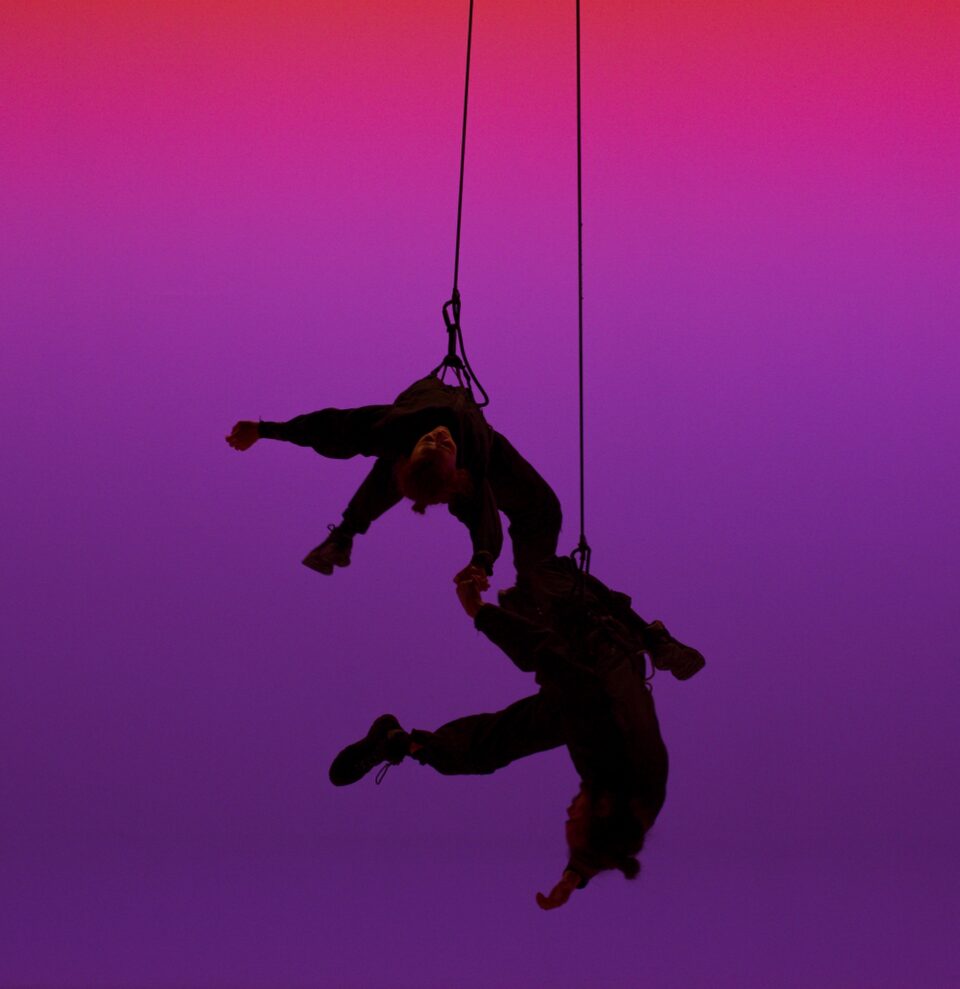
Sidereal (2024) is one of the show’s most visually striking elements. It features two dancers who are suspended against a colour-shifting background, which is designed to change like the light of day. The effect is James Turrell-esque, with oranges, pinks and purples blending into one another. The choreography, meanwhile, recalls the movement of celestial bodies or satellites – a timely topic given the 1 April liftoff of Artemis II’s 10-day moon mission. The work’s title refers to “sidereal time”, which is an astronomical timescale based on the Earth’s rotation in relation to stars, rather than the sun.
Other key works include Relay League (2017), based on the final message sent in morse code by the French Navy in 1997, marking its transition to digital communications. It read: “Calling all. This is our last cry before our eternal silence.” Here, readers might be reminded of Brigitte Kowanz, who made many pieces based on the iconic dots and dashes, as well as other groundbreaking moments in telecommunications – from the first email to the launch of Google, the iPhone and Wikipedia. Her posthumous retrospective in Vienna last year featured 90 artworks that riffed on the rise of the information era.
Elsewhere in the show, visitors will discover Prepared Piano for Movers (Haussmann) (2012), which depicts two people in Paris carrying a grand piano up six flights of stairs. The point: even in the post-industrial age, where AI is making headlines every day, some tasks still depend entirely on human collaboration and labour. The soundtrack stands out here; it is a chance-based composition – the piano was prepared with objects placed inside that create unpredictable percussive sounds with every movement.
Overall, Reverb is a reminder that human beings always leave a mark. Time passes, technologies evolve, but the traces of our presence — whether through a simple gesture, an act of service, or something more violent — endure. The show also confirms what we already knew: Mesiti is a master of multimedia, whose installations continue to captivate, immerse and entrance audiences wherever they are exhibited.
Angelica Mesiti: Reverb is at Museum Tinguely, Basel, until 30 August.
Words: Eleanor Sutherland
Image Credits:
1. Angelica Mesiti. Reverb at Museum Tinguely, Basel, 2026. The Rites of When. © 2026 ProLitteris, Zürich; Copyright the artist. Courtesy the artist, Galerie Allen, Paris, and Anna Schwartz Projects, Melbourne. Commissioned by the Art Gallery of New South Wales. 2026 Museum Tinguely, Basel; Pati Grabowicz.
2. Angelica Mesiti, The Rites of When (video still), 2024. © 2026 ProLitteris, Zürich; Copyright the artist.
Courtesy the artist, Galerie Allen, Paris, and Anna Schwartz Projects, Melbourne. Commissioned by the Art Gallery of New South Wales. 2026 Museum Tinguely, Basel; Pati Grabowicz.
3. Angelica Mesiti, Sidereal (video still), 2024. © 2026 ProLitteris, Zurich; Copyright the artist. Courtesy the artist, Galerie Allen, Paris, and Anna Schwartz Projects, Melbourne. Coproduction of the Fonds cantonal d’art contemporain and the Fonds d’art contemporain de la Ville de Genève for the Mire programme.
4. Angelica Mesiti, The Rites of When (video still), 2024. © 2026 ProLitteris, Zürich; Copyright the artist.
Courtesy the artist, Galerie Allen, Paris, and Anna Schwartz Projects, Melbourne. Commissioned by the Art Gallery of New South Wales.


