

Proximitites, a wide-ranging exhibition of art from the United Arab Emirates (UAE) at the Seoul Museum of Art (SeMA) opened in a far more innocent world last December than when it closed on 29 March, several weeks into the US-Israeli war on Iran that has quickly escalated to include most of Gulf countries and beyond. The nuanced societal shifts and daily life in the UAE presented in Proximities—intended to balance out Emirati stereotypes of gilded excess—have abruptly become echoes of a pre-war existence.
“We were given complete freedom to really curate and think about the thematics without any interference,” says the independent curator Maya El Khalil, who co-organised the show with SeMA staff curator Eunju Kim alongside six artist-curators. “The whole idea was actually to present the multiple perspectives of these artists, of the work that’s taking place in the UAE, and also [art by] foreign resident artists. So there’s a lot of works that are revisiting or commenting on a certain socio-political reality.”
She cites Layan Attari’s Zen Dubai Fountain Soothing Water Sounds for Relaxation, Meditation, and Inner Peace (2019), a sculptural audio work that plays water sounds from the famous Dubai fountain—stripped of its usual music accompaniment—heard through an artificial conch shell. “It’s quite an interesting and poetic work, given the idea of the UAE being a coastal country, and [its] historic relationship with the sea. But also the reclaiming of the land that’s taking place, and […] how the landscape has changed […] how Dubai also is creating these fake [bodies of] water.”
Layan Attari’s Zen Dubai Fountain Soothing Water Sounds for Relaxation, Meditation, and Inner Peace (2019) Photo: Cocoapictures
The show of more than 110 artworks by 47 UAE-based artists (33 of whom are Emirati), spread over SeMA’s upper two floors, opened with a section titled A Place for Turning curated by the photographer Farah Al Qasimi. It included the artist’s bright maximalist photographs of private spaces and her compellingly funny video Um Al Naar (Mother of Fire) (2019), a mockumentary about a mischievous spirit, known in Arabic as jinn. Appearing in several sections are Shaikha Al Ketbi’s videos and photographs of ghostly, faceless figures haunting empty pools and abandoned playgrounds—including Sigh (2019) and Al Ukhra (2019)—in tribute to the nostalgiac pangs of spacial change.
Another section, Recording Distance, Not Topography curated by the artists Mohammed Kazem and Cristiana de Marchi, included Kazem’s photographs and videos Window 2003-2005 (2005) capturing the construction of a Dubai high rise through a window, as well as the lives of the migrant labourers who built it and the resulting fancy hotel that, due to social discrimination, they were unlikely to ever enter.”
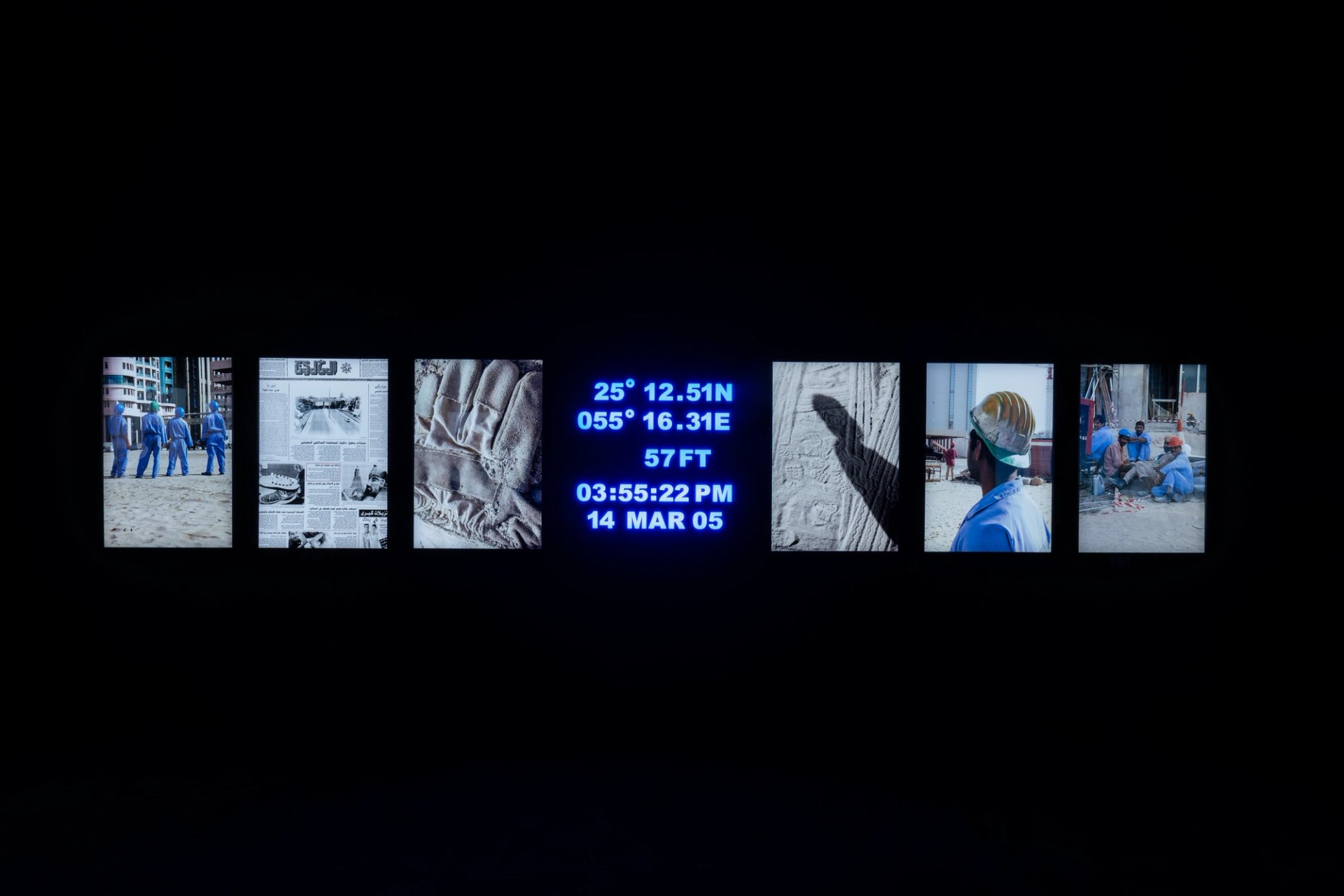
Mohammed Kazem’s Window 2003-2005 (2005) Photo: Cocoapictures
The show is a collaboration between SeMA and Abu Dhabi Music & Arts Foundation, and seems to be part of the former’s efforts to connect directly with the cultures of other non-Western countries, without the usual Western intermediaries (another example is Working for the Future Past, a show of Latin American artists in 2017-18). Proximities was preceded by an exhibition of Korean art titled Layered Medium: We Are in Open Circuits that opened in Abu Dhabi in May 2025 and was co-curated by El Khalil and SeMA curator Kyung-hwan Yeo.
Though national shows always run a risk of artwashing, especially for countries with as many complexities as the UAE, Proximities went soft on the soft power. Instead it created a sense of place and sought to establish commonalities with South Korea, as former colonies turned economic juggernauts. “The UAE and Korea have a very similar history. We [experienced] colonisation from Japan and the UAE [experienced] colonisation from the UK,” Kim says. “Both had a very rapid process of development economically [and] share a very similar social environment.”
Proximities showed, in particular, the powerful female and feminist artist voices of the region including the under-appreciated and wide-ranging nuances of women’s experiences there and their battles to be better heard. Aliyah Al Awadhi’s painting Corpse (2022), depicting a naked woman hogtied and served on a platter, laments the devolution of reproductive rights in the US, according to the wall text.
Omitted from the show, though, is the two countries’ commonality as political protectorates of the US, which maintains military bases in both. In the final weeks of the exhibition, US bases in the UAE began taking Iranian fire in retaliation for the US-Israeli bombardment of Iran. It recalls the high cost South Korea has paid for its US protection, including the US carpet bombing of Seoul following North Korea’s invasion of South Korea in 1950. But as in works like the video of Maitha Ali’s performance work Goat House (2021)—presenting migration from Iran to the Gulf as told through memories, contrasting Arabic dialects, and the sunset over a goat shed made up of fragments from destroyed homes—the scars are loud even when the wounds are silent.


