

When he left NYU’s Tisch School of the Arts in the early 1990s, the acclaimed British artist-filmmaker Steve McQueen said it was because “they wouldn’t let you throw the camera up in the air.” In his three-decade career, McQueen has amassed Oscar, BAFTA and Golden Globe awards as well as the Turner Prize. Across his video works, television series and feature films – including the 2014 Oscars Best Picture winner 12 Years a Slave and the Cannes Camera d’Or -winning debut Hunger (2008) – he seems to suggest that understanding the most extreme boundaries of humanity requires pushing our own limits as viewers. Tension, intensities, darknesses and silences are all raised, in service of getting at the truths of what we’re often too paralysed to name. “It’s about not blinking,” McQueen has previously said, and his subject matter ploughs new depths to get there. In Western Deep (2002), for instance, he takes us down into the world’s deepest gold mine, South Africa’s TauTona. It’s an extremely immersive atmosphere – the claustrophobia, dust and noise is unforgettable. When McQueen throws the camera, we have to catch it.
McQueen has cited influences in Andy Warhol, Buster Keaton, Ingmar Bergman, Okwui Enwezor and the French New Wave. The artist is from west London, born in 1969 to a Grenadian father and Trinidadian mother. His work often centres Black subjects, focusing on recurring themes of boyhood, masculinity, criminal justice and colonialism, whilst engaging with the afterlives and contemporary realities of oppressive systems in both Britain and USA. From his childhood in a racist British school environment to the glittering peaks of Hollywood and the western art world, his works do what most of us are too afraid to even consider: see the pain and fragility of the human condition, down to its core. But they also capture a distilled sense of being alive – a near-magic vibrancy, resilience and creativity. This duality is exemplified by the two-channel Ashes (2002-2015), where the construction of a young Caribbean man’s tomb, following his murder, is juxtaposed with blissful scenes of him sailing on his boat.
Many know McQueen for his seminal video, television and film work. Recent examples include Grenfell (2019), a powerful and unflinching response to the 14 June 2017 fire in which 72 people – to whom the piece is dedicated – tragically lost their lives. He has also ventured into more abstract territories of late, via immersive light and sound installations like Bass (2024). Now, after settling with his family in Amsterdam over 20 years ago, he is opening his first solo show in the Netherlands: Atlas at De Pont Museum. The exhibition spans mixed-media within four works and is curated by Martijn van Nieuwenhuyzen and Maria Schnyder, in close collaboration with the artist. A newly-commissioned piece, Atlas, appears alongside Sunshine State, a 2022 spatial, multi-channel video installation about McQueen’s father, recently acquired by the museum. Additionally, a 2025 sound piece, Untitled, is on display, as is the 2024 photo series, Bounty.
“What we see throughout Steve McQueen’s work is a constant desire to question how images function and how histories are told,” says van Nieuwenhuyzen, who is the Director and Chief Curator of De Pont Museum in Tilburg. “He often takes familiar materials – archival film, historical narratives, scientific data – and transforms them in unexpected ways.
By slowing down images, reversing them, separating sound from picture or translating data into visual form, he opens up new ways of seeing. That experimental attitude is central to his practice. Formally, the works also share a very precise orchestration of rhythm, repetition, silence, light and space.”
De Pont Museum used to be a wool-spinning mill, and McQueen has taken inspiration from its abundant spaces and long sightlines across the galleries, particularly for the work Atlas. For this, he used astronomical data gathered by the European Space Agency’s Gaia mission, recording the position, movement and brightness of over one billion stars. Collaborating with Alejandro Stefan Zavala, davidkremers and Julian Humml, he transformed the mass of telescope data into a mesmerising visual installation. “Using autonomous machine-learning models, the data is translated into moving images. But the result is not a literal scientific visualisation,” explains van Nieuwenhuyzen. “[It] creates a poetic and immersive journey through space. Visitors encounter an experience that is empirically grounded and highly evocative.”
Sunshine State is one of McQueen’s most personal works, reflecting on a specific episode from his father’s life. In the 1950s, he travelled from Grenada to Florida, where he experienced racial violence whilst working as a seasonal labourer during the orange harvest. The work does more than recount the experience. It opens with footage of the burning sun, which gives way to a narration of his father’s story layered over altered excerpts of the The Jazz Singer (1927). The musical drama is recognised as the first feature-length film, or “talkie”, to include synchronised dialogue. Notably, McQueen focuses on scenes in which the lead actor, Al Jolson (1886–1950), applies blackface, ahead of going on stage to perform. McQueen “reverses, slows and inverts the imagery so that black becomes white and white becomes black.” He stretches the clips out across four projections, never precisely syncing them to further distance the sound and image. Here, McQueen intertwines close familial experiences with the wider lineage of cinema. It’s an example of the artist’s interest in “how individual experience relates to larger historical structures,” a thread which runs throughout the show.
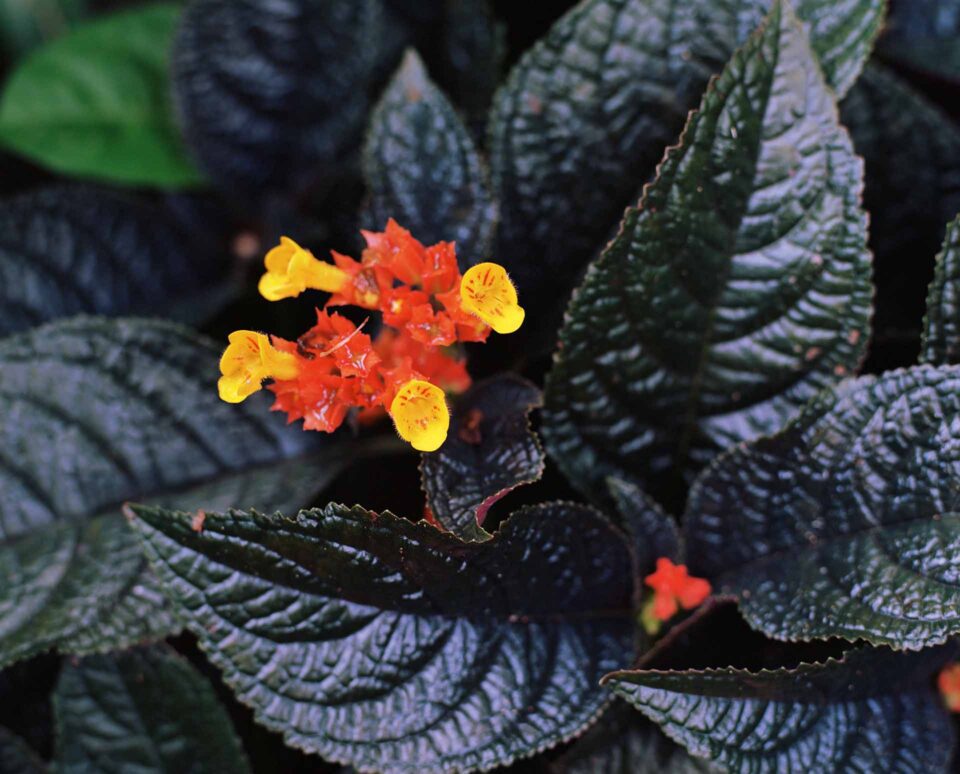
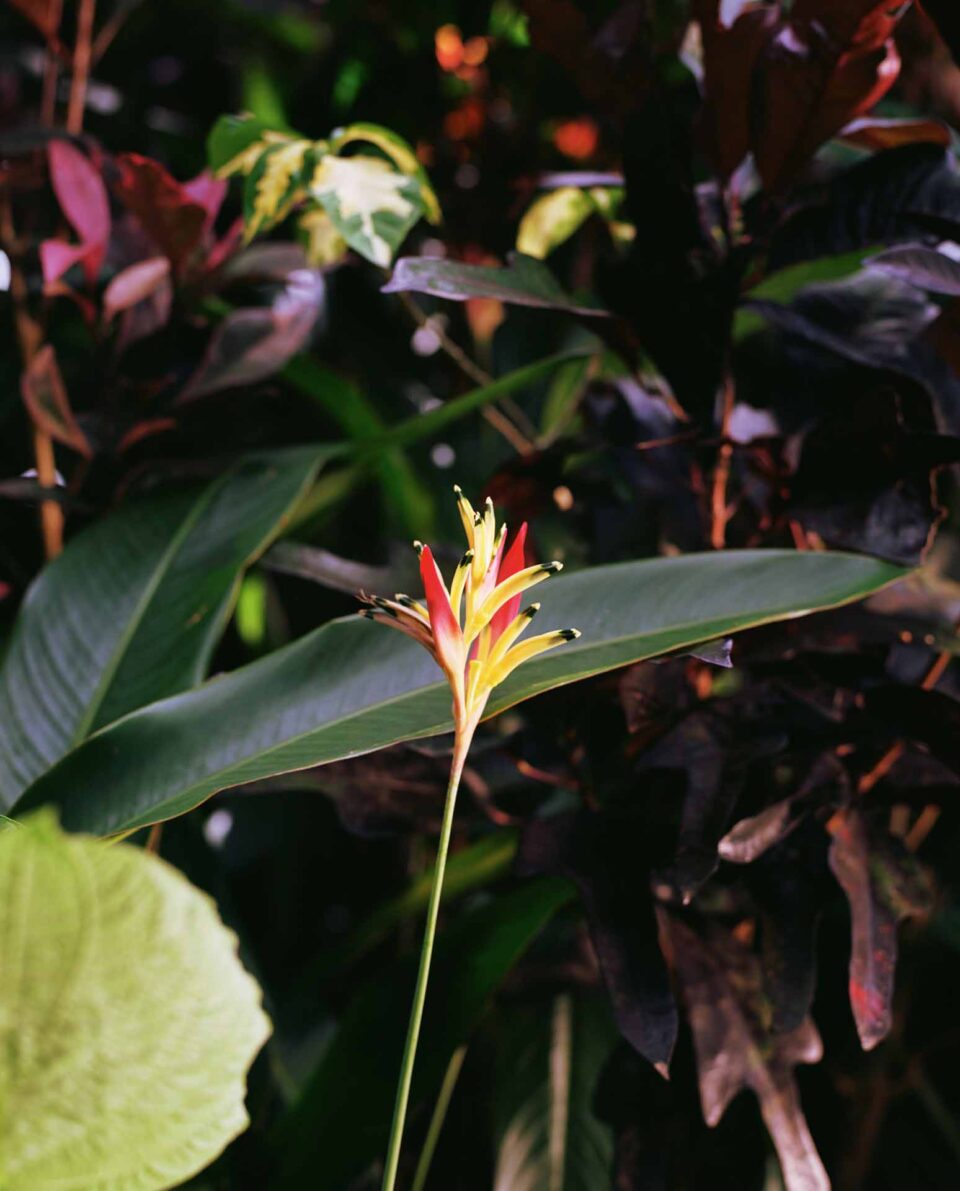
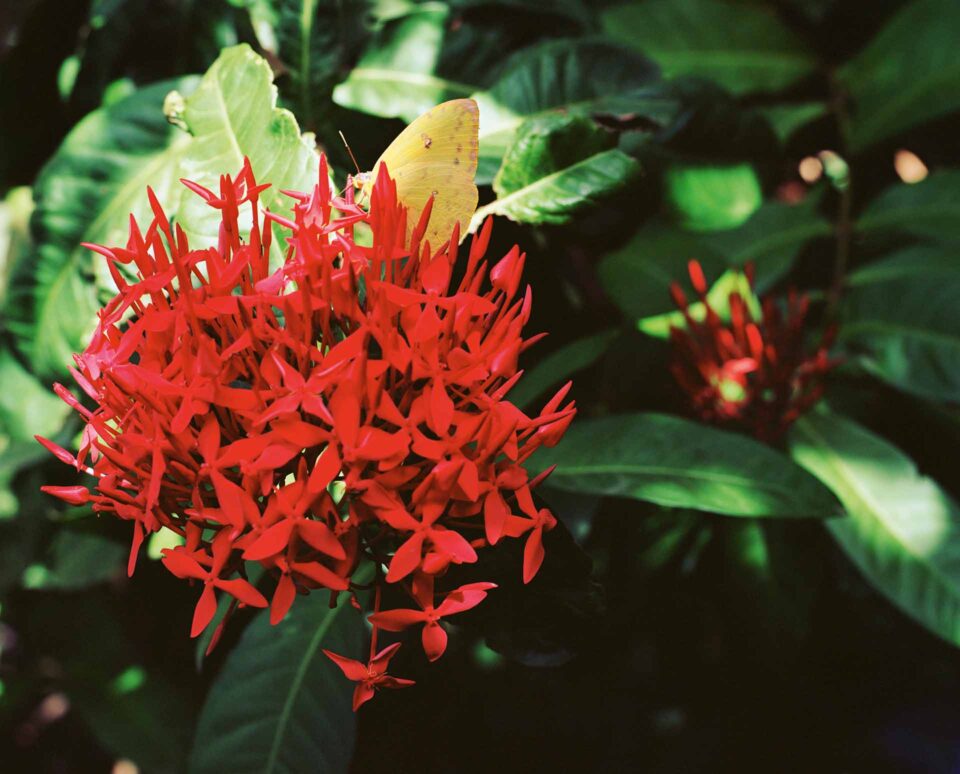
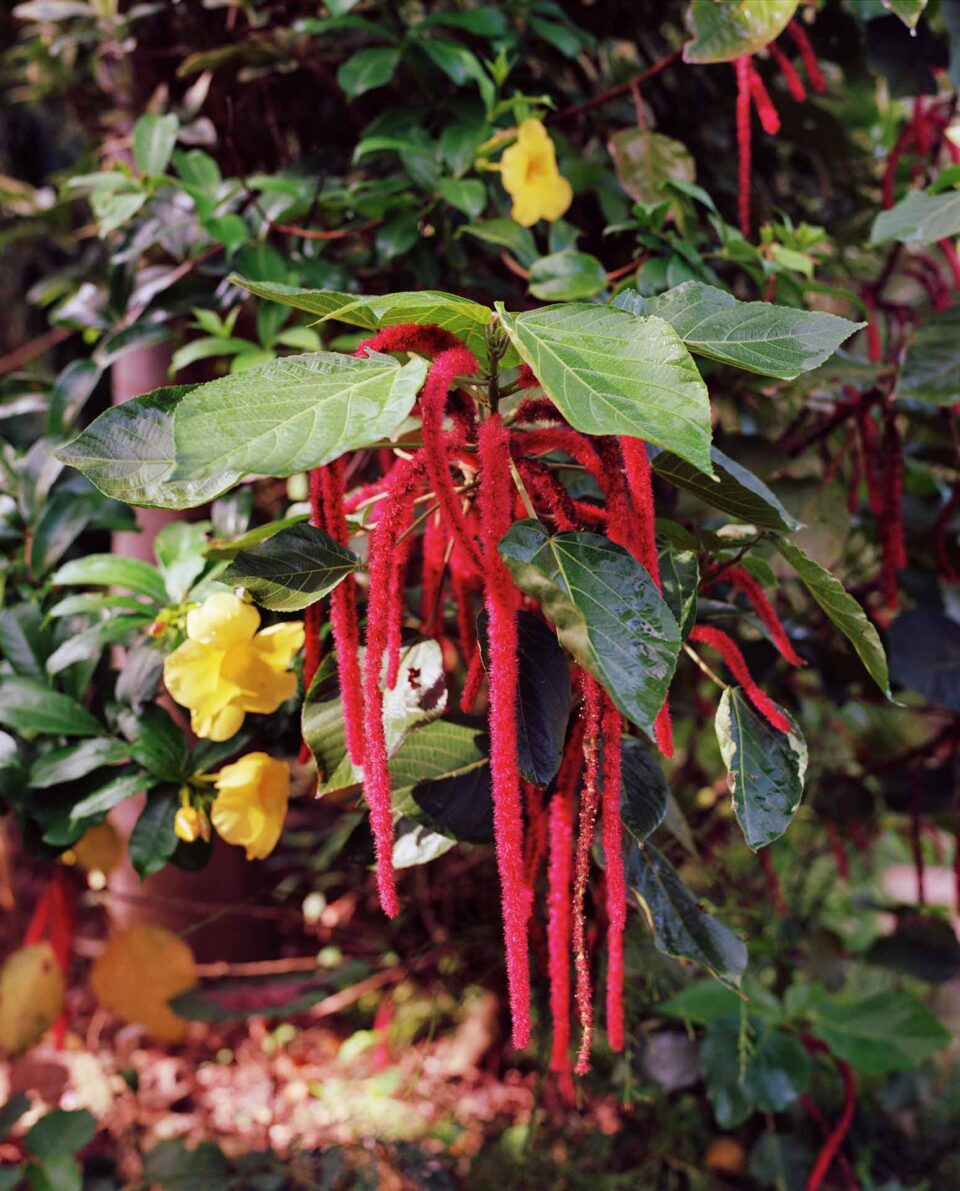
McQueen returns to Grenada, and its colonial history, in the 47-part colour photo series Bounty. Here, the moving image comes to a standstill, allowing for a more direct, contemplative gaze. The images are not focused on human bodies, but tropical blooms and plants native to the island. They “invite viewers to spend time with the extraordinary beauty of these flowers whilst gradually becoming aware of the darker histories embedded in that landscape – histories of colonisation, forced relocation and slavery,” van Nieuwenhuyzen explains.
When Grenada was under colonial rule, the Indigenous population was systematically killed, and the enslaved further exploited; yet flora continued growing abundantly. The simultaneous oppression and resistance by the life forms on the island appears in the series’ double definition: “bounty” meaning abundance, and “bounty” meaning reward for a capture or killing. The work retorts at those with romanticised, picturesque visions of the Caribbean. It affirms that these beautiful landscapes are still shaped by violence, and asks: what does this do to our understandings of a place’s beauty?
For the Bounty show at Marian Goodman Gallery last year, McQueen described the flowers “as flesh wounds, as hurt, as pain.” Yet, they are strikingly beautiful, mesmerising and somewhat innocent-looking. They have done nothing wrong, only insisted on their survival. These flowers are metonymic of Grenada as a scarred, sovereign nation – and as a home.
Through Bounty, McQueen joins several other contemporary artists who are working with plants and botanical imagery to examine colonial pasts. Kapwani Kiwanga’s ongoing Flowers for Africa series, for example, involves research into bouquets shown in archival photographs of ceremonies marking the Independence of African nations. Kiwanga then collaborates with local florists to recreate the displays, exhibiting them on plinths where they are left to wilt and decay.
Another take comes from American multidisciplinary artist Taryn Simon (b. 1975), whose 2015 photographic series, Paperwork and the Will of Capital, presents flowers as politically loaded. Simon researched international treaties, agreements and political meetings that occurred between 1968 and 2014. For each, she sourced archival photographs chronicling when the leaders signed their documents. Instead of reproducing the image, however, she identified the flower arrangement in the photograph, recreated it with a florist, then shot it in a highly controlled studio setting against a neutral background. Finally, the large-format print – often resembling a Dutch still-life painting – is paired with a caption that describes the political agreement it references and its reverberating impacts. Where Kiwanga and McQueen take a specifically decolonial approach, Simon’s framework is wider, examining the aesthetics of bureaucracy, power and capital.
Meanwhile, running concurrently with Atlas, is Botanical Tales and Seeds of Empire, by contemporary British Punjabi artists The Singh Twins. It’s on view in London at Kew’s Shirley Sherwood Gallery until 12 April, and is based off the Gardens’ botanical archives. The duo explores the interlinking histories of horticulture, empire and trade within the context of British colonialism. They navigate the role of cotton, dyes and spices in imperialist expansion, whilst also emphasising the plants’ traditional cultural significance and symbolism.
The beauty of nature, versus its darker implications, continues to provide fertile ground for investigation. Indeed, the Twins’ short film named King Cotton: An Artist’s Tale looks at why plant commodification is still a highly relevant subject today. In 2023, The Guardian ran Cotton Capital, a series looking at its founders’ links to transatlantic slavery. These are reminders that colonial systems have far from disappeared, only absorbed and refitted themselves into modern global supply chains. Crops grown in the Global South are still frequently produced for export markets controlled by multinational corporations, continuing to perpetuate vast economic inequalities, and leaving communities and populations mired in cycles of poverty, crime and sickness. It’s why a series like Bounty has great resonance, especially when coming from McQueen, who has a personal relationship to the land he is documenting. In a way, the flowers in Bounty are ancestral figures finally being paid their due reverence.
The collaboration between McQueen and De Pont Museum evolved organically out of a family visit in 2021. It has crystallised into a particularly significant moment for the institution, especially with the obtainment of Sunshine State. “For us as a museum, the work is extremely significant because it brings together many of the key themes in McQueen’s practice: personal memory, race, representation and the power of images,” says van Nieuwenhuyzen. “It is both deeply intimate and historically resonant.” This is one of the most influential artistic visionaries of our generation at the top of his game.
Image Credits:
1 Steve McQueen, Bounty 22, (2024). © Steve McQueen. Courtesy the artist, Thomas Dane Gallery and Marian Goodman Gallery.
2. Steve McQueen, Bounty 2, (2024). © Steve McQueen. Courtesy the artist, Thomas Dane Gallery and Marian Goodman Gallery.
3. Steve McQueen, Bounty 7, (2024). © Steve McQueen. Courtesy the artist, Thomas Dane Gallery and Marian Goodman Gallery.
4. Steve McQueen, Bounty 4/5, (2024) (detail). © Steve McQueen. Courtesy the artist, Thomas Dane Gallery and Marian Goodman Gallery.
5. Steve McQueen Bounty 40, (2024). © Steve McQueen. Courtesy the artist, Thomas Dane Gallery and Marian Goodman Gallery.
The post Histories Connected appeared first on Aesthetica Magazine.


