

Ideas of permeability, interdisciplinarity and civic imagination form the conceptual backbone of Isamu Noguchi: ‘I am not a designer’, a retrospective that reframes authorship through movement between categories rather than allegiance to any single one. The exhibition foregrounds the collapse of boundaries between sculpture, architecture and design, asking how objects function socially as much as aesthetically. It also considers how creativity might inhabit the everyday, extending beyond the gallery into the lived environments of cities and communities. At its core is Noguchi’s own provocation, articulated in 1949, “I am not a designer,” a statement that destabilises disciplinary hierarchies while opening a more expansive field. This is a repositioning, an insistence that design is not subordinate to art but coextensive with it. Such a thesis resonates with contemporary concerns around participation, access and the politics of space.
Rooted in a transnational identity, Isamu Noguchi developed a practice informed by movement between Los Angeles and Japan, shaped by the influence of a Japanese poet father and an American writer mother. This dual perspective became foundational, enabling him to synthesise Eastern and Western philosophies into a distinct visual language. Widely regarded as one of the 20th century’s most influential artists, Noguchi’s work traversed sculpture, landscape design, theatre and industrial production. His collaborations ranged from figures such as Martha Graham to architects and manufacturers, underscoring his refusal of disciplinary isolation. Early works like Play Mountain (1933) signalled an enduring interest in participatory environments, while later commissions for public plazas and memorials demonstrated his commitment to civic engagement. Iconic designs, including his work with Herman Miller and the celebrated Akari light sculptures, remain embedded in global design consciousness. Across decades, Noguchi maintained a belief that art should be lived with, encountered and inhabited.
Framed by a deep institutional history, the exhibition at the High Museum of Art marks the first comprehensive design retrospective of Noguchi’s work in nearly a quarter century. Running from 10 April to 2 August before touring nationally, it gathers nearly 200 objects, many of which have never been exhibited. As Director Rand Suffolk notes, “This exhibition is an incredible opportunity to bring so many of his rare and important works together,” emphasising both the scale and rarity of the presentation. The High’s historical connection to Noguchi is particularly resonant, having commissioned Playscapes in 1976, his only realised playground in the USA during his lifetime. That project, situated in Piedmont Park, continues to function as a living artwork embedded within the city’s social fabric. The exhibition’s national tour to the Peabody Essex Museum and the Memorial Art Gallery of the University of Rochester further underscores its institutional significance. It is both a scholarly undertaking and a public-facing proposition.
Organised through a sequence of thematic sections, the exhibition opens with a striking introduction centred on Song of the Bird (1958), a rarely seen sculptural work derived from an unrealised architectural commission. From here, Making Multiples examines the role of reproducibility within Noguchi’s practice, situating industrial design alongside fine art through works such as Radio Nurse (1937) and his furniture collaborations. Archival material reveals the breadth of his early experiments and the network of collaborators who informed them, complicating distinctions between authorship and production. Elements of Architecture shifts scale, exploring Noguchi’s engagement with interiors, architectural language and spatial thinking through lighting designs, maquettes and projects such as Hiroshima’s Peace Memorial Park. The inclusion of the stage set for Seraphic Dialogue (1955) underscores his sensitivity to movement and temporality, expanding architecture into performance. The final section, Shaping Spaces, draws these threads together through models, films and realised projects that demonstrate how Noguchi’s environments, from playgrounds to civic plazas, actively shaped social experience.
Underscoring this curatorial framework, Monica Obniski says, “Today we think about design as expansively as Noguchi thought about sculpture during his lifetime,” reframing his practice through a contemporary lens. The exhibition consistently resists hierarchy, presenting design as integral rather than supplementary to his sculptural output. Co-curator Marin R. Sullivan reinforces this position, observing that the show “demonstrates how generative and interconnected the two disciplines were to his practice as a whole.” What emerges is a practice defined not by medium but by method, one that privileges experimentation, collaboration and adaptability. The thematic structure allows these connections to unfold gradually, revealing the continuity that underpins seemingly disparate works. In doing so, the exhibition reframes Noguchi not simply as a sculptor or designer but as a thinker operating across systems.
Extending beyond its historical scope, the exhibition inevitably prompts consideration of Noguchi’s influence on contemporary practice. Artists such as Olafur Eliasson, Theaster Gates and Do Ho Suh continue to explore the intersections of space, participation and social function in ways that echo his approach. Eliasson’s immersive installations foreground perception and environment, while Gates’ work reconfigures urban space through community engagement. Suh’s architectural fabrications, meanwhile, interrogate memory and displacement with a sensitivity to lived experience that recalls Noguchi’s own concerns. Each operates across disciplines, resisting categorisation in favour of fluid, responsive practices. Their work underscores the enduring relevance of Noguchi’s thinking within a contemporary context. Influence here is not direct but atmospheric, shaping a broader field of enquiry.
Situated within a wider programme of internationally significant exhibitions, the presentation at the High signals a continued commitment to cross-cultural dialogue and interdisciplinary enquiry. The museum’s recent trajectory has foregrounded exhibitions that bridge historical narratives with contemporary concerns, positioning design and art as mutually informing practices. Within this context, Noguchi’s retrospective emerges as both timely and necessary, offering a model for how creativity can operate beyond fixed definitions. Its emphasis on participation, accessibility and the integration of art into everyday life reflects broader institutional priorities. At the same time, it reinforces the importance of revisiting canonical figures through new critical frameworks.
Isamu Noguchi: ‘I am not a designer’ proposes a redefinition of artistic practice that feels profoundly relevant to the present moment. By foregrounding the intersections between object, environment and experience, it positions Noguchi’s work as a living methodology rather than a closed historical chapter. His assertion, “I am not a designer,” resonates as an invitation to think differently about how art functions in the world. The exhibition leaves open the question of where art begins and ends, suggesting that its most meaningful impact lies in how it is encountered. In this sense, Noguchi’s legacy is not simply preserved but activated.
Isamu Noguchi: I am not a designer is at High Museum of Art, Atlanta from 10 April – 2 August: high.org
Words: Simon Cartwright
Image Credits:
1. Louise Dahl-Wolfe (American, 1895–1989), Isamu Noguchi, 1955, gelatin silver print. © Center for Creative Photography, Arizona Board of Regents. © 2026 The Isamu Noguchi Foundation and Garden Museum, NewYork / Artists Rights Society (ARS), New York.
2. Designed by Isamu Noguchi (American,1904–1988), Gardens for UNESCO, Paris, 1956–1958. The Noguchi Museum Archives, 150822.© 2026 The Isamu Noguchi Foundation and Garden Museum, New York / Artists Rights Society (ARS), New York.
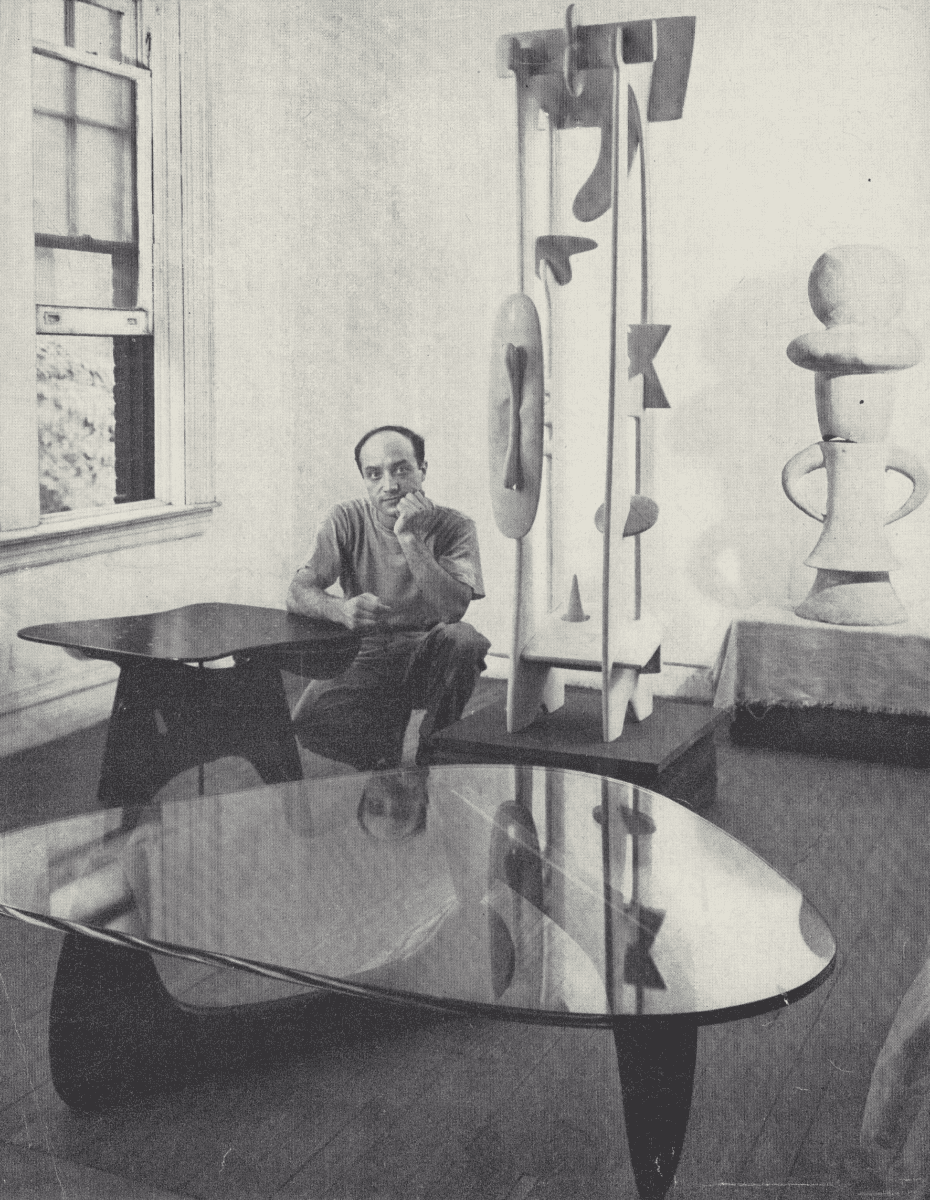
3. Isamu Noguchi with a Chess Table (IN-61), Coffee Table (IN 50), Statue, and The Queen in his MacDougal Alley studio, New York, from “Sculptor Noguchi Designs Free-Form Tables, ”House &Garden, January 1948. Photo by Geoffrey Baker / The Noguchi Museum Archives, 143954. © 2026 The Isamu Noguchi Foundation and Garden Museum, New York / Artists Rights Society (ARS), New York.
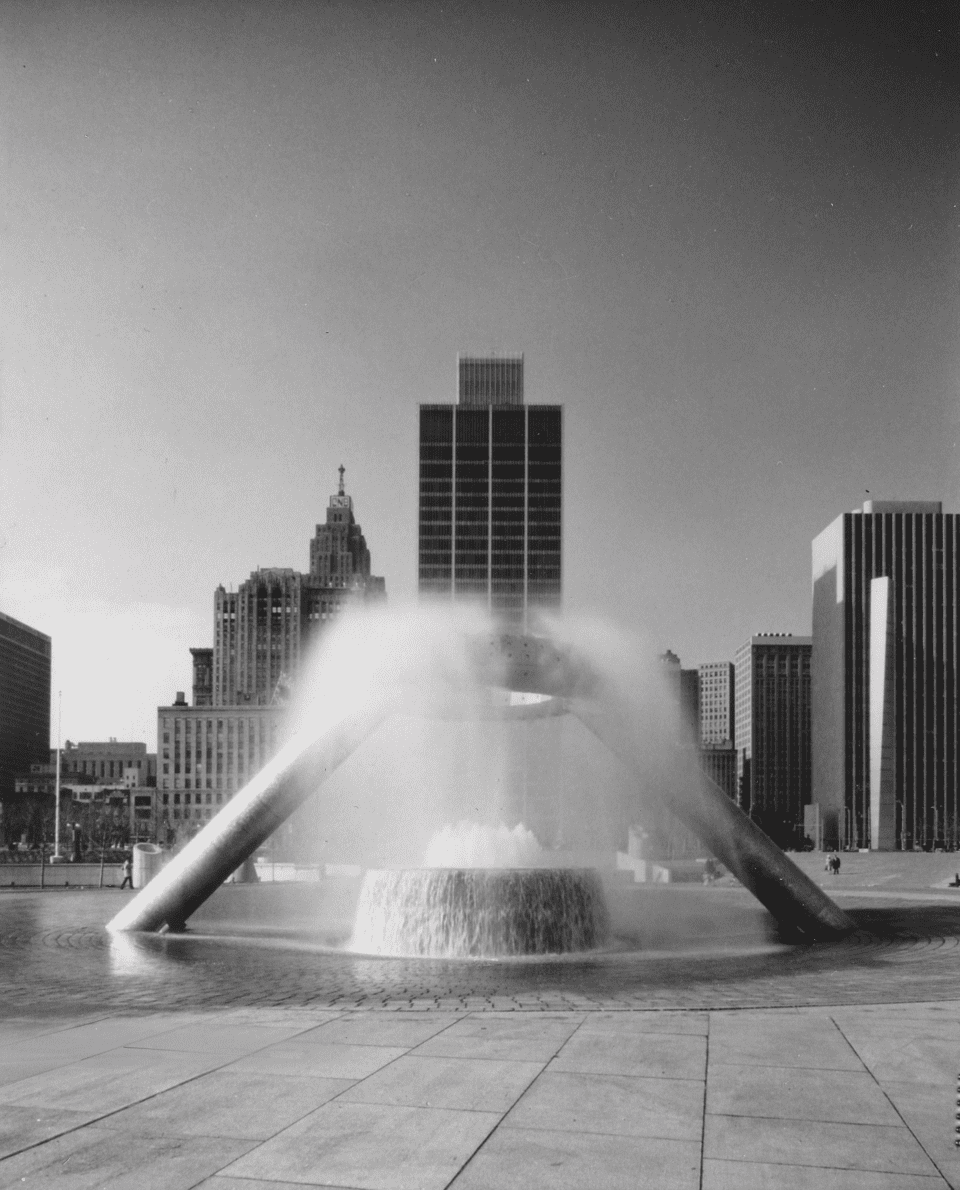
4. Designed by Isamu Noguchi (American,1904–1988) with Shoji Sadao (American, 1927–2019), Horace E. Dodge Fountain, Philip A. Hart Plaza, Detroit, 1971–1979. The Noguchi Museum Archives, 02126. ©2026The Isamu Noguchi Foundation and Garden Museum, New York / Artists Rights Society (ARS), New York.


