

For Paul Arnhold, the acts of making and collecting go hand in hand. The New York-based glassblower is also the fourth-generation heir to one of the world’s greatest collections of 18th-century Meissen porcelain collections, and observes how his approaches to both closely inform each other. “Glass demands immediacy,” he says. “Working at temperatures above 2,000ºF leaves little room for overthinking, so the process becomes a kind of live dialogue between material, colour and chance. That same immediacy informs what I’m drawn to as a collector: works that carry a decisive gesture, a tactile presence, and the feeling that they could only exist in one form.”
While many of the porcelains were gifted to the Frick Collection by Arnhold’s late grandfather, he still lives with a portion of them nearby in his Upper East Side home. There, they sit alongside a personal collection spanning centuries, from ancient Etruscan stone works to 20th-century photography by Bruce Nauman and Laurie Simmons, and paintings by Salman Toor made just last year. “The common thread isn’t provenance or a category; it’s what I find beautiful and what brings me joy—objects where technique and sensibility are inseparable, and where you can feel the maker’s decisions.” Naturally, this feeds back into his studio practice. “Collecting across periods is a reminder that what looks ‘contemporary’ is often a continuation of long histories of technique, experimentation and taste, something I’m conscious of every time I return to my studio.”
Paul Arnhold’s spring/summer 2026 collection Photo: Jason Jamal Nakleh
The Art Newspaper: What was the most recent work you bought?
Paul Arnhold: An Etruscan bronze mirror from Kallos Gallery.
What do you regret not buying when you had the chance?
I try not to collect regrets.
If you could have any work from any museum in the world, what would it be?
Alexander Calder’s Circus (1926-31), at the Whitney Museum of American Art.
Surround yourself with beauty, and don’t let provenance be the only thing that guides you
What is the best advice you have received on collecting?
Collect what brings you joy. Surround yourself with beauty, and don’t let provenance be the only thing that guides you.
What tip would you give to someone visiting Maastricht for the first time?
Take a walk through the Stadspark before or after the fair.
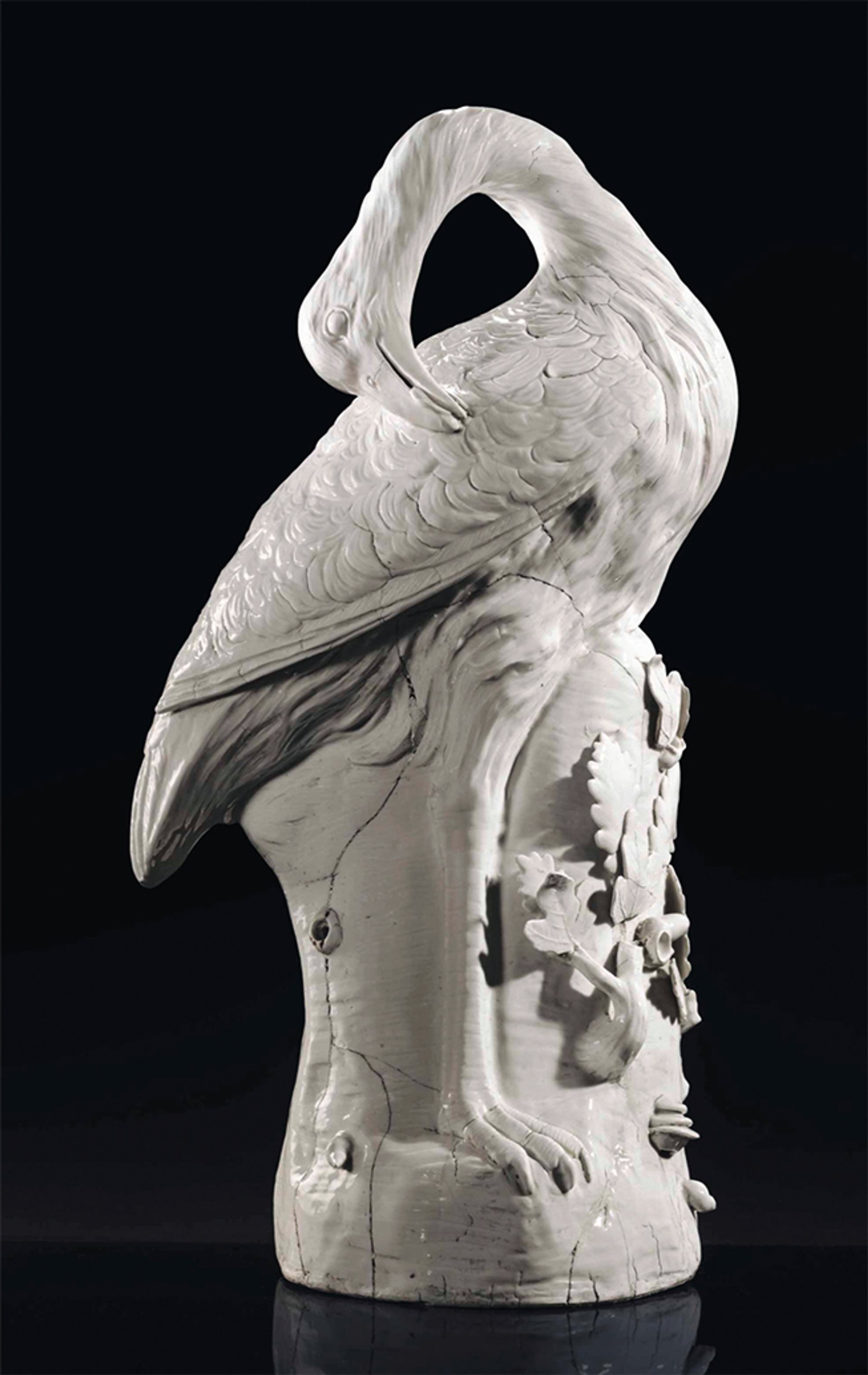
Great Bustard (1732) by Johann Gottlieb Kirchner, in the Frick Courtesy of the Frick Collection
What are you looking forward to seeing at Tefaf Maastricht?
The first person I seek out is always my friend and dealer, Laura Kugel. She brings the most special and unexpected objects, pieces with real personality, and we always end up in a lively conversation that sharpens my eye for what feels alive rather than simply “important”. I will also be visiting Michele Beiny, who was close to my late grandfather, Henry H. Arnhold. He was a passionate collector of early 18th-century Meissen porcelain, and that love of objects really shaped me. His Meissen collection began in Dresden with his mother, my great-grandmother, Lisa Arnhold, and the highlights are now at The Frick. I am also fortunate enough to live with a few of those pieces at home, which makes that lineage feel present every day through their intimacy of scale, precision and the inventiveness of the makers. Tefaf’s great strength, for me, is that it mirrors the way I like to collect across periods and categories, with real historical depth and an emphasis on objects that spark joy and curiosity.


