

At the intersection of fashion, art, and the uncanny, Inez van Lamsweerde and Vinoodh Matadin have for four decades challenged the ways we perceive images. Can Love Be A Photograph – 40 Years of Inez & Vinoodh, at the Kunstmuseum Den Haag, offers a monumental survey of a career defined by its refusal to settle, blending the quotidian with the surreal and the personal with the performative. Their work operates in the liminal space where digital manipulation, intimacy, and high-gloss fashion imagery converge, revealing both the extraordinary and the unsettling within everyday life. “Inez & Vinoodh have been able to create something utterly fantastic; an invisible reality that looks artificial but is not. A reality that speaks of our ungraspable inner world and its relationship with our perceptions and imagination. A world in which love and passion, once they encounter each other, cannot separate any longer. Blessed and doomed at the same time. Yes.” writes Francesco Bonami in his 2025 essay, Inner Invisible Artificiality. The exhibition, spanning 18 galleries, emphasises themes of love, perception, and the endurance of beauty.
Inez van Lamsweerde, born in 1963, and Vinoodh Matadin, born in 1961, emerged in the late 1980s with a practice that bridged photography’s commercial and artistic realms. They were among the first to embrace digital imaging as a creative medium, developing a signature visual lexicon marked by seduction, subtle unease, and provocative narrative. Their editorial work for Vogue, V Magazine, Visionaire and The New York Times Magazine redefined fashion photography, pairing glamour with psychological depth. Parallel to this, campaigns for brands like Chanel, Dior, Louis Vuitton, and Gucci explored how commerce intersects with culture, turning advertising into a form of contemporary allegory. In addition to still imagery, Inez & Vinoodh have directed music videos for artists including Lady Gaga, Björk, Rihanna, and Paul McCartney, further demonstrating their versatility across visual media. Their work has been presented at institutions such as the Stedelijk Museum Amsterdam, Hayward Gallery and The Whitney Museum of Contemporary Art in New York, consolidating their status as innovators and raconteurs of contemporary visual culture.
The exhibition itself is organised thematically rather than chronologically, a decision that mirrors the artists’ ongoing interrogation of time, identity, and intimacy. Central to the display is The Psychomorphic Phenomenon, a suite of early 1990s series that manipulate the human form to explore desire, imperfection, and societal expectations. Works such as Thank You Thighmaster (1993), Final Fantasy (1993), and The Forest (1995) confront ideals of physical perfection, childhood innocence, and masculine authority, highlighting the tension between aspiration and vulnerability. Meanwhile, The Kiss, a motif recurring since 1999, crystallises the exhibition’s meditation on emotional and physical fusion, presenting intimacy as a space where individual identities dissolve and coalesce. The inclusion of the Me Kissing… series alongside the latest Think Love bodies of work underscores continuity and evolution, demonstrating how notions of affection, legacy, and intentionality are transmitted across generations. This central thematic curation reframes photography not merely as representation but as a vehicle for human empathy and connection.
Beyond their art practice, Inez & Vinoodh’s fashion photography has wielded profound cultural influence. Michael Bracewell observes that they “manipulate the high-gloss surface of fashion photography into psychological allegory,” a testament to their ability to encode narrative and emotion within commercially-driven images. Portraits of contemporary icons – from Taylor Swift to Kendrick Lamar, Billie Eilish, and Brad Pitt – inhabit a liminal space between celebrity and sacred iconography, while still-life floral compositions adopt a similar reverence, crossing genre boundaries to assert the vitality and potential inherent in all subjects. A dedicated gallery of editorial and collage work highlights the collaborative dimension of their practice, showcasing the meticulous interplay between image, text, and layout. In this way, the exhibition considers the broader dialogue between authorship and teamwork, reinforcing how the artists’ influence extends beyond the image itself into the structures of creative production.
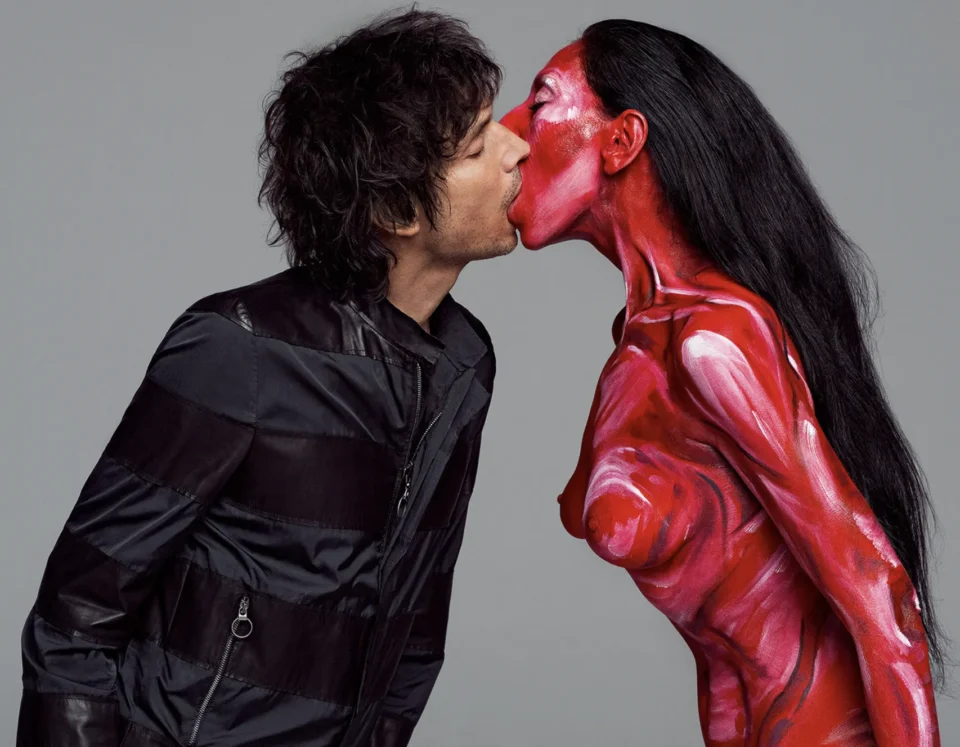
In the context of contemporary photography, Inez & Vinoodh’s work resonates alongside that of artists such as Cindy Sherman, Gregory Crewdson and Petra Collins. Sherman’s exploration of selfhood and constructed identity parallels Inez & Vinoodh’s meditations on perception and persona, while Crewdson’s cinematic tableaux echo the duo’s intricate manipulation of digital space to convey psychological states. Collins, emerging in the contemporary fashion sphere, similarly fuses intimacy with aesthetic stylisation, suggesting the enduring influence of Inez & Vinoodh’s approach to merging personal narrative with commercial visuality. Collectively, these artists exemplify a shift in photographic practice that prioritises emotional resonance and conceptual experimentation over mere documentation, a legacy to which Inez & Vinoodh have contributed significantly. Their work has inspired both established and emerging creatives to question how images can articulate interior life, blurring distinctions between reality, fantasy and desire.
Returning to Can Love Be A Photograph, the exhibition frames these themes across four decades with compelling visual intelligence. By removing chronological constraints, images from different eras converse across temporal boundaries, creating unexpected relationships and allowing viewers to engage with recurring motifs in new ways. Galleries dedicated to iconic portraits, fashion campaigns, and floral studies highlight the artists’ dual engagement with art and commerce, demonstrating that beauty and intimacy are not incompatible with commercial production. The catalogue, designed by M/M (Paris) and featuring essays by Donatien Grau, Francesco Bonami, Pamela Chen, and Willemijn van der Zwaan, expands upon these ideas, offering multiple perspectives on the work alongside an intimate interview conducted by Tilda Swinton. Such publications ensure that the exhibition’s insights extend beyond the walls of the museum, cementing the artists’ contribution to both visual culture and the historiography of photography.
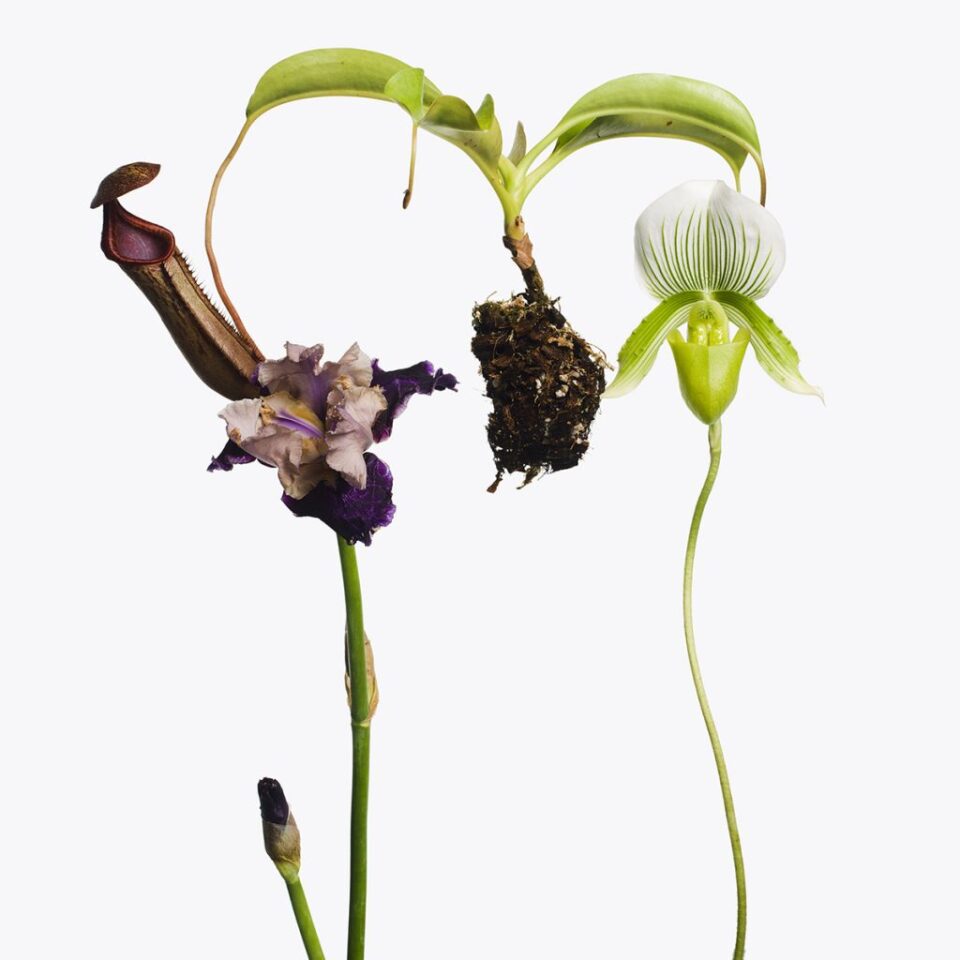
Inez & Vinoodh’s retrospective is more than a celebration of a 40 year career. It is an invitation to reflect upon the ways in which images shape our understanding of love, identity and desire. By threading together art, fashion, and portraiture, the duo constructs a visual lexicon that is at once seductive, disquieting and profoundly human. Their oeuvre demonstrates that photography can be both mirror and invention, capable of revealing the inner workings of the mind as much as the surface of the world. Can Love Be A Photographoffers an experience of intimacy, imagination, and visual exhilaration, reaffirming Inez & Vinoodh’s singular position in the contemporary canon. It is a testament to the enduring power of seeing with care, of creating worlds where love and vision cannot be separated, and of the subtle alchemy that occurs when art transcends mere representation to become an act of consciousness.
Can Love Be a Photograph is at Kunstmuseum Den Haag 21 March – 6 September: kunstmuseum.nl
Words: Shirley Stevenson
Image Credits:
1. Inez & Vinoodh, Think Love, 2025.
2. Inez & Vinoodh, Well Basically Basuco is Coke Mixed with Kerosine… – The Face Magazine, 1994
3. Inez & Vinoodh, Me Kissing Vinoodh (Eternally), 2010.
4. Inez & Vinoodh, 1 Pitcher Plant, 1 Purple Iris, 1 Lady Slipper, 2013.


