

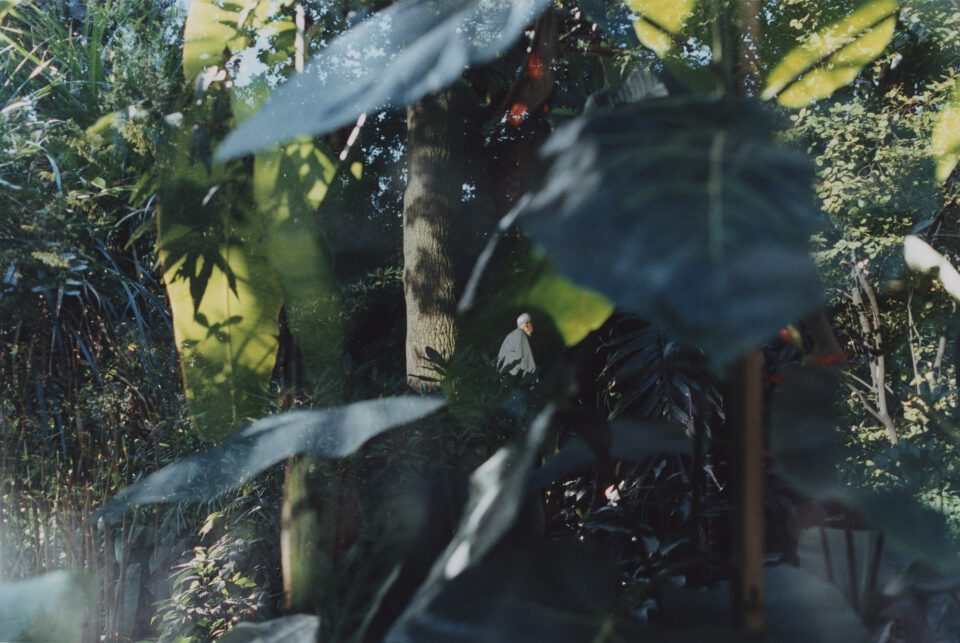
Photographer Samuel Laurence Cunnane travels around the world by van, capturing fleeting scenes that result in luminous images, revealing remarkable beauty hidden in plain sight. The Irish artist makes his London debut at Southbank Centre’s Hayward Gallery with Blue Road, a show that encourages viewers to look more intently in moments of stillness. It is the fifth exhibition in the RC Foundation Project Space Exhibition series, which showcases the next generation of emerging international artists. The titular work depicts a stretch of newly tarmacked road that appears as a deep blue river, gleaming in the early evening light. Elsewhere, dense green foliage parts to reveal a figure in the distance, obscured by trees. The show distills many years of work into one comprehensive experience, defying traditional “series” to allow audiences to make their own connections and uncover new ideas. We caught up with the artist to discuss his creative inspirations, why he makes work slowly and what audiences can expect from Blue Road.
A: How did your relationship to photography first begin?
SLC: It sounds ridiculous and made up, but I was about 14 and I woke up one school day – which I was not excelling at – and for some reason the thought occurred to me, with very strong clarity, that photography is what I was going to do. It happened just like that, completely out of nowhere. From there, I then went about borrowing whatever cameras I could and started making photographs.
A: Are there any particular artists or creatives who have shaped or influenced your practice?
SLC: Yes definitely, I found I discovered different ones at various key moments throughout my life. For instance, I came upon the world of direct cinema in college; the Maysles brothers, DA Pennebaker, Richard Leacock and Jean Rouch in France, which then led to Chris Marker. In terms of still photography, more recent discoveries are Bertien Van Mannen and Laurenz Berges who are both incredible.
A: Blue Road brings together years image-making. How did this body of work first take shape?
SLC: I found I wasn’t very interested in making photographic “projects” as such, or anything with a very specific research focus. It seemed strange to me that photography, moreso than other practices, has these constraints. I wanted to make open ended work that could be pieced together later into endless constellations. So I began moving around a lot, from the likes of Istanbul to Tehran. I crossed Russia on a train. I would stay here and there for a few months at a time and photograph all the while, trying to distill what I saw and recorded. This exhibition at Hayward Gallery, Blue Road, is one of those constellations.
A: You travel for long periods without a fixed itinerary. How does not knowing what you’re looking for shape what you eventually find?
SLC: I think it’s a big part of the process. I suppose it comes down to trusting that you’ll just know what to photograph when you come across it and then more critically, what to print when it comes to the editing. As I look back on making all these photographs, there is a sense of just watching the world unfold.
A: In an age of instant digital images, you remain committed to analogue photography. What do you find compelling about working slowly and by hand?
SLC: I think in the same way that the body of work evolves over years, and the fact that I can spend months on the move, time and its slow unfolding is just part of it. I have a very particular rhythm where I take photographs for a period of months, never seeing the images and then I return to the studio and develop all the work at once. I did it this way from quite early on and I found it suited me. Likewise regarding printing all the work by hand, I find I have a level of control over the colour and tones that I’m used to.
A: There’s a strong sense of stillness in the work, even when it’s made on the move. How do you balance motion and pause in your practice?
SLC: It’s interesting because I have often found that within a photograph, some of the images I find most interesting have a quality of stillness, whilst being fleeting. It might just be the sense that this image is an event in time, to be followed by another, or a certain quality of the light or some other inexplicable quality. And so in that sense, I find that the fact that I move and photograph in the world as I go lends itself to exactly this.
A: The titular image turns fresh tarmac into something almost liquid. What excites you about moments when the everyday briefly becomes unfamiliar?
SLC: It’s certainly part of the reason I really love taking photographs and I think that familiarity is a delicate thing, like a fine veil that can drop any moment.
A: What’s next for you? Anything we can look forward to?
SLC: The main thing right now is a first book of my work, it’s still early but these things take time.
Samuel Laurence Cunnane: Blue Road is at Hayward Gallery, London 17 February – 3 May: southbankcentre.co.uk
Words: Emma Jacob & Samuel Laurence Cunnane
Image Credits:
1. Green river (2019): Hand-printed C-type print on archival photo paper, framed. Image Size: 22.5 x 30.6. Framed Size: 45 x 53 (all dimensions in cm).
2. Samuel Laurence Cunnane, Blue Road, 2023. Hand-printed C-type print on archival photo paper © Samuel Laurence Cunnane. Courtesy of the Artist.
3. Man in Botanical Garden, Hamburg (2014): Hand-printed C-type print on archival photo paper, framed. Image Size: 16.7 x 25.5. Framed Size: 39.7 x 48.1 x 3 (all dimensions in cm).
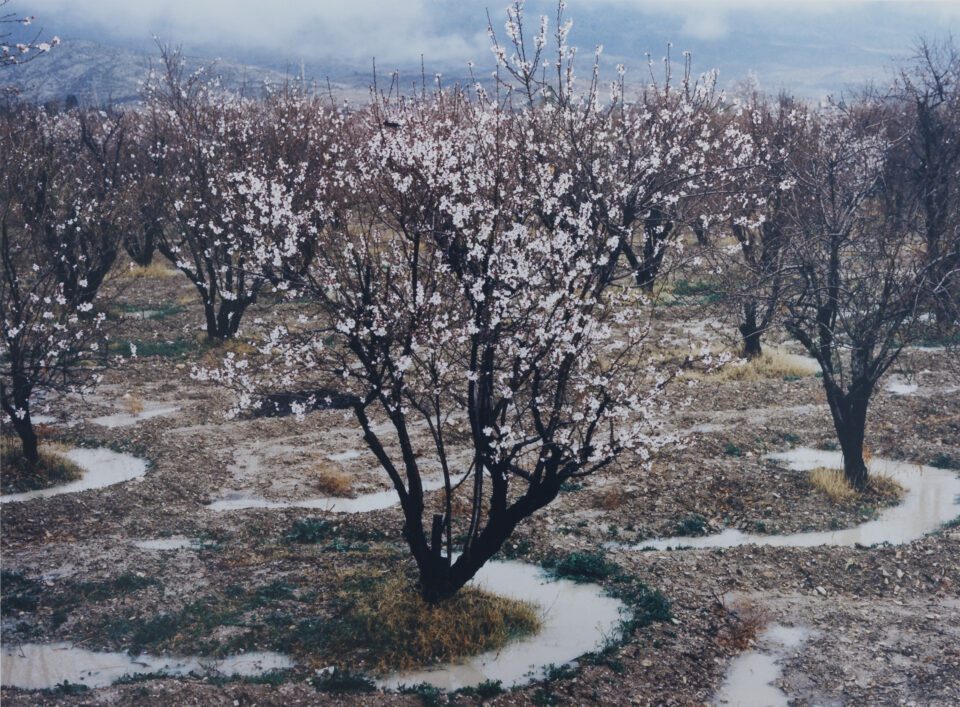
4. Walnut Trees (2017): Hand-printed C-type print on archival photo paper, framed. Image Size: 18.7 x 25.5. Framed Size: 41.4 x 48.2 x 3 (all dimensions in cm).
The post Roads Less Travelled appeared first on Aesthetica Magazine.


