

Archaeologists have discovered what they believe is the world’s oldest known rock art, in a cave off the island of Sulawesi, Indonesia. The hand stencil has been dated to at least 67,800 years ago, making it 1,100 years older than the earliest example of rock art that was known about before this, produced in Spain by Neanderthals. The Sulawesi work may, its finders say, provide insights into the migration of early humans to Australia.
“Making this discovery was both thrilling and humbling. Seeing the dating results for the first time was a real surprise, because they showed the art was far older than anyone expected,” says Maxime Aubert, an archaeologist and geochemist from Griffith University in Australia, and a co-author of the study published by the researchers in the journal Nature. “It was one of those rare moments in science when you realise you are looking at something that changes how we understand our shared human story.”
As part of a survey of south-east Sulawesi, Aubert and colleagues have documented 44 sites, including 14 that were previously unknown. While investigating these sites, the team used a new technique to date 11 rock art motifs. The hand stencil with the earliest date was found in a cave on the satellite island of Muna.
Adhi Agus Oktaviana, one of the researchers, at work in a cave in Sulawesi
Photo: Maxime Aubert
“We were able to date this art by analysing thin mineral crusts that formed on top of the paintings,” Aubert says. “Because these crusts grew after the art was made, they tell us the youngest possible age of the images.”
To create hand stencils such as this one, ancient people blew pigment over their hands while they were placed against the rock. Certain stencils found in Sulawesi, including the 67,800-year-old example, are distinctive because the artists reshaped the tips of the fingers to give them a pointed appearance. “This feature may have had symbolic meaning, possibly linked to animals,” Aubert says.
“A hand stencil is emotionally compelling,” says April Nowell, a palaeolithic archaeologist at the University of Victoria in Canada, who was not involved in the research. “When you see it, you know these people were us, that in a fundamental way we are the same and the 68,000 year gulf between us and them disappears.”
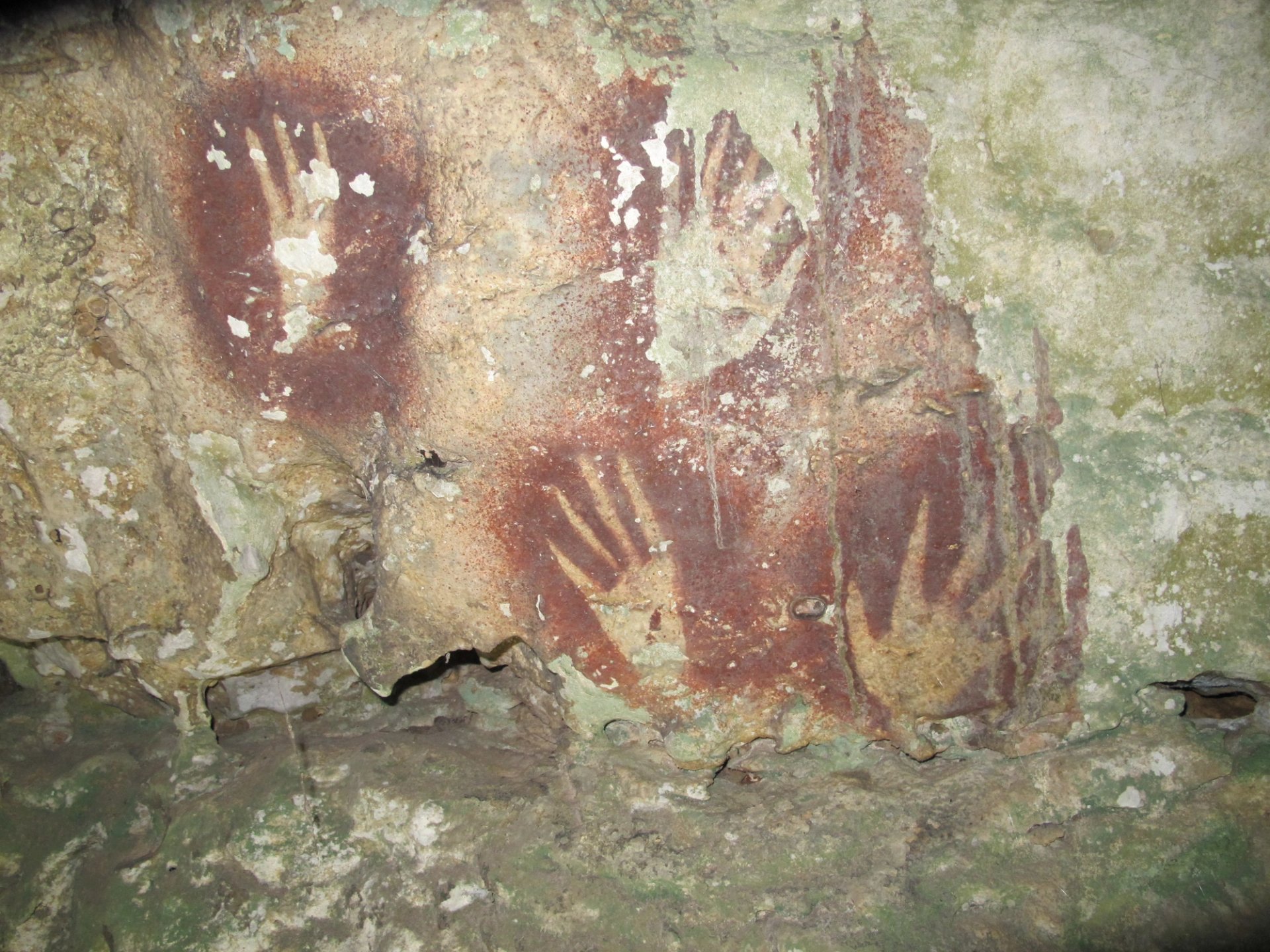
Narrowed finger hand stencils in Leang Jarie, another cave in Sulawesi
Photo: Ahdi Agus Oktaviana
Nowell adds: “The particular tendency to intentionally narrow the fingertip of one of the stencils speaks to a long-lasting regional tradition and the existence of a community of practice.”
This discovery also provides new insight into when, and by which route, the earliest people arrived in Australia. Previously, some experts proposed an arrival of around 50,000 years ago. Others argued for a much earlier date, around 60,000 to 65,000 years ago—a theory called the “long chronology”.
“Together, the archaeological and genetic evidence now strongly supports the long chronology and shows that the ancestors of Indigenous Australians were moving through Southeast Asia and creating symbolic art as they travelled,” Aubert explains.
The findings in Sulawesi follow the discovery there—in 2024—of the oldest example of figurative art, depicting a wild pig and a trio of human figures. There are now questions about how much more ancient art remains undiscovered on nearby islands, Aubert notes. “For us, this discovery is not the end of the story. It is an invitation to keep looking.”
Nowell says: “This is another example of a meticulous study from this team working in Indonesia. This new discovery is exciting and fits with what we know about the art from this region. I suspect the more research this team undertakes, the older the (pre)history of art will become.”


