

Paul Gauguin is renowned for his revolutionary paintings, but he also created some astonishingly bold and imaginative ceramics. One of these, the Cleopatra Pot (winter 1887-88), quickly became linked to Vincent van Gogh and his brother Theo—and the fabled Sunflowers.
Two days after Gauguin joined Van Gogh at the Yellow House in Arles in October 1888 he wrote to his Parisian artist friend Émile Schuffenecker: “We are here in a small, rather charming little house, and I would like to have some pottery to look at”. Schuffenecker, who was looking after some of Gauguin’s effects, sent him two ceramics, including the requested Cleopatra Pot.
Two months later came the tragic incident in which Van Gogh severed his ear, during the evening of 23 December 1888. By this time relations between him and Gauguin had deteriorated. On Christmas Day, Vincent’s brother Theo arrived by train from Paris to visit him in hospital, and that night Theo and Gauguin returned to Paris together.
Soon afterwards Gauguin presented the Cleopatra Pot to Theo, who was an art dealer in Paris, partly to thank him for having mounted an exhibition of his work a few weeks earlier. On Theo’s death in 1891, the ceramic remained with his widow Jo Bonger.
Photograph (winter 1925-26) of Jo Bonger’s bedroom in her Amsterdam apartment, with the Cleopatra Pot on the piano—and a detail Van Gogh Museum, Amsterdam (Vincent van Gogh Foundation)
In the winter of 1925-26, the pot appears in a photograph of Jo’s bedroom, on the piano and containing a bunch of flowers or grasses. Appropriately, three of the pictures hanging on the wall behind are flower still lifes by Adolphe Monticelli and Georges Jeannin, artists whom Van Gogh admired and collected.
Jo had died in September 1925 and the apartment was about to be cleared. Above the piano’s closed keyboard is a painting of her (next to a portrait of her young grandson, Theodoor), presumably placed there in memory on the instrument that she would never play again.
Seductive symbol
The fascinating story of the Cleopatra Pot has been revealed by Joost van der Hoeven, a researcher at the Van Gogh Museum in Amsterdam—and it has just gone online. Gauguin had crafted the glazed stoneware pot in the winter of 1887-88, along with a group of ceramics that he made in the Paris workshop of Ernest Chaplet.
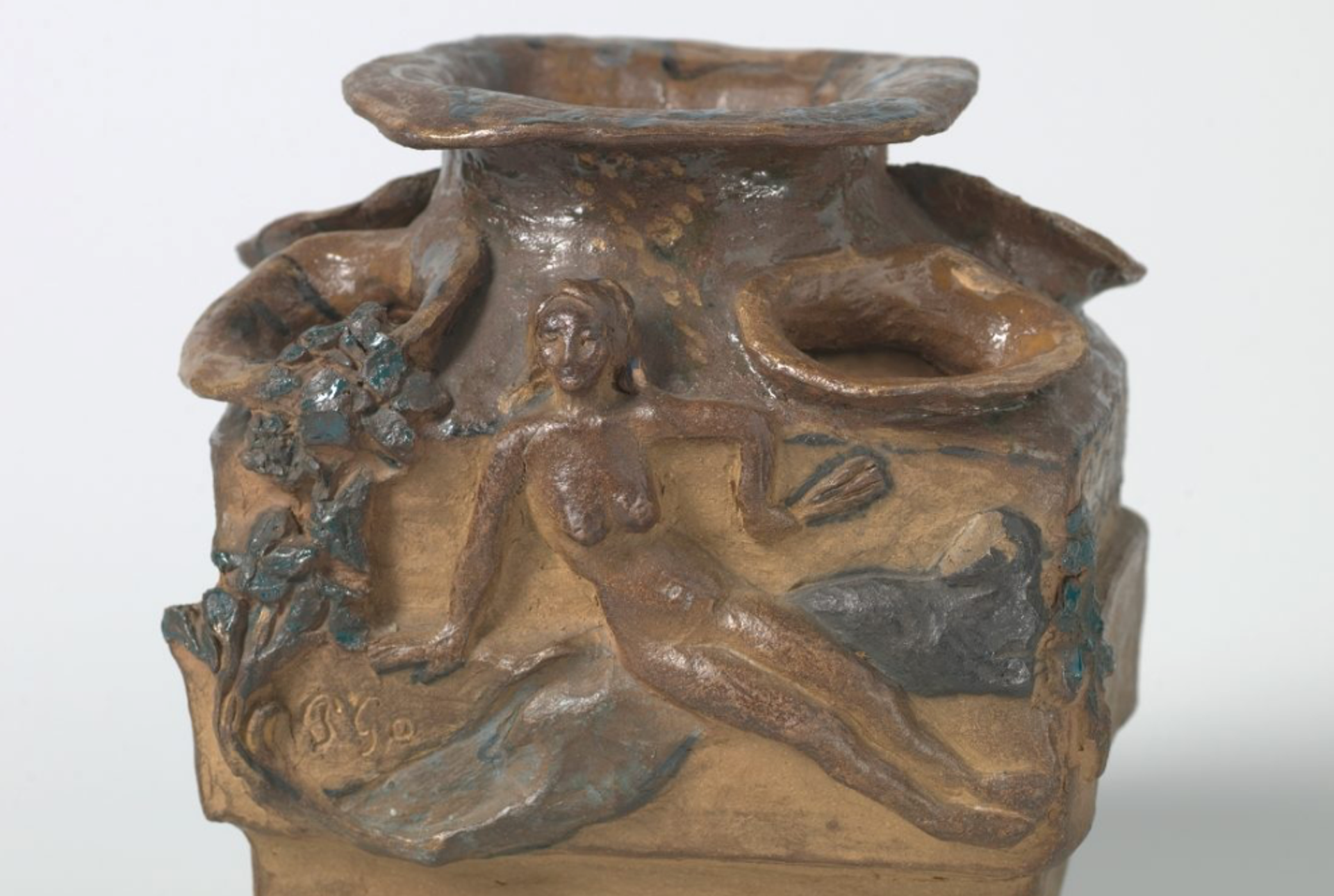
The front of Gauguin’s Cleopatra Pot, with a reclining figure representing the Egyptian queen, behind her (on the right side) a black sheep and with the PGo signature Van Gogh Museum, Amsterdam (Vincent van Gogh Foundation)
On the pot’s front is a nude figure representing the legendary Egyptian queen Cleopatra. Van der Hoeven points out that in the 19th century she was regarded as “a vivid symbol of beauty, seduction and desire”. Her naked body provocatively sits near the rear of a black sheep (the glaze of its head has now chipped off), an animal that at that time could be seen as symbolising sin. Paul Gauguin signed the front “PGo”, a monogram that in French sounds like “pego”, a slang word for penis. The reverse of the pot is decorated with two pigs, which Gauguin regarded as standing for lust.
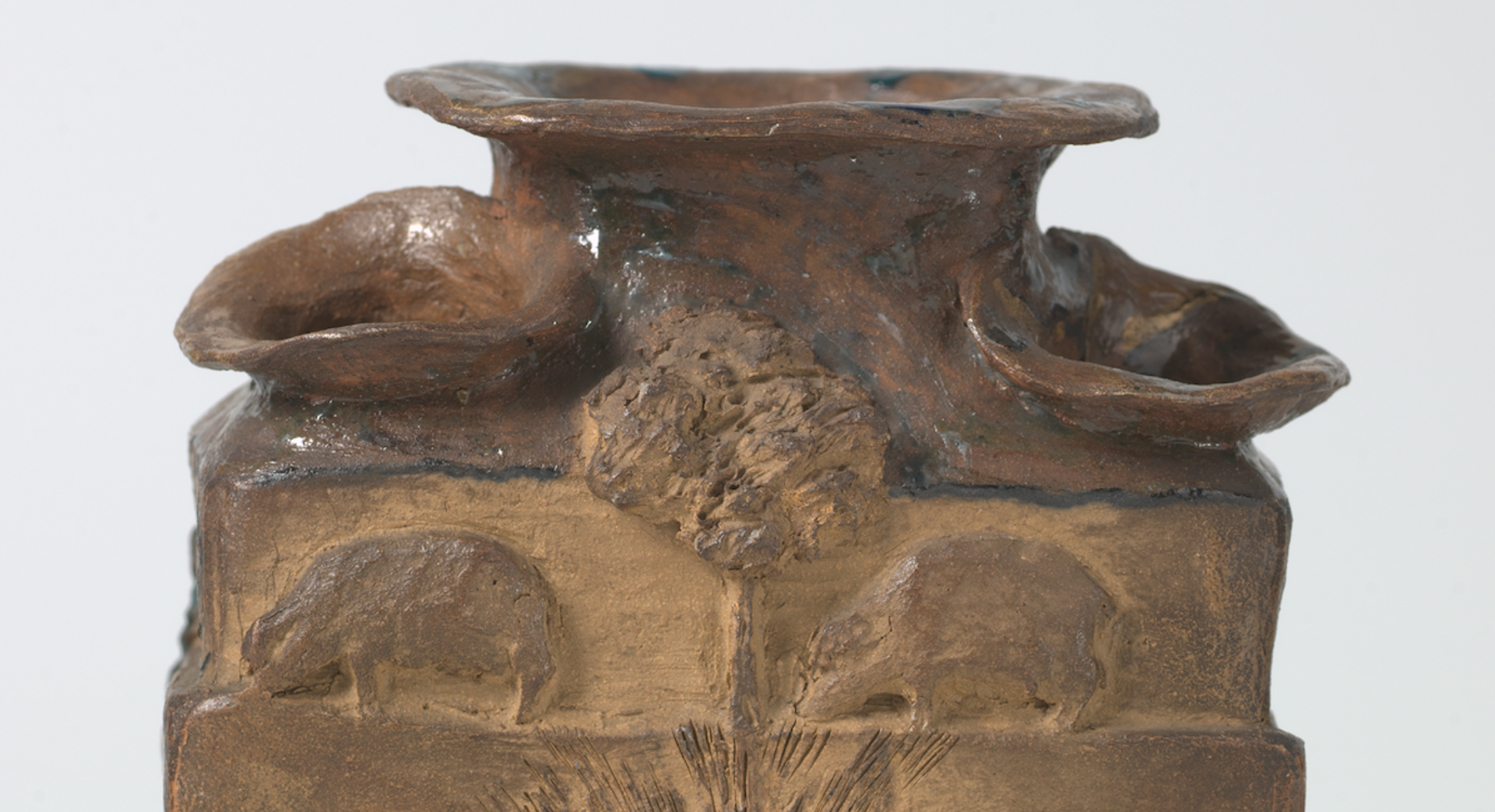
The back of Gauguin’s Cleopatra Pot, with two pigs Van Gogh Museum, Amsterdam (Vincent van Gogh Foundation)
The figure of the reclining Cleopatra was taken directly from a painting by Pierre Puvis de Chavannes, Hope (1871-72), which Van Gogh and Gauguin had both admired when it was displayed in Paris in November 1887. Gauguin then transformed the woman in Hope into an allegory of seduction.
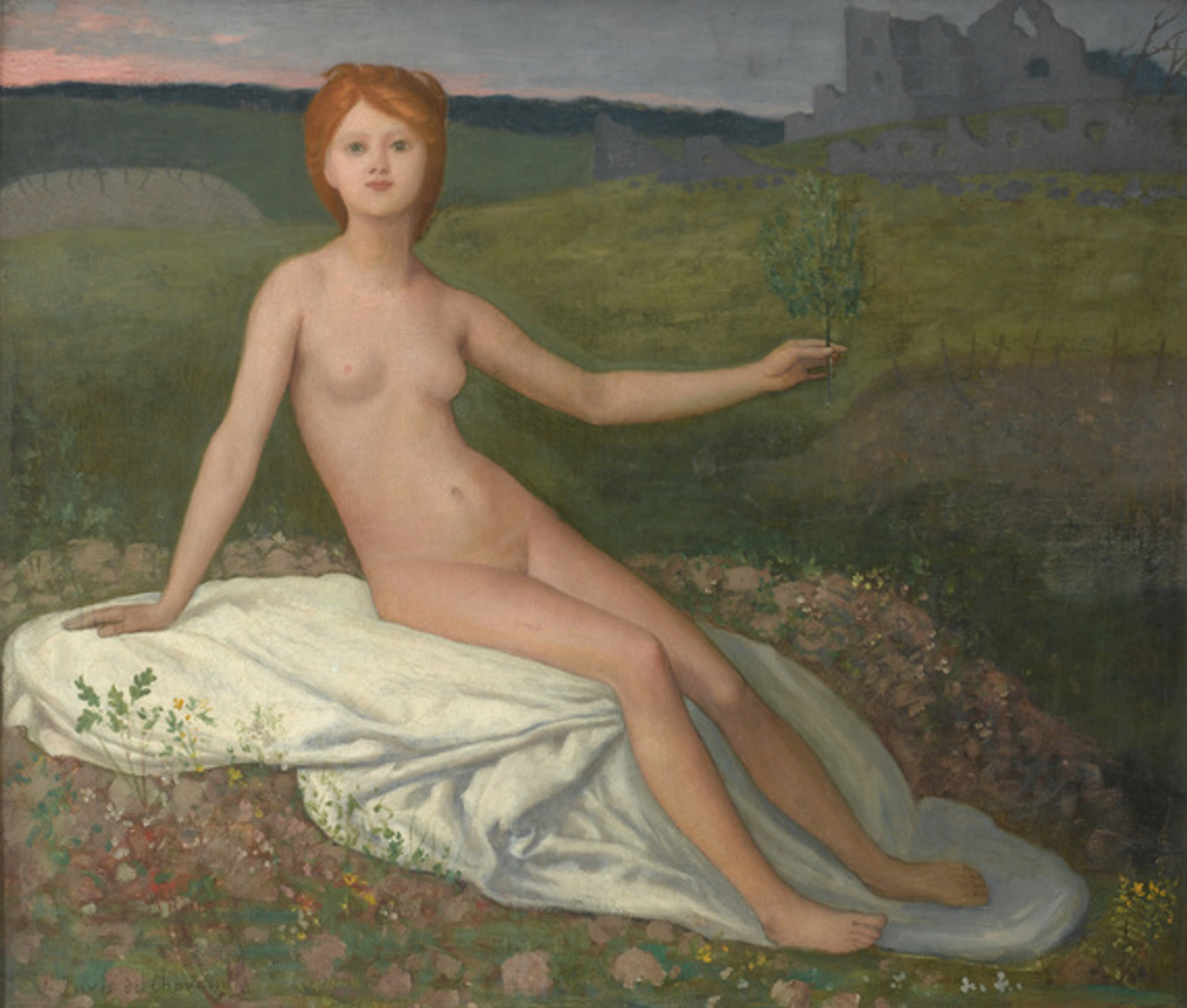
Pierre Puvis de Chavannes’ Hope (1871-72) Musée d’Orsay, Paris
Along with the Cleopatra Pot, Gauguin also gave Theo an even more important work, the picture Vincent van Gogh Painting Sunflowers (December 1888). As Van der Hoeven explains, the two gifts may have been made to console Theo or “out of feelings of guilt”, because Gauguin had played a part in the circumstances that led to Vincent’s mutilation of his ear. Gauguin also wanted to keep on the right side of Theo, who was then his dealer and had just mounted an exhibition of his work.
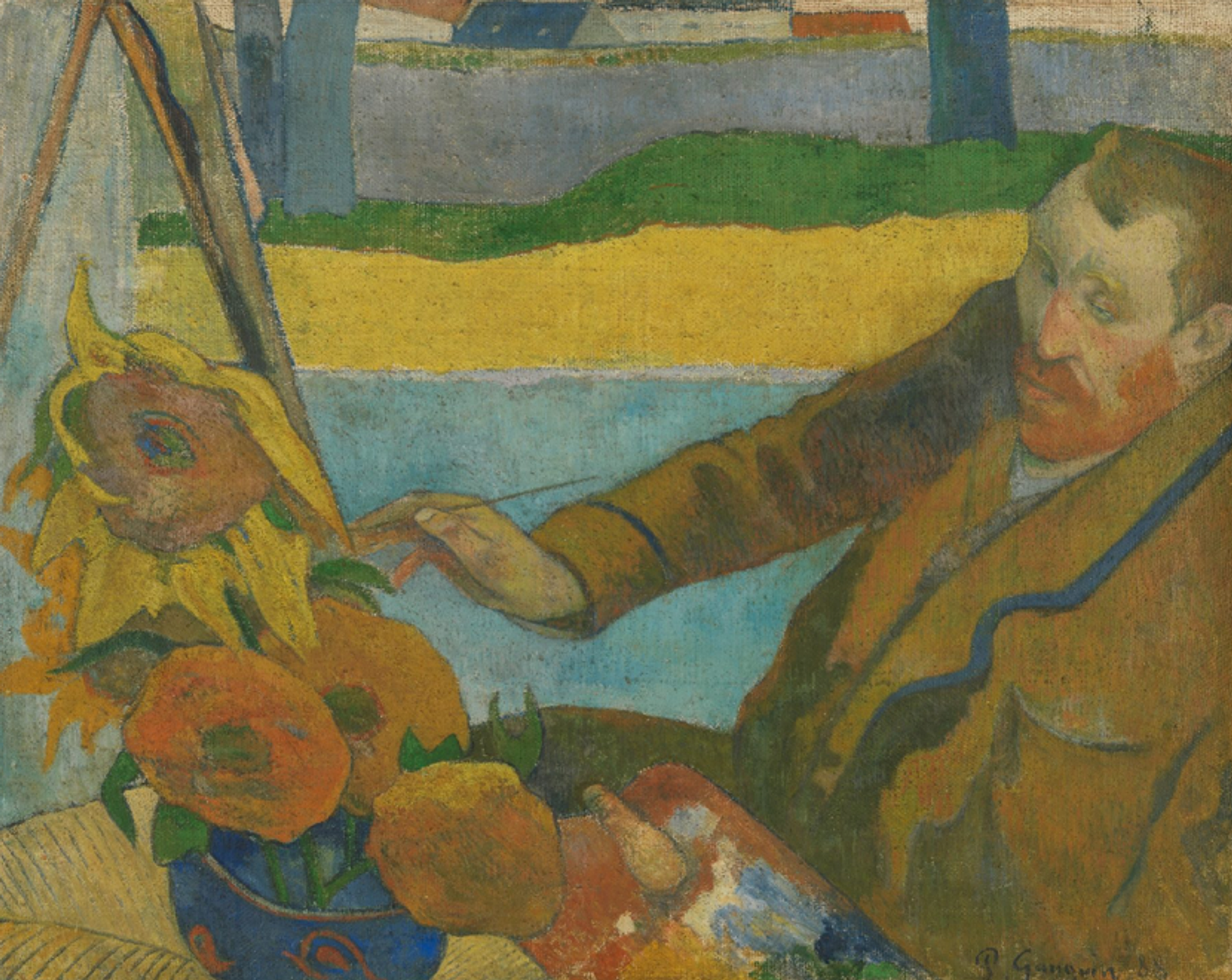
Gauguin’s Vincent van Gogh Painting Sunflowers (December 1888) Van Gogh Museum, Amsterdam (Vincent van Gogh Foundation)
Since Van der Hoeven’s account was posted, we have been able to establish when the two gifts were probably presented to Theo. In a letter from Gauguin to Vincent, dated between 8 and 16 January 1889, he mentions that he had just visited Theo. Gauguin commented: “At your brother’s home I saw your Sower, which is very good, as well as a yellow still life, apples and lemons. Your brother gave me a lithographed reproduction of an old painting of yours.” This was Van Gogh’s lithograph of The Potato Eaters (April 1885). Another letter suggests the visit took place on 2 or 3 January.
Gauguin presumably turned up at Theo’s apartment bearing his two gifts, the Cleopatra Pot and Vincent van Gogh Painting Sunflowers. Theo might then have felt he should reciprocate, which he did by presenting the more modest lithograph.
Fresh light on the Sunflowers
The newly established link between the gifts provides a fascinating insight into Gauguin’s attempt to acquire one of Van Gogh’s Sunflowers. In Van Gogh’s letter to Gauguin of 21 January 1889 he wrote that he had heard (from Theo) that his friend would like “a canvas of mine, the sunflowers with a yellow background”. (By coincidence, this letter is going on display in Arles, see Other Van Gogh News, below).
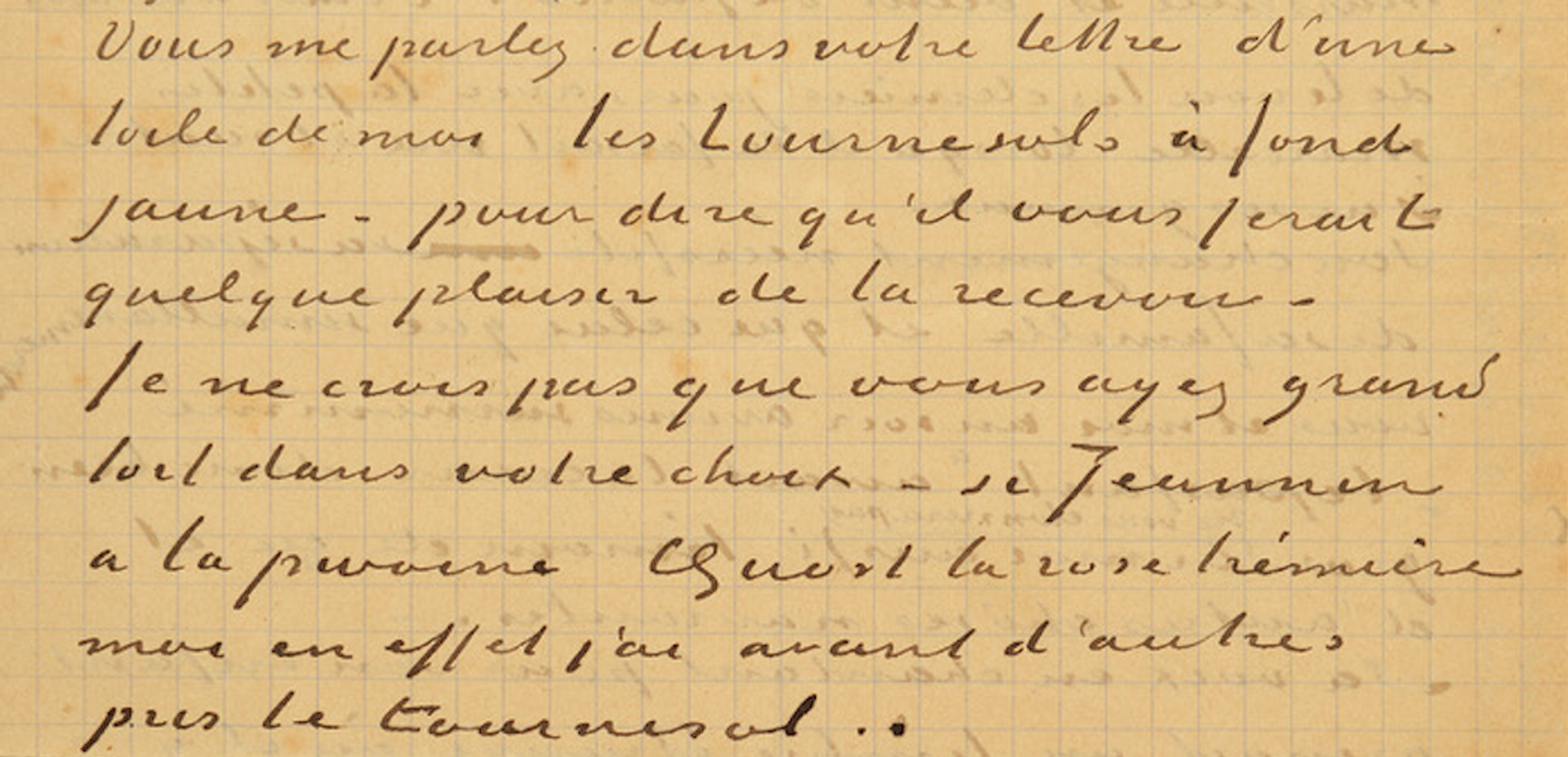
Extract from Van Gogh’s letter to Gauguin, 21 January 1889: “You talk to me in your letter about a canvas of mine, the sunflowers with a yellow background—to say that it would give you some pleasure to receive it. I don’t think that you’ve made a bad choice—if [Georges] Jeannin has the peony, [Ernest] Quost the hollyhock, I indeed, before others, have taken the sunflower.” Musée Réattu, Arles; photograph Hervé Hôte
Gauguin was often wily in his dealings with friends, and one suspects that his gift of Vincent van Gogh Painting Sunflowers and the Cleopatra Pot was motivated by a desire to acquire the Sunflowers. If that was indeed his intention, it failed, since it seems that Gauguin never owned one of the yellow Sunflowers.
The Cleopatra Pot is currently on display in a Van Gogh Museum touring exhibition in Japan, now at the Tokyo Metropolitan Art Museum (until 1 December) and then going to the Aichi Prefectural Museum of Art (3 January–23 March 2026) in Nagoya. Considering Japan’s great tradition of ceramics, Gauguin’s imaginative pot will be much appreciated there.
Other Van Gogh news
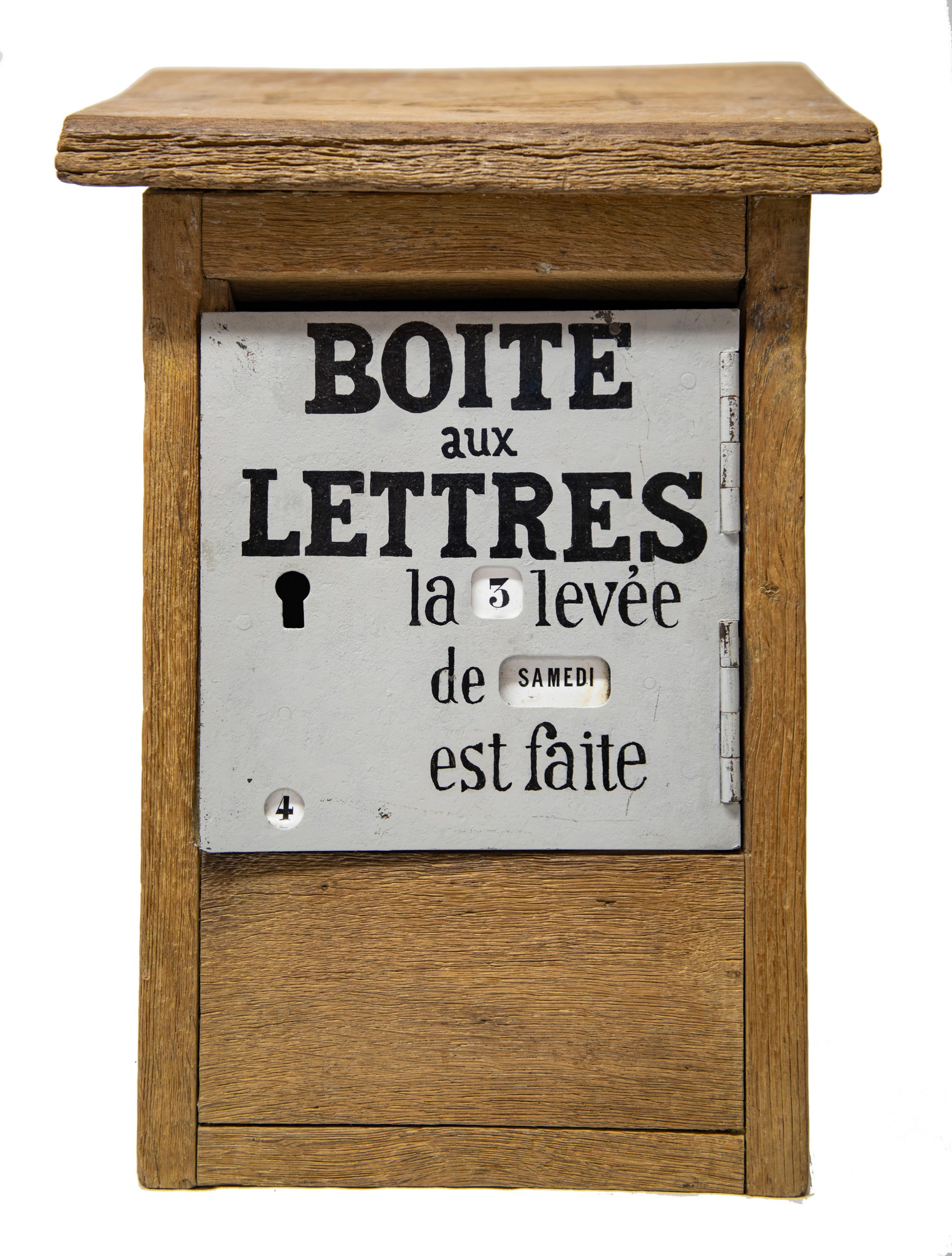
A French rural post box (1882), on display in an Arles exhibition of artists inspired by Van Gogh’s letters © Photo: Musée de La Poste, Paris/La Poste; photograph Thierry Débonnaire
The Fondation Vincent van Gogh Arles is about to open an exhibition entitled To Vincent, A Winter’s Tale (30 November-21 April 2026), featuring artists inspired by Van Gogh’s letters. These include Rineke Dijkstra, Gustave Fayet, Anselm Kiefer and Wolfgang Tillmans. Two Van Gogh paintings are coming from Amsterdam’s Van Gogh Museum: Head of a Woman (December 1885) and Sunflowers Gone to Seed (August-September 1887). Also on show will be Van Gogh’s letter to Gauguin of 21 January 1889, on loan from the Musée Réattu in Arles.
Martin Bailey is a leading Van Gogh specialist and special correspondent for The Art Newspaper. He has curated exhibitions at the Barbican Art Gallery, Compton Verney/National Gallery of Scotland and Tate Britain.
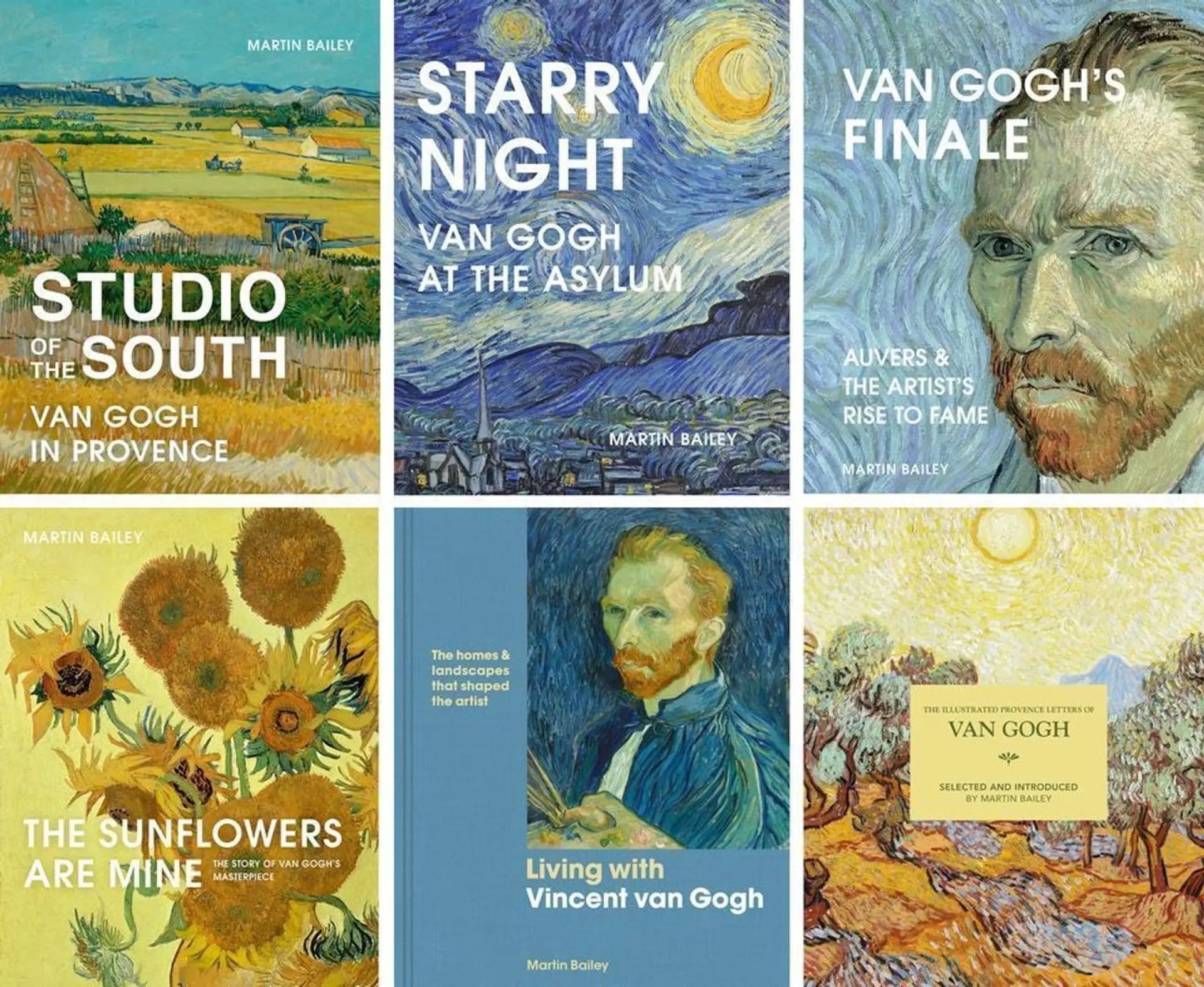
Martin Bailey’s recent Van Gogh books
Martin has written a number of bestselling books on Van Gogh’s years in France: The Sunflowers Are Mine: The Story of Van Gogh’s Masterpiece (Frances Lincoln 2013, UK and US), Studio of the South: Van Gogh in Provence (Frances Lincoln 2016, UK and US), Starry Night: Van Gogh at the Asylum (White Lion Publishing 2018, UK and US) and Van Gogh’s Finale: Auvers and the Artist’s Rise to Fame (Frances Lincoln 2021, UK and US). The Sunflowers are Mine (2024, UK and US) and Van Gogh’s Finale (2024, UK and US) are also now available in a more compact paperback format.
His other recent books include Living with Vincent van Gogh: The Homes & Landscapes that shaped the Artist (White Lion Publishing 2019, UK and US), which provides an overview of the artist’s life. The Illustrated Provence Letters of Van Gogh has been reissued (Batsford 2021, UK and US). My Friend Van Gogh/Emile Bernard provides the first English translation of Bernard’s writings on Van Gogh (David Zwirner Books 2023, UKand US).
To contact Martin Bailey, please email vangogh@theartnewspaper.com
Please note that he does not undertake authentications.


