

Born within a year of each other, it is hard to think of two more emblematic British artists than J.M.W. Turner and John Constable—or of two greater artistic rivals. Yet there has never been a major exhibition devoted to both. Spanning 2025 and 2026—the years of their respective 250th anniversaries—Tate Britain’s Turner and Constable will tell the story of their interlinked careers and how their proximity to each other helped define our ideas of them.
Turner (1775-1851) and Constable (1776-1837) were regularly pitted against each other, and they felt a keen sense of rivalry. Or at least Constable did. A slower starter than the precocious, market-savvy Turner, Constable once touchily referred to his fellow artist as “he who would be lord of all”.
J.M.W. Turner’s Caligula’s Palace and Bridge (around 1831) Image courtesy of Tate
Having finally become a full Royal Academician in 1829 (27 years after Turner), Constable was invited to hang the annual Summer Exhibition in 1831. He committed the faux pas of installing one of his own paintings in pride of place, next to a similarly large Turner. The move paid off: critics delighted in the comparison, dubbing the two artists “fire and water”, and cementing Constable’s long-sought status as a titan of landscape painting.
This was the story that inspired the Tate curator Amy Concannon to put on the show. At its heart is a reconstruction of that famous 1831 pairing: Turner’s Caligula’s Palace and Bridge (1831) next to Constable’s Salisbury Cathedral from the Meadows (1829-31). Through similar historical reconstructions, as well as loans of rarely seen works from private collections, this show is the definitive chance to witness the battle of the elements.
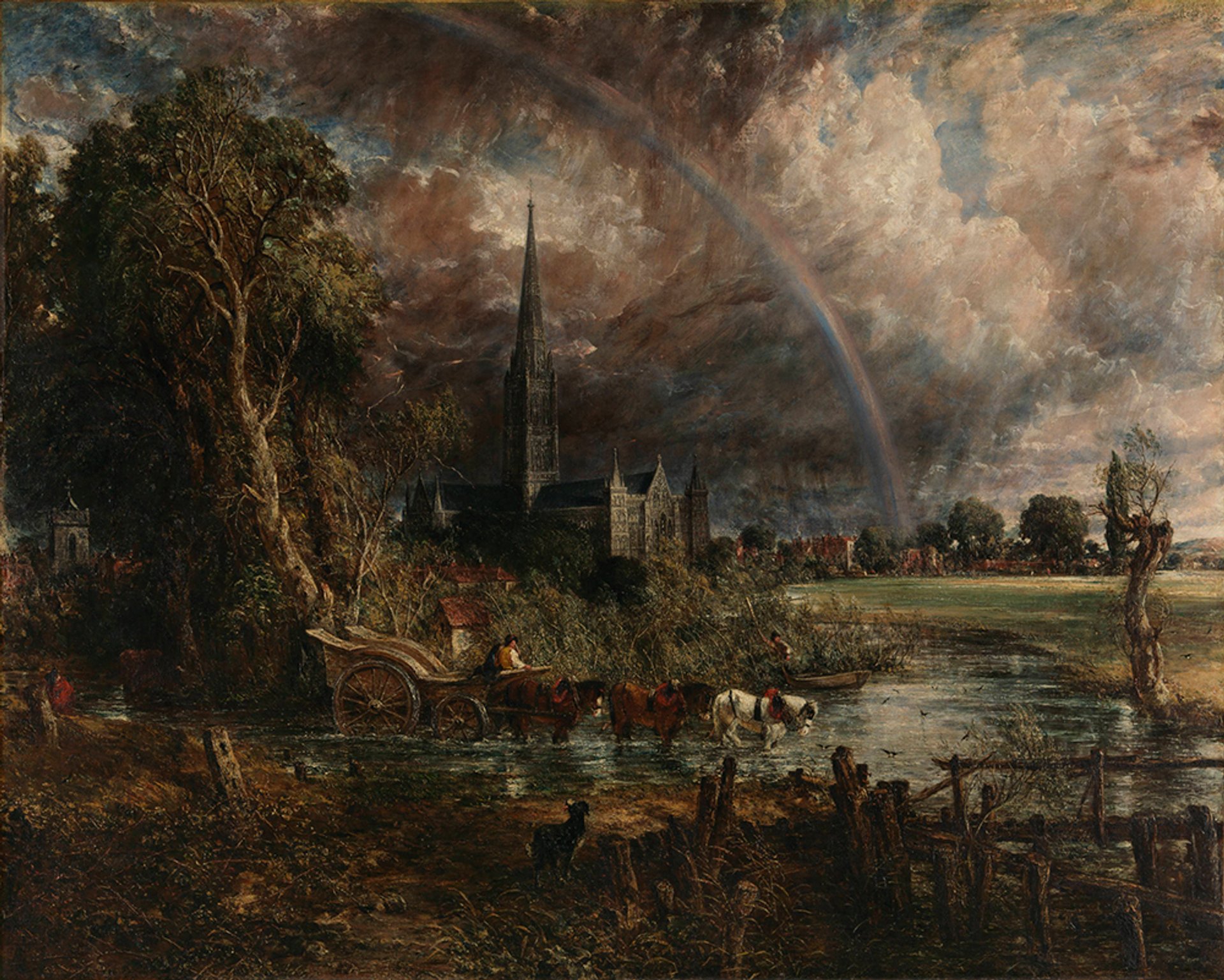
In the 1831 Summer Exhibition hanging, John Constable gave his own Salisbury Cathedral from the Meadows pride of place
Photo © Tate
Chalk and cheese
By origin and temperament, they were very different men. The London-born Turner was encouraged from an early age by his father—a barber turned studio assistant—to develop his talent into a commercially viable operation. Turner had a taste for the grandeur of classical landscapes and the drama of the sublime. His sense of history is also abundant in his contemporary scenes, such as The Burning of the Houses of Lords and Commons, 16 October 1834 (1835)—a loan from the Cleveland Museum of Art, which will be on show in the UK for the first time since 1883.
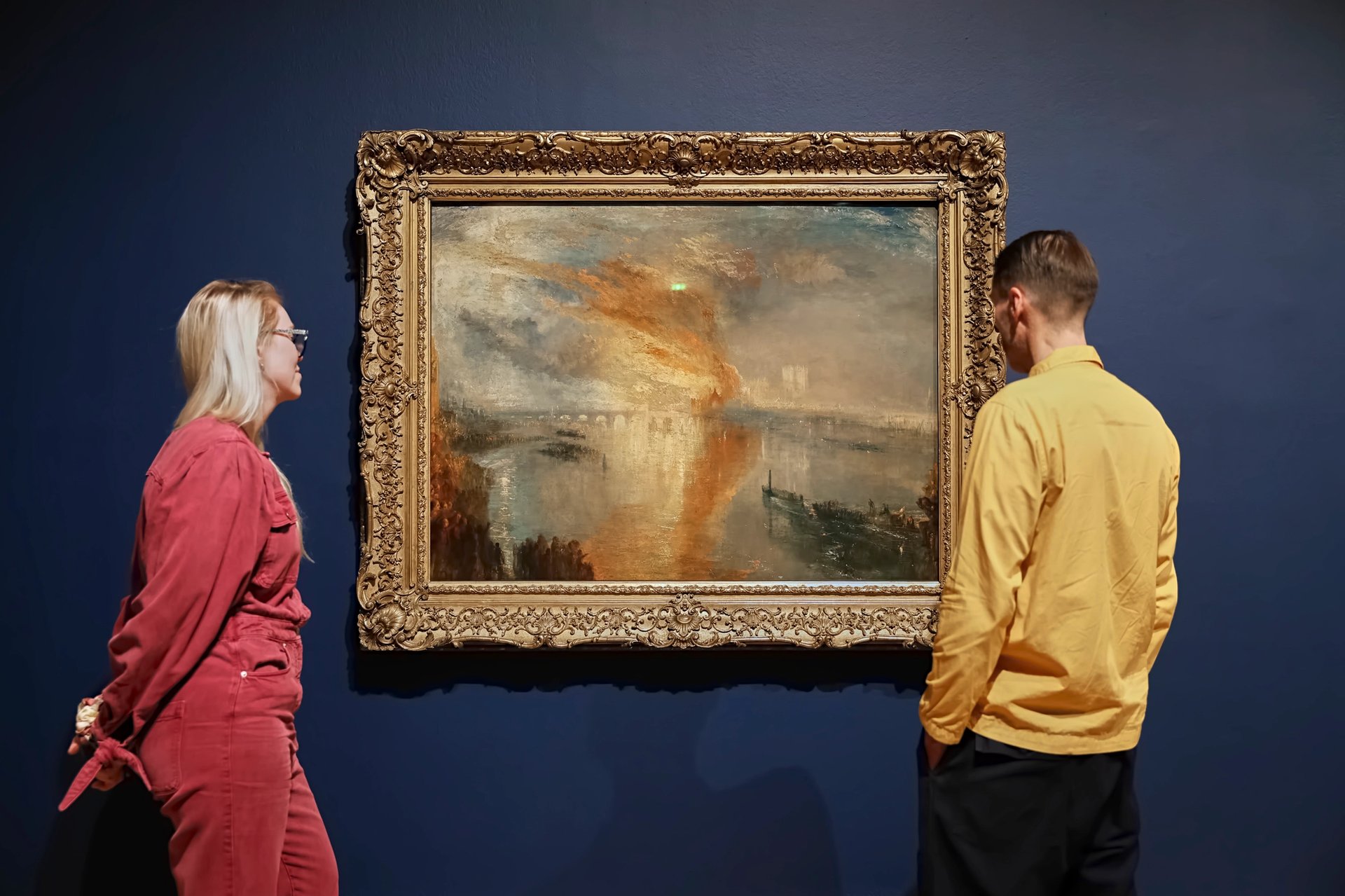
Installation view of J.M.W. Turner’s The Burning of the Houses of Lords and Commons, 1835 in Turner and Constable: Rivals and Originals at Tate Britain Photo © Tate Photography (Yili Liu)
By contrast, Constable was born into an affluent Suffolk family who would have preferred him to follow a more respectable path. His decision to paint Salisbury Cathedral under cloudy skies may have recalled the political woes of the Church of England, but in general he chose more staid subject matter than his rival. However, Concannon argues: “Constable is the bolder artist sooner, in terms of his technique.” From the off, his canvases bore the traces of vigorous and innovative attempts to capture the unruliness of nature. “When you put that in the Royal Academy, in front of the eyes of the critics, compared to the smooth finesse of other paintings—even Turner’s in many cases—Constable was termed crude,” Concannon says.
If the 1831 pairing was a challenge, Turner answered it at the following Summer Exhibition in another contest that audiences can relive at Tate Britain. With a single, publicly executed dab of paint, he introduced an anchoring red tone into the foreground of his seascape Helvoetsluys (1832). The economy and panache of this gesture made a mockery of the disparate foreground reds of Constable’s nearby The Opening of Waterloo Bridge (1832), a painting that had been 13 years in the making. Constable supposedly claimed that with that daub of red, Turner had “fired a gun”—conveniently forgetting his own provocation of the previous year.
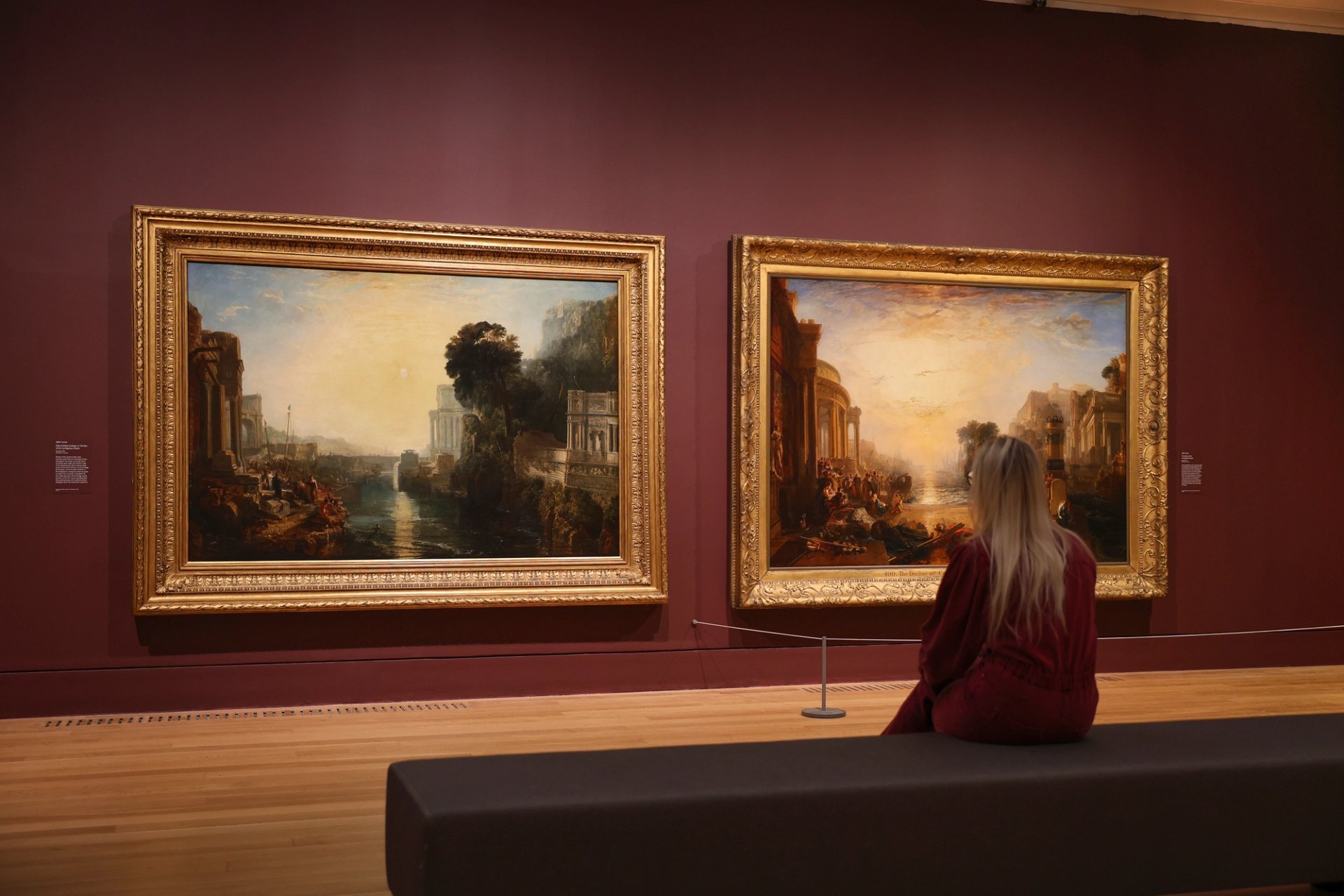
Installation view Turner and Constable: Rivals and Originals at Tate Britain Photo © Tate Photography (Yili Liu)
Hitting it off
Despite their differences, they could get on well in person. When Constable was elected a Royal Academician, Turner paid him a visit, and their discussions lasted into the early hours.
The final paintings in the show will be unfinished canvases, offering insights into dimensions of both artists’ work that posterity would cherish, despite not being intended to be seen by the public. Tate Britain’s Norham Castle (1845) will be coupled with Constable’s full-scale sketch Stoke-by-Nayland (1836), on loan from the Art Institute of Chicago and supposedly a favourite of Lucian Freud’s.
The exhibition will focus on the artists’ lives, their work and its reception, leaving questions of legacy to the accompanying publication and a film featuring contemporary artists such as Frank Bowling and Bridget Riley.
Tate Britain is also offering free entry to London’s black cab drivers as a goodwill gesture. Perhaps they were thinking of affable cabbies telling passengers not to miss the Turner and Constable. It may be worth heeding their advice.
• Turner and Constable, Tate Britain, London, 27 November-12 April 2026


