

The last five years have seen a growing number of art world organisations pledge their commitments to sustainability and implement green practices, but a weighty question remains: what actually is the industry’s climate impact? While groupings of reports and small-scale studies have helped form estimates, the sector’s overall impact is difficult to grasp. Aiming to find answers, the Getty has released a comprehensive assessment of the environmental toll of its most recent regionwide PST Art initiative, titled Art & Science Collide (2024-25), which it says will help reshape how museums approach exhibitions. The findings are based on the organisation’s inaugural Climate Impact Program (CIP), a voluntary initiative, and centre on emissions, waste and material use.
“With so many of the exhibitions in Art & Science Collide focused on climate change, environmental justice and Indigenous knowledge systems, much of the initial impetus [for climate action] came from our partners,” Joan Weinstein, the director of the Getty Foundation, tells The Art Newspaper. “It also came at a moment when Getty was embracing sustainability as an institutional priority. Once we realised that the appetite was there to address these issues as a larger community, we set about providing some of the infrastructure to make it happen.”
Installation view of Material Acts: Experimentation in Architecture and Design (29 September 2024-5 January 2025) at Craft Contemporary Photo courtesy of Craft Contemporary, Los Angeles. Exhibition Installation Image: Marc Walker
Guided by the CIP developed by the climate adviser Laura Lupton of LHL Consulting and the artist Debra Scacco, PST Art participants were offered webinars, one-on-one guidance and networking opportunities. According to the report, all of the PST Art partners attended at least one webinar, most accepted the one-on-one meetings and over two-thirds completed a comprehensive climate impact report. Only around half of the participants who completed the report had taken any form of climate action before the CIP.
“The biggest surprise was how eagerly participants embraced change,” Weinstein says. “In the end, most of the institutions found ways to reduce their waste in simple ways that didn’t break the bank, and many of them have made permanent sustainability commitments for their exhibition programmes moving forward.” The CIP findings will underpin the next edition of PST Art in 2030 and provide a model for an industry that has struggled to standardise its approach to sustainability.
The flexible structure of the CIP was key to meeting participants where they were in their sustainability journeys rather than forcing them to adapt to prescriptive rules. “We met with almost all projects early on and worked to meet each team where they were to build a strategy that made sense for their specific team and project,” says Lupton. “Many projects that initially didn’t feel able to participate ended up engaging as a result, incorporating a range of new exhibition-making strategies and resulting in almost 70% of partner venues completing a report—more than we ever expected for a voluntary initiative.”
According to the report, air travel followed by air freight of art emerged as the most carbon-intensive categories. The data suggest that shifting art transport from air to sea freight would have reduced total emissions by 18%. The extensive analysis states that the total emissions (based on the full reports submitted) would power 452 US homes for a year.
Material choices and reduction strategies also offered significant opportunities to curb waste. “Getting pictures of empty dumpsters from the Huntington and Lace was a particular moment of joy—we could really see the impact the programme had at that moment,” Lupton says. “Craft Contemporary has now committed to being entirely zero waste within five years—they were already able to reduce the waste from their next show to fit into a single cup!”
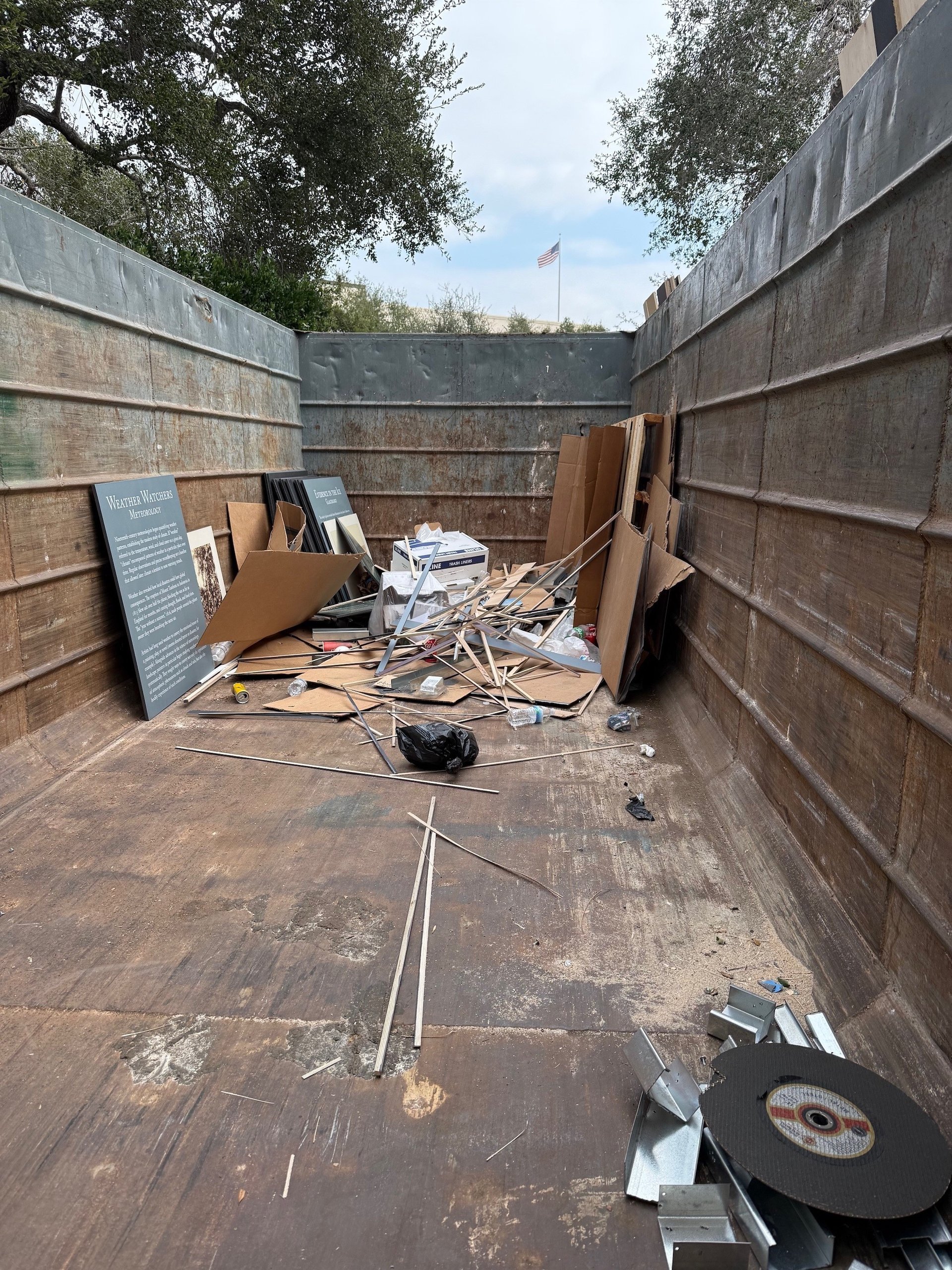
Nearly empty dumpster showing minimal waste after the deinstallation of Storm Cloud: Picturing the Origins of Our Climate Crisis (14 September 2024-6 January 2025) at The Huntington Photo courtesy of The Huntington
Some institutions reported that waste reduction efforts brought financial benefit. Craft Contemporary, for example, abandoned vinyl wall labels in favour of paper, trimming costs by $10,000. Likewise, the Museum of Contemporary Art saved at least $8,000 on energy bills over nine months by implementing relaxed climate control conditions in their gallery space. The Hammer Museum also relaxed its climate standards for its PST exhibition galleries, reducing the institution’s overall utility usage and cost by 5% to 9%.
“Those galleries specifically [using less stringent climate standards] saw a maximum reduction of utility usage by as much as 30%,” says a Hammer Museum spokesperson, adding that it has committed to implementing these broader climate control guidelines across all exhibitions and collections.
Many institutions reported that they have already adopted practices learned from the CIP in exhibitions and operations, including the Huntington. “Continuity shows how quickly these approaches can become standard practice once a framework is in place,” the institution’s curator of British art, Melinda McCurdy, and senior curator of literary collections, Karla Nielsen, say in a joint statement. “Going forward, we plan to keep refining our data collection, expanding material-reuse strategies and building on the cross-departmental conversations that have proven so productive.”
This standardisation and scaling of green practices are key goals of the CIP. By unifying reporting, the programme offers a potential template for an industry still in the early stages of reckoning with its environmental responsibilities.
“Teams want to know their work is connected to something bigger than their project—to something with real-world impact,” Lupton says. “One show at one institution will not get us there, but changing our practices collectively not only makes a direct impact within the art sector but also shows our broader communities that this kind of change is possible.”


