

Between 2023 and 2024, four dams on the Klamath River in Oregon and California were blown up with dynamite after generations-long activism from Indigenous communities. This landmark moment in the fight against injustice for tribes including the Yurok, Karuk, Klamath, and Hoopa, and the Shasta Indian Nation, forms part of Lucy Raven’s dramatic video installation, Murderers Bar (2025), which has its European première in The Curve at the Barbican.
As Shanay Jhaveri, the Barbican’s head of visual arts, explains, the dam in the film, called Copco No. 1, was built in 1918. “It caused a huge detrimental impact to local ecosystems inhabiting the river, especially its salmon population, which was of great spiritual, cultural and nutritional value to the Indigenous people who lived across and alongside the river.”
There are no overt references in Raven’s film to the communities’ activism. “Her work is not documentary,” Jhaveri says. “There are no talking-head interviews. But it’s built on deep research and collaboration and engagement with the material that has been gathered by being in consultation with these tribes and the work that they’ve done.”
Raven’s video installation shows the deliberate destruction the Copco No. 1 dam in California
© the artist; Courtesy of the Artist and Lisson Gallery
Build-up, collapse, release
Raven’s film is the final part of a trilogy she calls The Drumfire, whose key linking thread, among others, is pressure. Each film deals with a different aspect of that force—broadly speaking: build-up, collapse and, in Murderers Bar, release. It is about “material states of change”, Jhaveri says. The protagonist of this third film, Jhaveri suggests, “is the river itself”. The piece begins with the laying of dynamite. But its key element is what happens next. “After its detonation,” he explains, “you see the moment of release. And what you follow is the water or the dirt as it rushes out of the dam and starts to find its way to the ocean.”
Characteristically, the New York-based Raven—who, as Jhaveri says, has long been “interested in histories of image production”—employed multiple techniques including aerial photography using helicopters and drones, and lidar and sonar animations. The feeling of “propulsiveness” from the release of the water is followed, once it reaches the Pacific, by “a hard turn”, as Raven goes back to the dam, Jhaveri says. “And what you really see is a landscape that has been transformed, deformed. But also [it has] potential now that it’s been released.”
Murderers Bar is “formally hugely accomplished”, he says, with nods to particular psychological or horror films including the opening scenes of Stanley Kubrick’s The Shining (1980), with its sequences shot from a helicopter moving over a lake, and Joseph Losey’s cult movie Figures in a Landscape (1970) , which is “essentially a helicopter chase the whole way through”, Jhaveri explains.
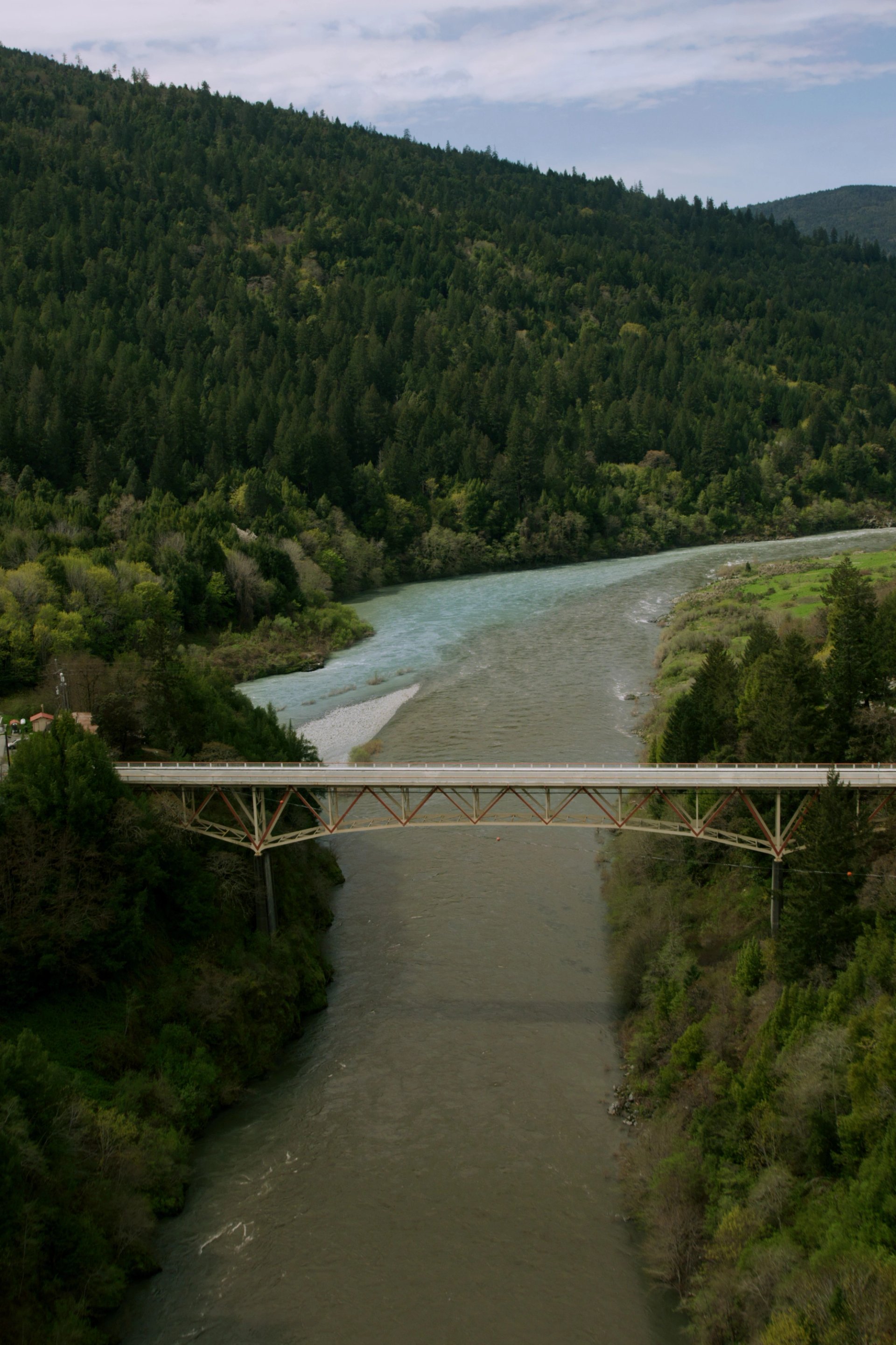
The near 100-year-old dam had long been seen as responsible for damaging delicate local eco-systems, and the homelands of indigenous groups from the region
© the artist; Courtesy of the Artist and Lisson Gallery
States of change
Unusually for an exhibition in The Curve, which is a long and relatively narrow arc around the back of the Barbican Centre’s theatre, Raven has chosen to focus on the space’s height, Jhaveri says. “We have this vertical curved screen, which goes almost right to the top of the space.”
The exhibition also includes a new kinetic sculpture, Hardpan (2025), which attempts to make physical some of the ideas explored in the film and takes inspiration from “centrifugal or rotating devices,” Jhaveri says. “So, something that viscerally would manifest this idea of states of change and of force and pressure.”
Hardpan is the first thing visitors see in The Curve, and even filters into the Barbican foyer. Encased in a cylindrical concrete aluminium structure is a spinning arm with lights, which is “going at very high speed”, Jhaveri explains. “So it’s almost like this beacon that you see from outside, going round and round, that pulls you in. And when you come in, you’ll immediately sense an atmospheric change because of the speed and noise of this physical thing that is just spinning away wildly by itself in this concrete bunker.”
Hardpan reflects Raven’s interest, explored elsewhere in her work, in “the language of tests—a very industrial language”. For instance, she explored astronauts training in centrifuges, simulating states of change in space, “where you first lose colour vision, then vision, and then your consciousness altogether”. Reassuringly, Jhaveri says, “we’re not going to do that to our visitors”. But, he hopes, the work provides a “very embodied, visceral experience that you take with you and carry forward to the film, where you see it play out in a very different way.”
- Lucy Raven: Rounds, The Barbican, London, until 4 January 2026


