

A bald, seemingly topless man leans down, stubble littering his chin, a mallet in one hand and a chisel in the other. This crude drawing on limestone is not what you would traditionally associate with Ancient Egypt, but it is as enlightening, in its way, as the golden funerary mask of King Tutenkhamun, for example, or the famous Nefertiti Bust.
For it depicts an Egyptian craftsperson: a figure who, together with many like him, created the Ancient Egyptian artefacts and structures that have fascinated for centuries. These makers have long been relegated to the sidelines, but now the Fitzwilliam Museum in Cambridge is opening an exhibition that brings their personalities, their lives and their achievements to the fore.
Made in Ancient Egypt will feature jewellery, ceramics, stonework and more drawn from major institutions such as the British Museum in London and the Berlin State Museums. The objects stretch back around six millennia, though the core works date from approximately 4,500 to 1,800 years ago, says the show’s curator Helen Strudwick.
Patience and prowess
Many exhibits will highlight the sheer technical prowess, and extraordinary patience, that these ancient craftspeople possessed. The decoration on the front of one mummy board—belonging to an overseer of craftspeople called Nespawershefyt (around 1000BC)—would have taken months to complete, with its images and inscriptions carefully painted on with the sharpened stem of a rush.
Meanwhile, a glass bottle in the form of a bunch of grapes, on loan from the Musée du Louvre in Paris, is the product of a complex process involving molten glass being wrapped around mud and metal.
“Until one or two years ago, it was thought that the Egyptians on the whole didn’t really make glass themselves and instead imported it and went, ‘Isn’t this lovely?’,” Strudwick explains. “But at [the archaeological site of] Amarna they found a series of workshops that make it quite clear there was glass-making going on—and they made some incredible things.”
Glass bottle in the form of a bunch of grapes, 1295–1069BC
© Musée du Louvre, Dist. Grand Palais Rmn. Photo: Maurice et Pierre Chuzeville
Equally incredible are the deeply personal slices of life provided by ostraca, the pieces of pottery or stone that Ancient Egyptians used like notepads. The depiction of the bald stonemason is one example; others include a gridded visual guide for drawing animals and a written record of work completed in the Valley of the Kings. Striking details on the latter include a reference to a worker called Panebu, who took the day off because he was bitten by an unnamed creature.
There have been notable discoveries made in the process of putting the exhibition together; in July, it was announced that an ancient handprint had been found on an object called a “soul house”, and Strudwick explains that a “teeny-tiny” signature has been found on a shrine. “Unfortunately, we still can’t read the damn thing. I’m still hoping by the time we open, we might have been able to,” she says.
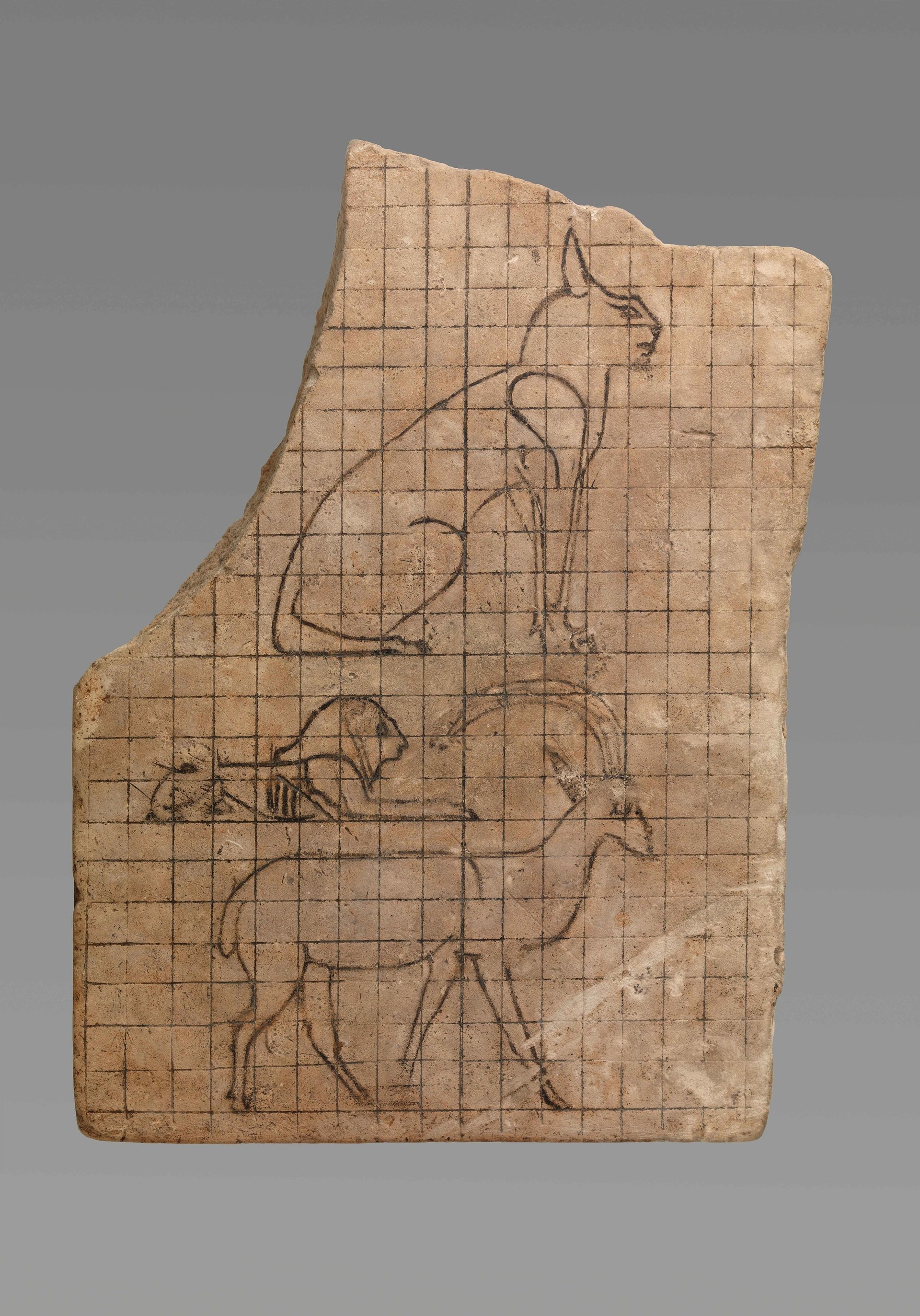
A guide for drawing animals, 664–332BC
© Musée du Louvre, Dist. GrandPalaisRmn. Photo Christian Décamps
Details such as these underline a key mission of the show. Getting close to these objects, in this manner, is “like shaking hands with the Ancient Egyptians,” Strudwick says. “I really hope that at the end people feel that they get them in a different—and perhaps even better—way”.
• Made in Ancient Egypt, Fitzwilliam Museum, Cambridge, 3 October-12 April 2026


