

Thaddaeus Ropac is feeling lucky. On 20 September the Austrian dealer opened his new gallery in Milan, just two weeks after the Italian government implemented a reduced 5% VAT on the sale and import of art—the lowest rate in the EU.
Another “great gift”, he says, came thanks to the UK government’s abolishment of the non-dom status, meaning UK residents with permanent homes elsewhere must now pay tax on foreign income. The move has caused an influx of millionaires from London to Milan attracted by generous tax-break schemes for expats.
“Sometimes I just get lucky,” Ropac tells The Art Newspaper in one of the chicly decorated offices above his new Milan gallery, which occupies the first floor of the historic Palazzo Belgioioso. “When I told some of the Italian dealers I know in London I was opening this gallery they said, ‘You’re crazy. We’re leaving Italy.’ But I just had a gut feeling about Milan.”
Thaddaeus Ropac (right) has appointed Elena Bonanno di Linguaglossa to direct the Milan gallery
© Ludovico Arcero / Thaddaeus Ropac
Ropac’s previous gut feelings have proven shrewd bets. When he opened a gallery in Seoul in 2021, colleagues looked at him “strangely”, he says. “They thought I should open in Hong Kong.” Now, the Korean city is home to Frieze as well as mega dealers including Pace and White Cube. It was the same with his Pantin space, which he opened on the outskirts of Paris city centre in 2012. Today, Pantin has gone from banlieue to hip area as part of the rebranding of Greater Paris.
So, is he expecting the same ripple effect in Milan? “I’m asked a lot about how much potential I see here, but I cannot answer this,” Ropac says, noting how he began looking at Milan three years ago, long before the changes in tax rules both in the UK and Italy. “We came here because we feel it’s an amazing place. Our artists are inspired, and people do great shows.” Though the dealer has a tightknit community of global collectors who follow his programme wherever he sets up, he is also keen to develop a local audience and market for his artists’ work. “Italy has a great structure of collectors—more than we think—and mostly concentrated in the north,” he says.
Big name collectors including the fashion designer Miuccia Prada, the pharmaceutical entrepreneur Luigi Rovati and Pirelli boss Marco Tronchetti Provera have all opened museums in Milan—though there is a big pool of collectors who operate under the radar in the region. Ropac estimates there are around 20 operating at a high level in Milan and Turin alone, many of them in the fashion and related industries. The dealer describes Milanese collectors as “a bit older, and very sophisticated”. Over the past few years, some have begun to collect his top-level contemporary artists: Georg Baselitz (who Ropac is showing with Lucio Fontana in Milan), Anselm Kiefer and Adrian Ghenie, among them. “Arte Povera added a lot of sophistication to the art collecting community in Milan,” Ropac notes. Minimal art has also been a favourite among locals, most notably the late Giuseppe Panza di Biumo, who was the biggest Minimal art collector in Europe.
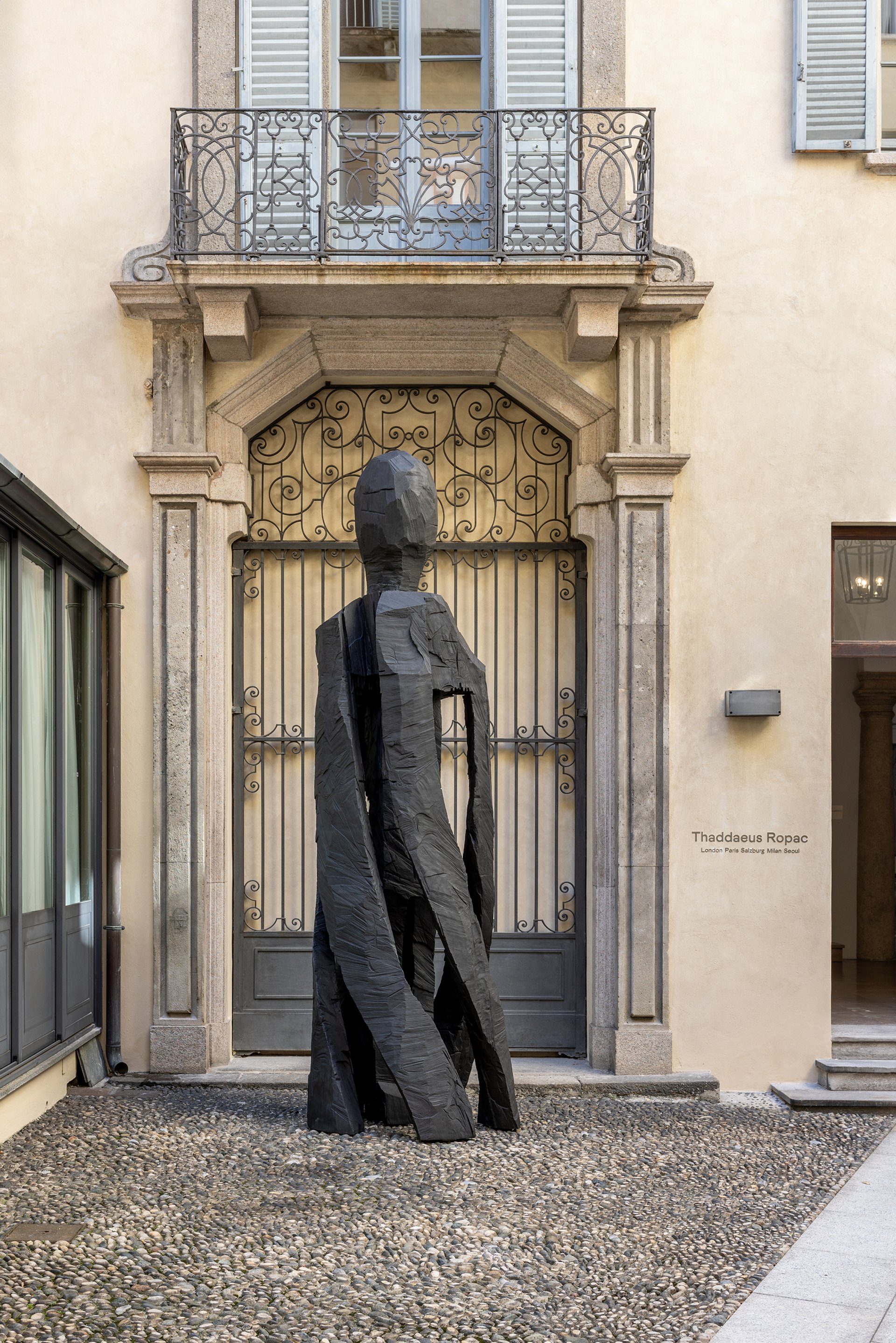
Cowboy (2024) by George Baselitz in the courtyard of Thaddaeus Ropac’s Milan gallery
© Thaddaeus Ropac
According to the Milanese collector Laura Colnaghi Calissoni, the president and chief executive of the textile group Carvico, many of her peers still buy older art, with only a handful focusing on Modern and contemporary work. “This is possibly a result of the restricted market we’ve had in Italy for so long,” she says. “With the 5% tax it’s opening things up, so that is likely to benefit other areas of the market.”
Colnaghi and her late husband first started collecting around 40 years ago, with a focus on art from the 1960s, mainly Italian, but also American and British Pop art. She lists Richard Hamilton, Peter Blake, Allen Jones, Peter Phillips, Antony Donaldson, Gerard Lange and Derek Boshier among her collection, as well as Warhol, Jim Dine and Ed Ruscha. At the centre are the Italian artists Fontana, Alberto Burri and Piero Manzoni.
The collector is now developing her contemporary art holdings, which includes names such as Elmgreen & Dragset, Paola Pivi, Yan Pei-Ming and Mike Lee. “It’s the expression of what is happening in our society. I think it’s always very important to have an eye on what’s new,” Colnaghi says.
Another boost may yet come for the Italian art market. As it stands, export rules are strict in Italy, with works over 70 years old needing authorisation from the ministry of culture to leave the country. “Together with curators and directors of very important museums, we are trying to develop a strategy to change this,” Colnaghi says. “When our art goes abroad, it’s always very good publicity for our country and for our artists. It’s better than keeping it hidden in private collections with no visibility, or even worse, keeping it in warehouses.”
The London-based collector and cultural adviser Sigrid Kirk notes how there are several “touch points” between London and Milan including the fashion industry and the design sector. “And now, of course, you have this art corridor,” she adds.
Kirk says the Italian changes in art VAT rules are only going to add to the non-dom drift. “I know so many friends who are going to Milan. Some are going to Rome, but Milan is a hub where you’ve got young artists, but you’ve still got these important links to Turin and Bologna and these other really important art and manufacturing centres.” Kirk also points out there are several members’ clubs opening in Milan. “I think there is an echo of how London works in Milan,” she says. “It’s an exciting time for all of us.”


