

The Canadian photographer Edward Burtynsky has spent more than 40 years chronicling the many ways that humans have remade the natural landscape to suit their wants and needs. His work has taken him from greenhouses in Ontario, oilfields in Texas and suburban developments in the Arizona desert to e-waste recycling communities in China, shipbreaking yards in Bangladesh and clothing factories in Ethiopia. Now, more than 70 of his photographs from 1981 onwards are on view in Edward Burtynsky: The Great Acceleration (until 28 September), a retrospective at the International Center of Photography (ICP) in New York curated by the centre’s creative director, David Campany.
“The work has always been about the industrialisation of nature—showing the scale of what we need to provide what we’re taking from nature and how we’re shaping it to our own needs,” Burtynsky says. “But I’m not interested in making a kind of a guidebook to what we’re doing. They’re more iconographic representations of human need.”
Edward Burtynsky, Shipbreaking #23, Chittagong, Bangladesh, 2000 © Edward Burtynsky, courtesy Howard Greenberg Gallery, New York
The exhibition is organised thematically rather than chronologically, focusing on mining operations, oil exploitation, vast factories, infrastructure projects of biblical proportions, landscapes turned incongruous colours by industrial activities and more. It includes a group of Burtynsky’s portraits—an elderly woman in China pausing next to a pile of electronic waste she is sorting through, a shipbreaker posing at the base of a disassembled tanker that fills the entire frame—which he has made regularly throughout his projects but never shown as a discrete group. It includes some of his earliest works from the first half of the 1980s capturing the scale of industrial farming and mineral extraction in Canada, which are also among his smallest photographs on view.
“This was my biggest print back then—it was considered big at the time,” he says, referring to photographs around two feet wide of mines in Ontario and British Columbia from 1984 and 1985. “The organisation of the frame, the all-overness and flattening, was already at work and defining a way of seeing.”
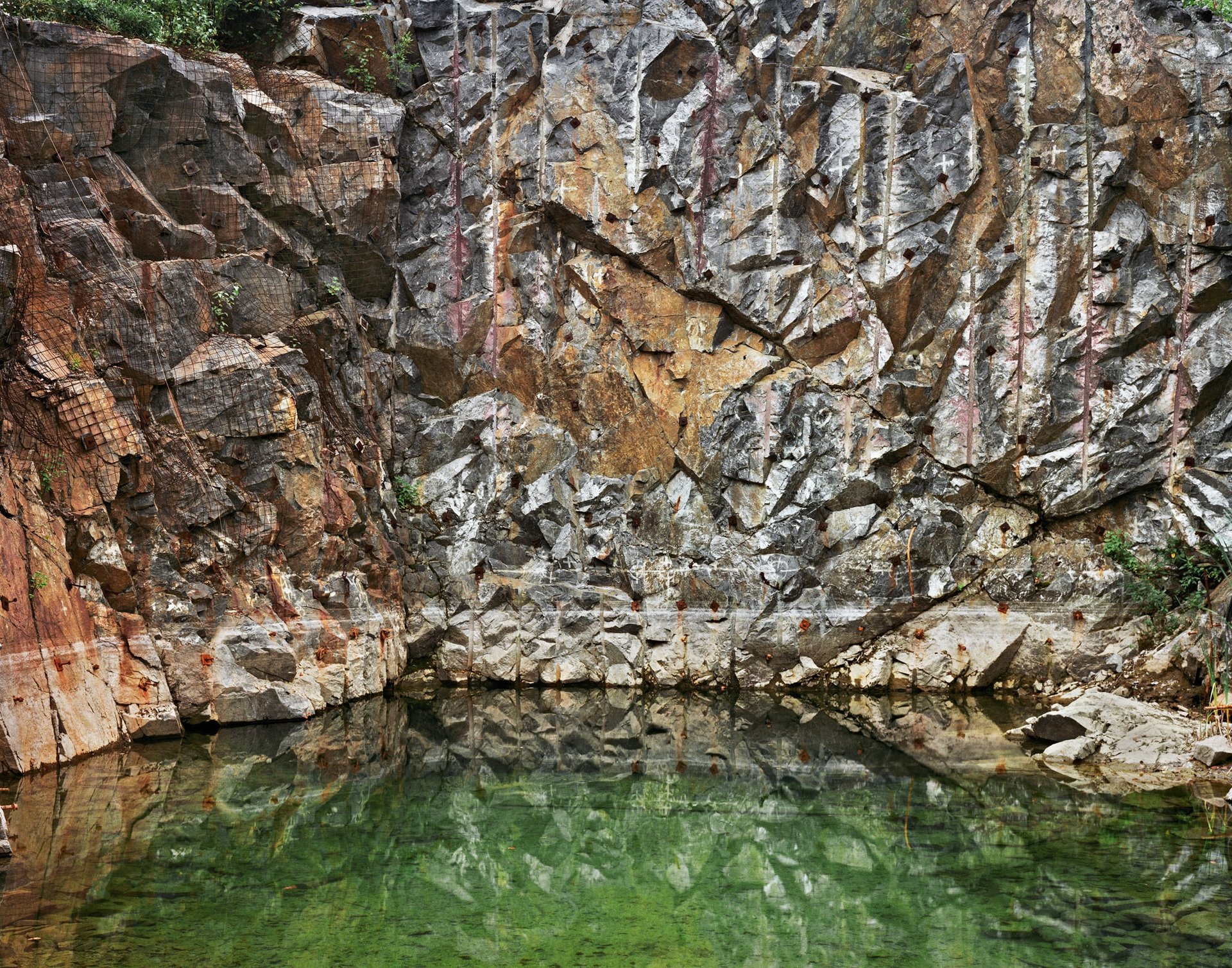
Edward Burtynsky, Mines #13, Inco – Abandoned Mine Shaft, Crean Hill Mine, Sudbury, Ontario, Canada, 1984 © Edward Burtynsky, courtesy Howard Greenberg Gallery, New York
For all their disorienting power, those early images look almost quaint compared to Burtynsky’s more recent prints, which like the landscapes he is photographing have grown practically industrial in scale. One of the newest photographs in the show—of a copper mine in the Democratic Republic of Congo where multi-storey piles of mineral-rich soil have turned the landscape every shade of red—is ten feet wide. Nearby, one entire 30ft-by-30ft gallery wall is covered by an aerial photograph of a farm in the Texas desert. The image was printed on adhesive vinyl in Burtynsky’s Toronto studio, where he has developed a range of advanced scanning, printing and imaging processes.
“This is the biggest photograph I’ve ever printed,” he says of the mural version of Pivot Irrigation #8, High Plains, Texas Panhandle, USA (2012), which looks nearly abstract until the eye registers the tiny buildings and cars in the lower lefthand corner. “It’s taken from the belly of a Cessna shooting straight down to give a sense of the scale of the pivot irrigation system. It was part of a project on water—about 70% of human use of water is agricultural.”
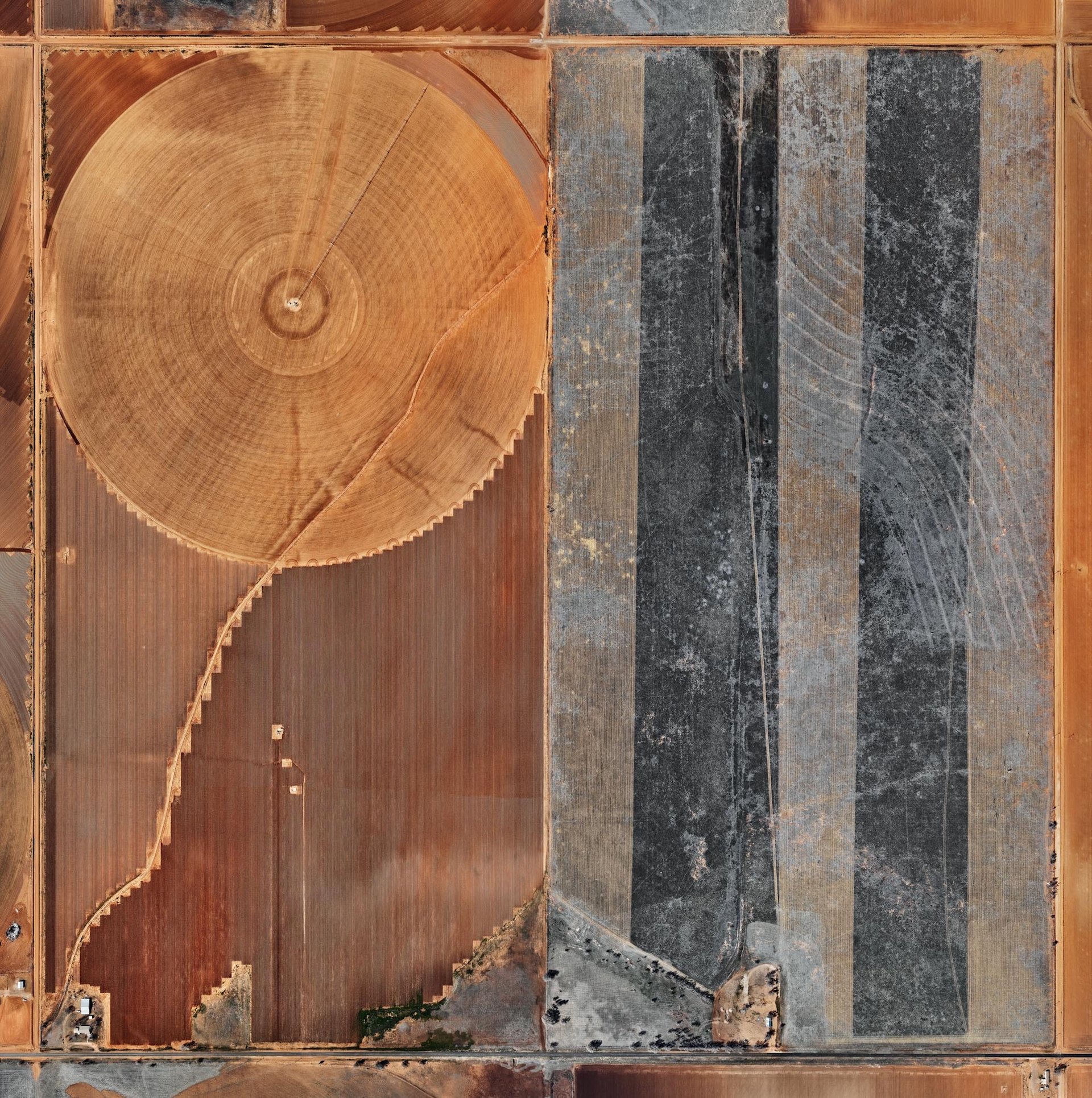
Edward Burtynsky, Pivot Irrigation #8, High Plains, Texas Panhandle, USA, 2012 © Edward Burtynsky, courtesy Howard Greenberg Gallery, New York
The ICP retrospective is the centrepiece of a bonafide Burtynsky bonanza in New York this summer. The nearby cinema Metrograph will show a trio of documentaries he made between 2006 and 2018 with the film-makers Jennifer Baichwal and Nick de Pencier (20-28 June). He will then have a solo exhibition at Howard Greenberg Gallery, Natural Commodities (7-20 August); and the following month Heft Gallery will show Hypertopographics (3-27 September), his collaborative project with the artificial intelligence (AI) artist Alkan Avcıoğlu.
“Alkan is taking the world where he thinks it’s going to be in 50 to 100 years and extending the scope and scale through AI,” Burtynsky says. “The images are creating this sense of an uncanny valley where the landscapes almost look probable.”
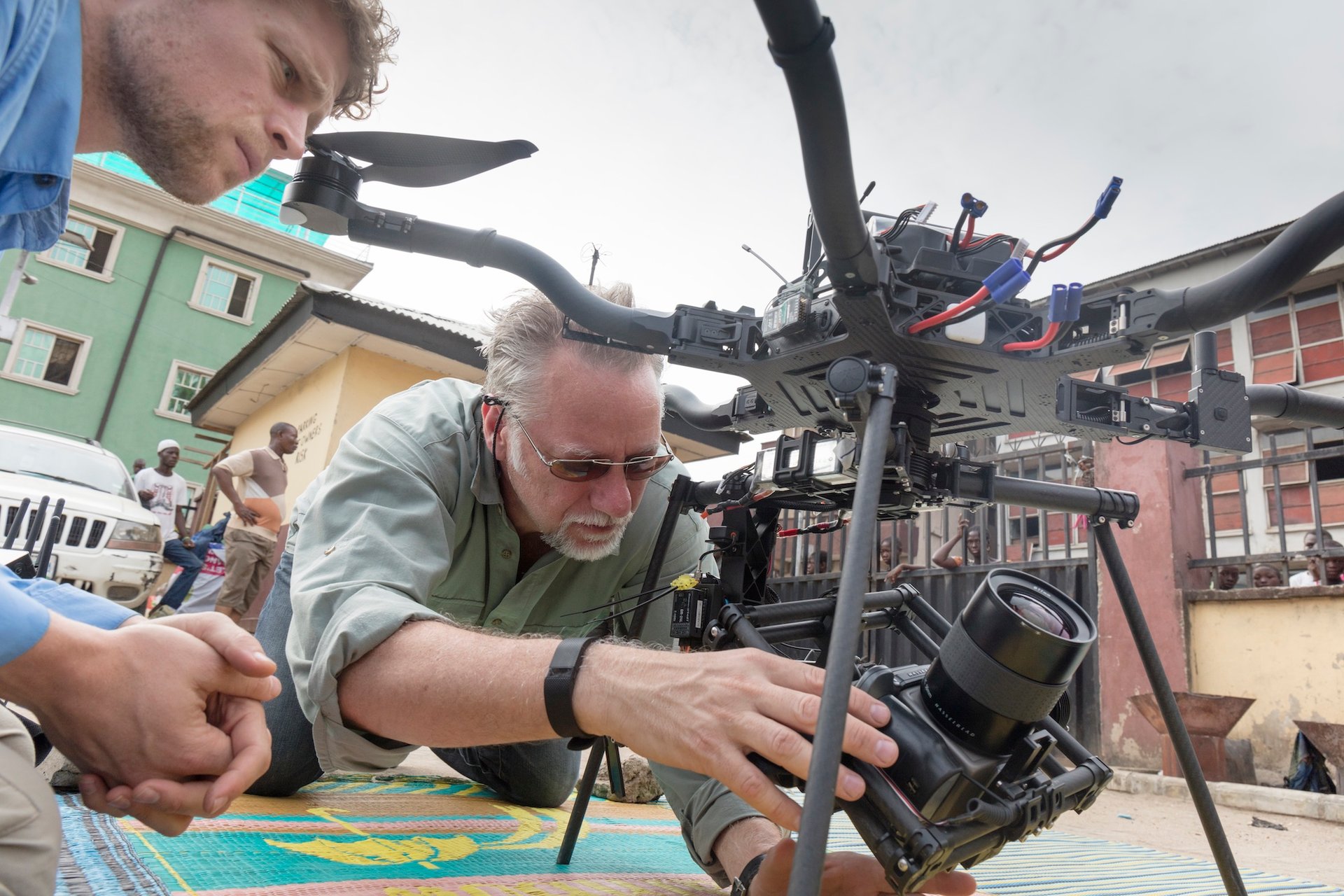
Drone preparation, Burtynsky in Lagos, Nigeria, 2017 © Edward Burtynsky Photography
The Great Acceleration, meanwhile, will remain on view through late September including, crucially, during Climate Week NYC 2025 (21-28 September), when his awe-inspiring images of mankind’s more or less indifferent remaking of the environment will surely find receptive audiences.
“I don’t see myself as a documentary photographer, I try to find singular images that just reveal or remind us of these cycles of consumption,” Burtynsky says. “There are three large phases: the source where everything comes from in the making, the consumption and then the waste stream. I focus on the first and last stages. To me, life is consumption.”
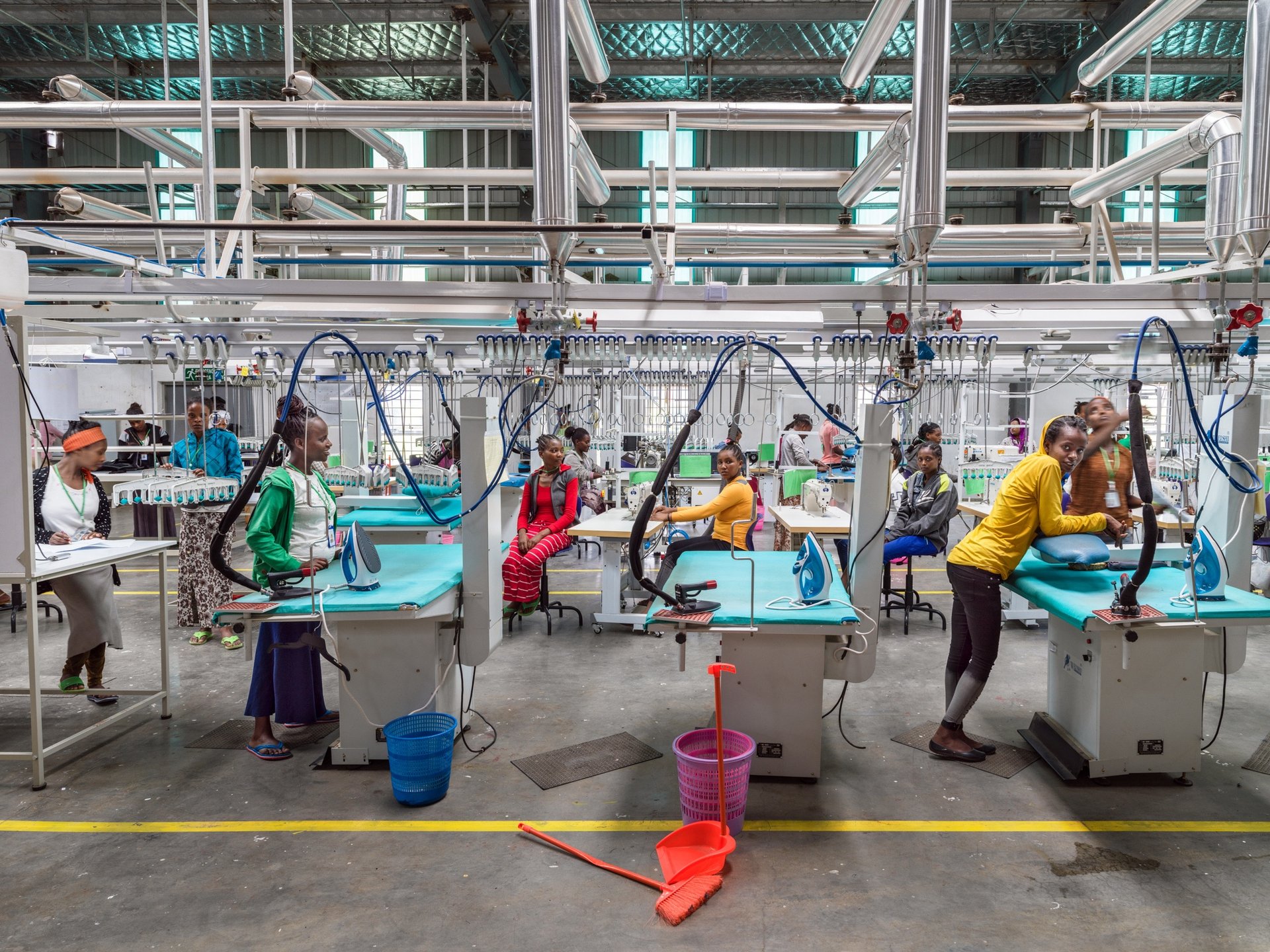
Edward Burtynsky, Silver Spark Apparel #1, Hawassa Industrial Park, Awassa, Ethiopia, 2018 © Edward Burtynsky, courtesy Howard Greenberg Gallery, New York
- Edward Burtynsky: The Great Acceleration, 19 June-28 September, International Center of Photography, New York
- The Anthropocene Trilogy, 20-28 June, Metrograph, New York


