

The Museum of Modern Art (MoMA) has acquired the works that were featured in Adam Pendleton’s monumental installation at the institution, Who Is Queen? (2019-21). The floor-to-ceiling spatial collage comprised 35 individual paintings, drawings and video works that reflect the artist’s years-long investigation of the “Black Dada”, a conceptual framework Pendleton first outlined in his Black Dada Manifesto (2008). It expanded on research he conducted as a MoMA artist-in-residence, where he explored the museum’s “limits and possibilities” and questioned what an exhibition representing the Black Dada could be.
The works in the installation, which was on view at the museum in 2021-22, were mounted on three wooden scaffolds that spanned the entirety of MoMA’s atrium. It included video works, monochromatic paintings and drawings from Pendleton’s Black Dada (2008-ongoing) series of works denoting the Black and queer experience, and other bodies of work that created an immersive environment of various mediums and contrapuntal harmonies.
“There was not a single moment or a focal point, which, I believe, is related to one of the articulations of abstraction,” Pendleton tells The Art Newspaper. “Your attention was pulled in many directions, like it is in contemporary life. I wanted to make people slow down and engage with what was in front of them.”
One of the core tenets of Black Dada is the “confluence between the past and present”, Pendleton adds. His work exploring Black Dada has been less focused on defining the visual or theoretic markers of the term, but rather “bringing the past into the future”, where disparate elements simultaneously “create a space that is perpetually fluid and in flux—not stagnant but constantly evolving and shifting”.
Installation view of Adam Pendleton: Who Is Queen? at the Museum of Modern Art, New York, 18 September 2021-21 February 2022 Photo by Andy Romer, courtesy the Museum of Modern Art
Some works in the installation, like Notes on the Robert E. Lee Monument, Richmond VA (Figure) (2021)—a black-and-white film that chronicles the titular monument in the aftermath of the racial justice protests of 2020—have been “revised” into new bodies of work since the MoMA exhibition, reflecting Pendleton’s interest in “rethinking and reworking similar materials”.
For example, in his current exhibition at the Hirshhorn Museum and Sculpture Garden in Washington DC, Pendleton is showing Resurrection City Revisited (Who Owns Geometry Anyway?) (2024-25). The video features images of the encampment on the National Mall ahead of Martin Luther King Jr’s 1968 Poor People’s Campaign interspersed with geometric forms. Pendleton says this piece “thinks about how video can function like painting as a bold method and medium”.
The MoMA exhibition was organised by Stuart Comer, the museum’s chief curator of media and performance, who began working with Pendleton during his residency in 2012-15. Pendleton was doing both on-site research into MoMA’s history and collection—particularly researching the architecture and design of historical exhibitions and exhibitions of geometric abstraction and African art—and traveling throughout the US to engage with communities as the Black Lives Matter movement was flourishing.
According to Comer, Pendleton began to “weave his own interest and deep knowledge of the avant-garde with the political conversations that were emerging quite powerfully at the time”. Although the installation was not a “direct manifestation” of the Black Dada Manifesto, the project created a foundational set of proposals that prompted Pendleton to “think about a counter museum at the heart of the museum” and amalgamate components of Modern art with political dialogue.
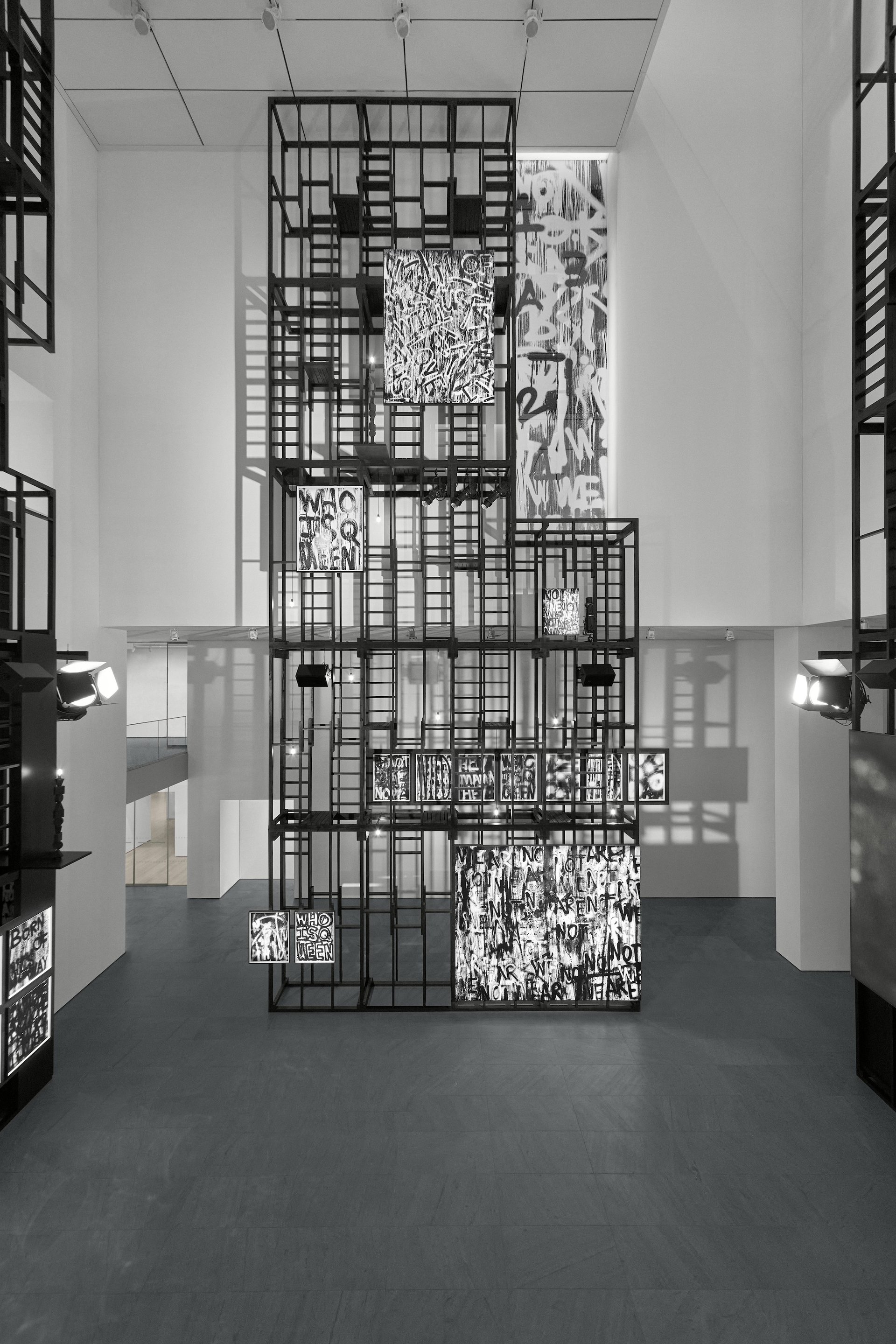
Installation view of Adam Pendleton: Who Is Queen? at the Museum of Modern Art, New York, 18 September 2021-21 February 2022 Photo by Andy Romer, courtesy the Museum of Modern Art
“What is important about this project in particular is that it is not defined by a single medium or discourse,” Comer says. “What MoMA has made quite clear is that we are interested in moving beyond the departmental silos for which the museum was known and think about how we can revisit earlier moments in Modernism that were more hybrid, not medium-specific. Adam has reclaimed that early chapter of Modernism in a very dynamic way.”
In addition, the acquisition “speaks to the history of MoMA and its collection but helps us rethink how to situate those histories in the present and look towards the future, and how to think about voices that were not always a part of that conversation”, Comer says. In the future, it is envisioned that the installation’s individual components may be shown, although there are no confirmed plans for the works to travel.
In the edition of Frieze New York opening this week (7-11 May), Pace Gallery will present a booth curated by Pendleton that positions six of his paintings with sculptures by Lynda Benglis. “Through our respective mediums, Lynda and I use gesture and processes of translation and transformation; an initial gesture becomes a series of acts and gestures that are enlarged, which is how I paint as well,” Pendleton says. “It’s taking the origin of something and transforming and translating it into something else.”


