

Violent electric shocks contort the body of the Thai artist Kawita Vatanajyankur as she struggles to draw a spiral with white chalk on a red background.
The confronting video, produced in the presence of a medical team because it was so dangerous, is called The Machine Ghost in the Human Shell.
It was commissioned and acquired by the Queensland Art Gallery | Gallery of Modern Art (QAGOMA) as part of the 11th Asia Pacific Triennial of Contemporary Art, which opened in Brisbane on the weekend, and runs until 27 April 2025.
As a QAGOMA acquisition, the work by Vatanajyankur and her collaborator, the American scientist Pat Pataranutaporn, is in the running to travel to the Victoria and Albert Museum in London (V&A), in 2026 as per a joint announcement by the institutions last year.
The Machine Ghost in the Human Shell is a visceral response to questions such as whether the increasing sophistication of AI will witness the exploitation of human beings as miserable labourers toiling in the service of a superior technology.
Vatanajyankur and Pataranutaporn’s video is far from being the only APT11 work to enter the QAGOMA collection. The gallery will acquire almost half the 70 artistic projects presented by 200 artists this year, according to the museum’s deputy director Simon Elliott.
The artists are from 30 countries including, for the first time, Timor-Leste, Uzbekistan and Saudi Arabia. Many of the projects were presented as community collaborations, including some of the contributions from Papua New Guinea, India, the Philippines and New Zealand.
Since 1993, APT has been the funnel through which more than 1,300 works have joined the QAGOMA collection.
Rithika Merchant, Temporal Structures (2023) Image: © Rithika Merchant, 2023. Courtesy of Rithika Merchant and TARQ
Among the acquired works from APT11 are the finely-rendered, dream-like imaginings of Indian-born Rithika Merchant, who attended the exhibition opening with Hena Kapadia of TARQ gallery, which represents Merchant in Mumbai.
In her series, Terraformation (2022-23), Merchant used gouache, watercolour and ink to imagine strange beings, which attempt to make new life on other planets after the Anthropocene has rendered Earth uninhabitable.
Also acquired by QAGOMA from APT11 were wooden carvings by the Ataúro Sculptors of Timor-Leste whose traditions were interrupted by the banning of ancestor worship by the Protestant church in the 1970s.
The Singaporean artist Dawn Ng’s multi-channel installation of a pigment-infused block of ice melting was another acquisition. The work is titled The Earth is an hourglass (2024).
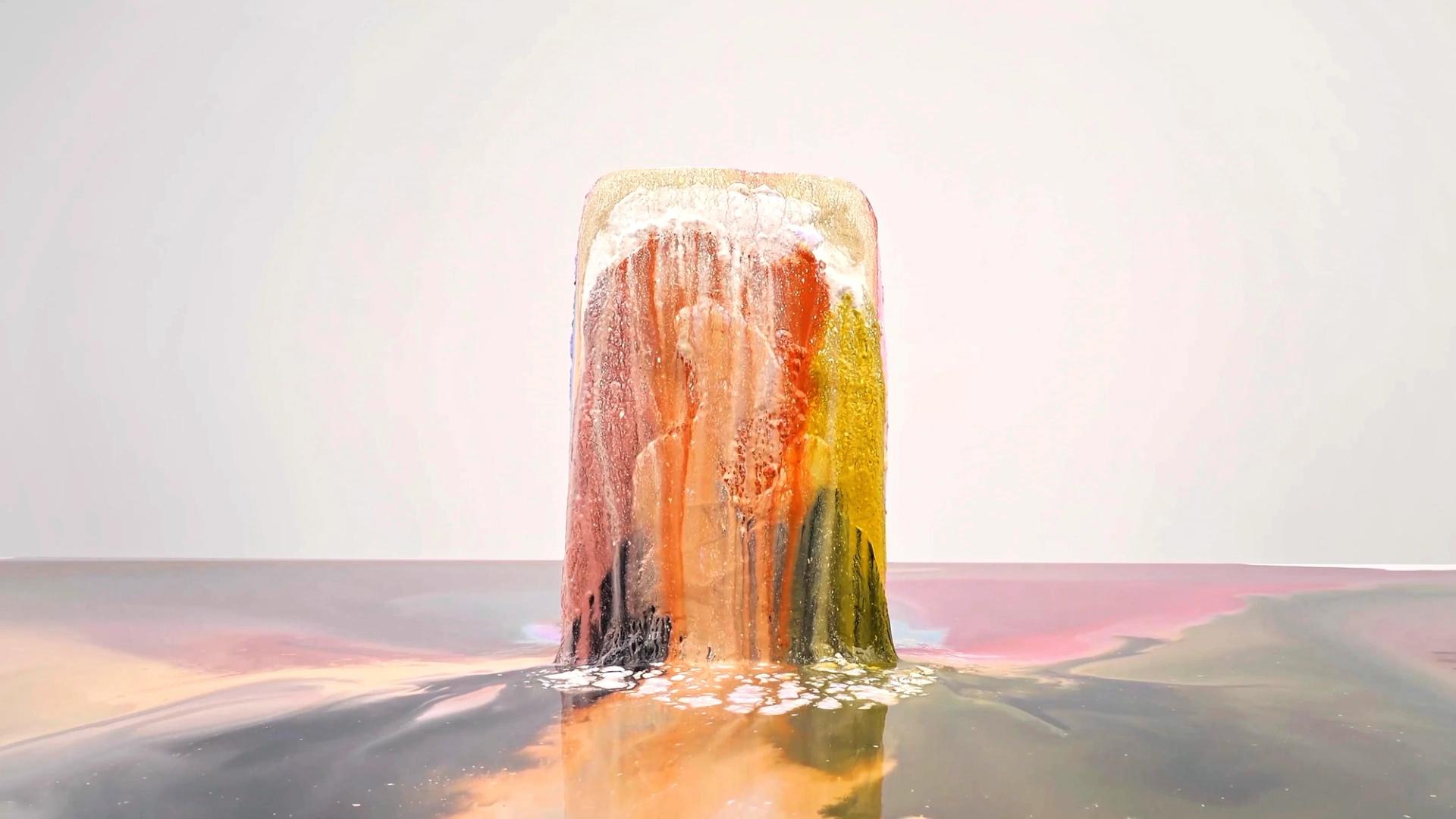
The Earth is an Hourglass (still), (2024), by the Singaporean artist Dawn Ng, is a single-channel video documenting the melting of a pigment-infused block of ice. The work is in the Asia Pacific Triennial and has been acquired by QAGOMA.
APT’s chief curator Tarun Nagesh tells The Art Newspaper that Tristram Hunt, the director of the V&A, had visited QAGOMA during the installation of APT11 and that the London museum’s director of exhibitions Daniel Slater is scheduled to visit in the coming days.
It was too soon to reveal which works will be chosen for presentation at the V&A, Nagesh said.
No specific theme was stamped across APT11, but concerns about climate change, rapid industrialisation, mining pollution and the struggle of traditional cultures to sustain themselves in the face of modernisation were painfully evident in many of the works.
Vatanajyankur tells The Art Newspaper her concern was for future dehumanisation caused by AI.
The artist has often used her powers of bodily endurance to protest against the exploitation of labour in South East Asia. Earlier videos depict the artist using her own head to scrub dishes, or inhaling dust like a vacuum cleaner.
But the “new machine” of AI prompted Vatanajyankur to team up with Pataranutaporn to explore the sinister implications of this rapidly evolving technology.
“In our project we’re asking this question: when we make machines more human, are we dehumanising ourselves into machines? Are we degrading ourselves into the level of technology?” Pataranutaporn said in an opening weekend artist presentation.
“Recent studies have shown that if you ignore the human experience when you’re talking about human-AI interaction, it could lead to deskilling, disconnection, disinformation and dehumanisation.”
Vatanajyankur comes from a long line of Thai judges and attorneys, and her aunt Intranee Sumawong is a senior public prosecutor in Thailand whose key interests include labour exploitation and human trafficking.
“She’s the one I talked to the most when I was doing the process (of making The Machine Ghost in the Human Shell),” Vatanajyankur said.
When QAGOMA and the V&A announced the APT exhibition project, the Australian museum’s director Chris Saines said his gallery had built “an unrivalled collection of contemporary Asian and Pacific art that represents the unique creative voices of world-renowned contemporary artists alongside collaborations with local communities and arts makers”.


